BEIRUT: Lebanon will need $250 million a month to help more than a million people displaced by Israeli attacks, its minister in charge of responding to the crisis said on Tuesday, ahead of a conference on Thursday in Paris to rally support for Lebanon.
Nasser Yassin told Reuters the government response, helped by local initiatives and international aid, only covered 20 percent of the needs of some 1.3 million people uprooted from their homes and sheltering in public buildings or with relatives.
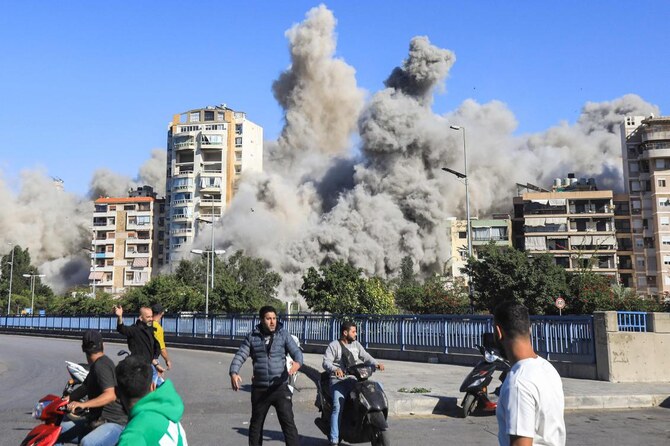
Those needs are likely to grow, as daily waves of airstrikes push more people out of their homes and leave Lebanon’s government scrambling to find ways to house them, Yassin said.
“We need $250 million a month” to cover basic food, water, sanitation and education services for the displaced, he said.
Schools, an old slaughterhouse, a fresh food market, an empty complex — all of them have been turned into collective shelters in recent days. “We’re transforming anything, any public building,” Yassin said. “There is a lot to be done.”
Yassin — whose official mandate as environment minister meant he was working on preventing forest fires before the current conflict broke out a year ago — now spends much of his time at government headquarters with a crisis team, including other Lebanese ministries, the United Nations Development Programme and the Lebanese Red Cross.
They are planning for relief operations on a timeline of four to six months — but Yassin hopes the spreading war will end sooner.
“We need to have a ceasefire today, and we need everybody in the international community, for once...to be brave enough to say what’s happening,” he told Reuters, a message he said he would stress in Paris.
“There is a member state of the UN waging war against a small nation in the most aggressive manner we’ve ever seen in the history of Lebanon. This should be the message,” he said.
Yassin said he estimated the damage to Lebanon to be in the billions of dollars.
“Full villages on the border were blown up in the last few days, but also public institutions...water establishments, pumping stations, hospitals, you name it. All of these need to be rebuilt.”
Lebanese authorities have yet to put a firm estimate on the scale of destruction across Lebanon and how much money it will take to rebuild. Nasser Saidi, a former economy minister, told Reuters last week that Israel’s bombing campaign has caused damage that will cost $25 billion to repair.
UNDP’s regional representative Blerta Aliko said on Tuesday the damage would be far-reaching and include “a drastic capital loss” — including to Lebanon’s ability to feed itself long-term.
“I’m not talking from the perspective of what is required in an immediate term, in the next month — I’m talking about the impact that has on the harvesting season ... being impacted in the south, being impacted in the east, which are very, very important for the country,” she said.

Lebanon needs $250m a month for displaced, minister says ahead of Paris summit
https://arab.news/br8q6
Lebanon needs $250m a month for displaced, minister says ahead of Paris summit
- “We need $250 million a month” to cover basic food, water, sanitation and education services for the displaced, minister said
Israel confirms ban on 37 NGOs in Gaza
JERUSALEM: Israel on Thursday said 37 humanitarian agencies supplying aid in Gaza had not met a deadline to meet “security and transparency standards,” and would be banned from the territory, despite an international outcry.
The international NGOs, which had been ordered to disclose detailed information on their Palestinian staff, will now be required to cease operations by March 1.
The United Nations has warned that this will exacerbate the humanitarian crisis in the war-ravaged Palestinian territory.
“Organizations that have failed to meet required security and transparency standards will have their licenses suspended,” Israel’s Ministry of Diaspora Affairs and Combating Antisemitism said in a statement.
Several NGOS have said the requirements contravene international humanitarian law or endanger their independence.
Israel says the new regulation aims to prevent bodies it accuses of supporting terrorism from operating in the Palestinian territories.
Prominent humanitarian organizations hit by the ban include Doctors Without Borders (MSF), the Norwegian Refugee Council (NRC), World Vision International and Oxfam, according to a ministry list.
In MSF’s case, Israel accused it of having two employees who were members of Palestinian militant groups Islamic Jihad and Hamas.
MSF said this week the request to share a list of its staff “may be in violation of Israel’s obligations under international humanitarian law” and said it “would never knowingly employ people engaging in military activity.”
‘Critical requirement’
NRC spokesperson Shaina Low told AFP its local staff are “exhausted” and international staff “bring them an extra layer of help and security. Their presence is a protection.”
Submitting the names of local staff is “not negotiable,” she said. “We offered alternatives, they refused,” hse said, of the Israeli regulators.
The ministry said Thursday: “The primary failure identified was the refusal to provide complete and verifiable information regarding their employees, a critical requirement designed to prevent the infiltration of terrorist operatives into humanitarian structures.”
In March, Israel gave NGOs 10 months to comply with the new rules, which demand the “full disclosure of personnel, funding sources, and operational structures.”
The deadline expired on Wednesday.
The 37 NGOs “were formally notified that their licenses would be revoked as of January 1, 2026, and that they must complete the cessation of their activities by March 1, 2026,” the ministry said Thursday.
A ministry spokesperson told AFP that following the revocation of their licenses, aid groups could no longer bring assistance into Gaza from Thursday.
However, they could have their licenses reinstated if they submitted the required documents before March 1.
Minister of Diaspora Affairs and Combating Antisemitism Amichai Chikli said “the message is clear: humanitarian assistance is welcome — the exploitation of humanitarian frameworks for terrorism is not.”
‘Weaponization of bureaucracy’
On Thursday, 18 Israel-based left-wing NGOs denounced the decision to ban their international peers, saying “the new registration framework violates core humanitarian principles of independence and neutrality.”
“This weaponization of bureaucracy institutionalizes barriers to aid and forces vital organizations to suspend operations,” they said.
UN Palestinian refugee agency chief Philippe Lazzarini had said the move sets a “dangerous precedent.”
“Failing to push back against attempts to control the work of aid organizations will further undermine the basic humanitarian principles of neutrality, independence, impartiality and humanity underpinning aid work across the world,” he said on X.
On Tuesday, the foreign ministers of 10 countries, including France and Britain, urged Israel to “guarantee access” to aid in the Gaza Strip, where they said the humanitarian situation remains “catastrophic.”
A fragile ceasefire has been in place since October, following a deadly war waged by Israel in response to Hamas’s unprecedented October 7, 2023 attack on Israel.
Nearly 80 percent of buildings in Gaza have been destroyed or damaged by the war, according to UN data.
About 1.5 million of Gaza’s more than two million residents have lost their homes, said Amjad Al-Shawa, director of the Palestinian NGO Network in Gaza.


