

Pakistan PM directs two planeloads of aid to be sent to Lebanon and Gaza

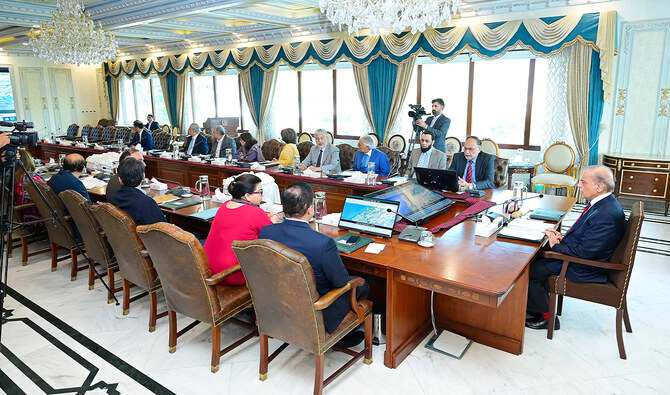
Pakistan Prime Minister Shehbaz Sharif (right) chairs a meeting on relief activities for Gaza and Lebanon in Islamabad, Pakistan, on October 22, 2024. (Government of Pakistan)
Short Url
Updated 22 October 2024
Follow

Pakistan PM directs two planeloads of aid to be sent to Lebanon and Gaza

  • Shehbaz Sharif urges public to donate to his relief fund for Palestinians in Gaza
  • Pakistan has dispatched 12 aid shipments to both Middle Eastern countries since 2023

ISLAMABAD: Pakistan’s Prime Minister Shehbaz Sharif on Tuesday directed authorities to send two planeloads of relief items for people in Lebanon and Gaza suffering from Israeli aggression, his office said in a statement, calling on masses to donate to his official Gaza relief fund.

Pakistan’s federal cabinet this month established a special fund for Palestine and Lebanon following an all-parties conference that discussed Israel’s war on Gaza. Islamabad has so far dispatched 12 aid shipments to Palestine and Lebanon since October 2023, which include ready-to-eat meat, tents, tarpaulins, warm bedding, winter clothing and powdered milk.

Israel has killed over 42,000 people in Gaza after a surprise attack by Hamas in October 2023, which the Palestinian group claimed was in response to the worsening conditions of Palestinians under Israeli occupation. More recently, it opened another front in Lebanon with the stated goal of destroying Hezbollah, which attempted to provide military assistance to the Palestinians. Israel’s military actions in Lebanon have raised fears of a broader regional conflict, potentially involving Iran.

“The prime minister immediately directed two planes of aid for Lebanon and Gaza,” the PM Office said on Tuesday after Sharif held a meeting to review relief activities for Palestine and Lebanon. “In addition to air, relief goods should be dispatched by trucks.”

Sharif directed Pakistan’s ambassadors in Palestine, Lebanon, Jordan and Egypt to improve relations with their host countries so that Islamabad could dispatch relief items there easily.

He urged authorities to ensure the aid reached deserving people in both countries, calling on Pakistani masses to donate to the PM’s Relief Fund for Gaza and Lebanon.

“Support the government in helping our Palestinian and Lebanese brothers and sisters by collecting donations,” Sharif was quoted as saying by his office. 

The PMO said that Pakistanis in the country and abroad can donate to this account: IBAN PK11SBPD000000111111429. 

The Pakistani premier was briefed regarding the ongoing relief operations in Gaza through which tents, clothes, blankets, medicine, food and drink were being dispatched abroad. PM Sharif was told about the difficulties being encountered in the transportation of relief goods.

“NGOs who want to send relief goods for the victims of Gaza and Lebanon will be provided facilities by the Government of Pakistan regarding the delivery of relief goods,” the PMO said. 

Pakistan does not recognize nor have diplomatic relations with Israel and calls for an independent Palestinian state based on “internationally agreed parameters” and the pre-1967 borders with Al-Quds Al-Sharif as its capital.

Since the beginning of Israel’s war on Gaza, Pakistan has repeatedly raised the issue at the United Nations, the Organization of Islamic Cooperation (OIC) and other multilateral platforms and demanded international powers and bodies stop Israeli military actions in Gaza. The South Asian country has also dispatched several aid consignments for the Palestinians.


Pakistan, global crypto exchange discuss modernizing digital payments, creating job prospects 

Updated 05 December 2025
Follow

Pakistan, global crypto exchange discuss modernizing digital payments, creating job prospects 

  • Pakistani officials, Binance team discuss coordination between Islamabad, local banks and global exchanges
  • Pakistan has attempted to tap into growing crypto market to curb illicit transactions, improve oversight

ISLAMABAD: Pakistan’s finance officials and the team of a global cryptocurrency exchange on Friday held discussions aimed at modernizing the country’s digital payments system and building local talent pipelines to meet rising demand for blockchain and Web3 skills, the finance ministry said.

The development took place during a high-level meeting between Finance Minister Muhammad Aurangzeb, Pakistan Virtual Assets Regulatory Authority (PVARA) Chairman Bilal bin Saqib, domestic bank presidents and a Binance team led by Global CEO Richard Teng. The meeting was held to advance work on Pakistan’s National Digital Asset Framework, a regulatory setup to govern Pakistan’s digital assets.

Pakistan has been moving to regulate its fast-growing crypto and digital assets market by bringing virtual asset service providers (VASPs) under a formal licensing regime. Officials say the push is aimed at curbing illicit transactions, improving oversight, and encouraging innovation in blockchain-based financial services.

“Participants reviewed opportunities to modernize Pakistan’s digital payments landscape, noting that blockchain-based systems could significantly reduce costs from the country’s $38 billion annual remittance flows,” the finance ministry said in a statement. 

“Discussions also emphasized building local talent pipelines to meet rising global demand for blockchain and Web3 skills, creating high-value employment prospects for Pakistani youth.”

Blockchain is a type of digital database that is shared, transparent and tamper-resistant. Instead of being stored on one computer, the data is kept on a distributed network of computers, making it very hard to alter or hack.

Web3 refers to the next generation of the Internet built using blockchain, focusing on giving users more control over their data, identity and digital assets rather than big tech companies controlling it.

Participants of the meeting also discussed sovereign debt tokenization, which is the process of converting a country’s debt such as government bonds, into digital tokens on a blockchain, the ministry said. 

Aurangzeb called for close coordination between the government, domestic banks and global exchanges to modernize Pakistan’s payment landscape.

Participants of the meeting also discussed considering a “time-bound amnesty” to encourage users to move assets onto regulated platforms, stressing the need for stronger verifications and a risk-mitigation system.

Pakistan has attempted in recent months to tap into the country’s growing crypto market, crack down on money laundering and terror financing, and promote responsible innovation — a move analysts say could bring an estimated $25 billion in virtual assets into the tax net.

In September, Islamabad invited international crypto exchanges and other VASPs to apply for licenses to operate in the country, a step aimed at formalizing and regulating its fast-growing digital market.