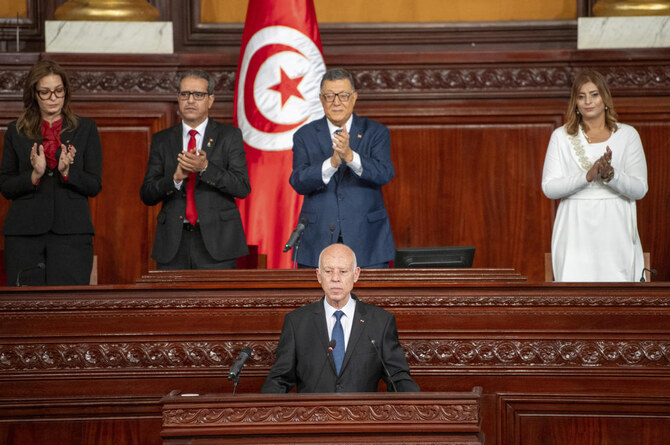
TUNIS: Tunisia’s President Kais Saied has been inaugurated for a second term, following a monthslong crackdown and string of arrests against his political opponents.
Weeks after winning re-election with a 90.7 percent share of the vote, the 66-year-old former law professor in his inauguration speech Monday called for a “cultural revolution” to combat unemployment, fight terrorism and root out corruption.
“The aim is to build a country where everyone can live in dignity,” Saied said in a speech addressing members of Tunisia’s parliament.
Saied’s Oct. 7 re-election came after a turbulent first term during which he suspended the country’s parliament, rewrote its post-Arab Spring constitution and jailed dozens of his critics in politics, media, business and civil society. He has justified elements of the crackdown as necessary to fight corruption and enemies of the state, using populism to appeal to Tunisians disillusioned with the direction that those who preceded him took the country after nationwide protests led to the 2011 ouster of Zine El Abidine Ben Ali.
He promised to target the “thieves and traitors on the payroll of foreigners” and blamed “counterrevolutionary forces” for obstructing his efforts to buoy Tunisia’s struggling economy throughout his first term in office.
“The task was not easy. The dangers were great,” he said. “The arms of the old regime were like vipers circulating everywhere. We could hear them hissing, even if we couldn’t see them.”
Though Saied proclaimed a commitment to respecting freedoms, many journalists were prevented from covering his swearing-in on Monday, leading to a rebuke from the National Syndicate of Tunisian Journalists, which expressed “its firm condemnation of the ongoing blackout policy and restrictions on journalistic work” in a news release on Monday.


![]()

Tunisia’s Kais Saied inaugurated as president for a second term
Short Url
https://arab.news/2j8ze
Tunisia’s Kais Saied inaugurated as president for a second term
- His re-election comes after a turbulent first term during which he suspended the country’s parliament, rewrote its post-Arab Spring constitution and jailed dozens of his critics


Latest updates


© 2026 SAUDI RESEARCH & PUBLISHING COMPANY, All Rights Reserved And subject to Terms of Use Agreement.