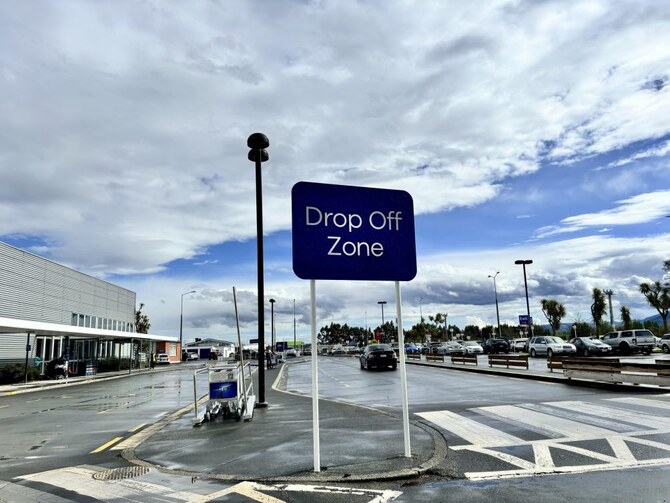
WELLINGTON: Emotional farewells are a common sight at airports, but travelers leaving the New Zealand city of Dunedin will have to be quick. A new three-minute time limit on goodbye hugs in the airport’s drop-off area is intended to prevent lingering cuddles from causing traffic jams.
“Max hug time three minutes,” warn signs outside the terminal, adding that those seeking “fonder farewells” should head to the airport’s parking lot instead.
The cuddle cap was imposed in September to “keep things moving smoothly” in the redesigned passenger drop-off area outside the airport, CEO Dan De Bono told The Associated Press on Tuesday. It was the airport’s way of reminding people that the zone was for “quick farewells” only.
The signs had polarized social media users, De Bono said.
“We were accused of breaching basic human rights and how dare we limit how long someone can have a hug for,” he said, adding that others had welcomed the change.
The signs were meant as an alternative to those at other airports warning of wheel clamping or fines for drivers parked in drop-off areas. Some in Britain have imposed fees for all drop-offs — however brief.
Dunedin’s airport — a modest terminal serving a city of 135,000 people on New Zealand’s South Island — preferred a “quirky” approach, De Bono said.
Three minutes was “plenty of time to pull up, say farewell to your loved ones and move on,” he said. “The time limit is really a nicer way of saying, you know, get on with it.”
A 20-second hug is long enough to release the wellbeing-boosting hormones oxytocin and serotonin, De Bono said. Anything longer was “really awkward.”
But passengers need not worry unduly about enforcement. “We do not have hug police,” De Bono said.
Visitors might, however, be asked to move their lingering embraces to the parking lot, where they can cuddle free of charge for up to 15 minutes.

New Zealand airport wants you to hug goodbye faster
https://arab.news/4f8yb
New Zealand airport wants you to hug goodbye faster
- Travelers leaving the New Zealand city of Dunedin will have to keep their emotional farewells brief after a new three-minute time limit
Cambodia takes back looted historic artifacts handled by British art dealer
- The objects were returned under a 2020 agreement between the Ministry of Culture and Fine Arts and the family of the late Douglas Latchford, a British art collector and dealer who allegedly had the items smuggled out of Cambodia
PHNOM PENH, Cambodia: Cambodian officials on Friday received more than six dozen historic artifacts described as part of the country’s cultural heritage that had been looted during decades of war and instability.
At a ceremony attended by Deputy Prime Minister Hun Many, the 74 items were unveiled at the National Museum in Phnom Penh after their repatriation from the United Kingdom.
The objects were returned under a 2020 agreement between the Ministry of Culture and Fine Arts and the family of the late Douglas Latchford, a British art collector and dealer who allegedly had the items smuggled out of Cambodia.
“This substantial restitution represents one of the most important returns of Khmer cultural heritage in recent years, following major repatriations in 2021 and 2023 from the same collection,” the Culture Ministry said in a statement. “It marks a significant step forward in Cambodia’s continued efforts to recover, preserve, and restore its ancestral legacy for future generations.”
The artifacts were described as dating from the pre-Angkorian period through the height of the Angkor Empire, including “monumental sandstone sculptures, refined bronze works, and significant ritual objects.” The Angkor Empire, which extended from the ninth to the 15th century, is best known for the Angkor Wat archaeological site, the nation’s biggest tourist attraction.
Latchford was a prominent antiquities dealer who allegedly orchestrated an operation to sell looted Cambodian sculptures on the international market.
From 1970 to the 1980s, during Cambodia’s civil wars and the communist Khmer Rouge ‘s brutal reign, organized looting networks sent artifacts to Latchford, who then sold them to Western collectors, dealers, and institutions. These pieces were often physically damaged, having been pried off temple walls or other structures by the looters.
Latchford was indicted in a New York federal court in 2019 on charges including wire fraud and conspiracy. He died in 2020, aged 88, before he could be extradited to face charges.
Cambodia, like neighboring Thailand, has benefited from a trend in recent decades involving the repatriation of art and archaeological treasures. These include ancient Asian artworks as well as pieces lost or stolen during turmoil in places such as Syria, Iraq and Nazi-occupied Europe. New York’s Metropolitan Museum of Art is one of the prominent institutions that has been returning illegally smuggled art, including to Cambodia.
“The ancient artifacts created and preserved by our ancestors are now being returned to Cambodia, bringing warmth and joy, following the country’s return to peace,” said Hun Many, who is the younger brother of Prime Minister Hun Manet.


