Multilateral action needed to promote sustainable economic growth, says Saudi finance minister

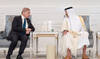
Saudi Minister of Finance and Chair of the International Monetary and Financial Committee Mohammed Al-Jadaan. X/@MAAljadaan
Short Url
Updated 22 October 2024
Follow

Multilateral action needed to promote sustainable economic growth, says Saudi finance minister

  • Saudi minister of finance said low-income nations are most affected by challenges facing global community
  • Mohammed Al-Jadaan said global financial institutions must continue to adjust quickly and decisively to solve challenges

RIYADH: Multilateral action should be adopted to address current risks and promote future sustainable economic growth and human development, a top Saudi official reiterated.  

While attending Macro Week at the Peterson Institute for International Economics on Oct. 21 in Washington, D.C., alongside the 2024 International Monetary Fund and World Bank Group Annual Meetings, Saudi Minister of Finance and Chair of the International Monetary and Financial Committee Mohammed Al-Jadaan highlighted that low-income nations are the most affected by challenges facing the global community.  

During his speech, Al-Jadaan also underlined that it is essential that global financial institutions continue to adjust quickly and decisively to solve challenges such as poverty and inequality, according to a statement.   

This commitment falls in line with the Kingdom’s Vision 2030 goal of a “Thriving Economy,” which stipulates generating diversified opportunities and attracting global talents and expertise to contribute to Saudi Arabia’s economic development.   

It also aligns well with the Sustainable Development Goal of promoting inclusive and long-lasting economic growth and achieving full and productive employment, decent work for all women and men, including for young people and persons with disabilities, and equal pay for work of equal value by 2030.   

“MDBs (Multilateral Development Banks) need to increase their focus on capacity-building, as well as provide the support and advice needed,” Al-Jadaan said during his speech.

“Today, I participated in the PIIE Macro Week on the sidelines of the 2024 Annual Meetings of the IMF and the World Bank, during which I stressed the importance of strengthening multilateral action to achieve sustainable economic growth.,” the minister said in a statement on X. 

The SDGs cover several aspects, including strengthening the capacity of domestic financial institutions to encourage and expand access to banking, insurance, and financial services for all.

It also entails protecting labor rights and promoting safe and secure environments accessible to everyone, including migrant workers – mainly females – and those in precarious employment. 

PIIE is recognized as a prominent global research institution that offers policy analysis and pragmatic approaches to bolster the resilience of the global economy. 

The organization strives to enhance global economic stability through actionable solutions by engaging top-tier experts in the field. 

PIIE Macro Week aims to assemble finance ministers, central bankers, governmental authorities, and industry influencers worldwide for deliberations on macroeconomic matters. This event also seeks to identify strategies to fortify global economic steadiness and advancement.


Saudi POS transactions see 20% surge to hit $4bn: SAMA

Updated 05 December 2025
Follow

Saudi POS transactions see 20% surge to hit $4bn: SAMA

RIYADH: Saudi Arabia’s total point-of-sale transactions surged by 20.4 percent in the week ending Nov. 29, to reach SR15.1 billion ($4 billion).

According to the latest data from the Saudi Central Bank, the number of POS transactions represented a 9.1 percent week-on-week increase to 240.25 million compared to 220.15 million the week before.

Most categories saw positive change across the period, with spending on laundry services registering the biggest uptick at 36 percent to SR65.1 million. Recreation followed, with a 35.3 percent increase to SR255.99 million. 

Expenditure on apparel and clothing saw an increase of 34.6 percent, followed by a 27.8 percent increase in spending on telecommunication. Jewelry outlays rose 5.6 percent to SR354.45 million.

Data revealed decreases across only three sectors, led by education, which saw the largest dip at 40.4 percent to reach SR62.26 million. 

Spending on airlines in Saudi Arabia fell by 25.2 percent, coinciding with major global flight disruptions. This followed an urgent Airbus recall of 6,000 A320-family aircraft after solar radiation was linked to potential flight-control data corruption. Saudi carriers moved swiftly to implement the mandatory fixes.

Flyadeal completed all updates and rebooked affected passengers, while flynas updated 20 aircraft with no schedule impact. Their rapid response contained the disruption, allowing operations to return to normal quickly.

Expenditure on food and beverages saw a 28.4 percent increase to SR2.31 billion, claiming the largest share of the POS. Spending on restaurants and cafes followed with an uptick of 22.3 percent to SR1.90 billion.

The Kingdom’s key urban centers mirrored the national decline. Riyadh, which accounted for the largest share of total POS spending, saw a 14.1 percent surge to SR5.08 billion, up from SR4.46 billion the previous week. The number of transactions in the capital reached 75.2 million, up 4.4 percent week-on-week.

In Jeddah, transaction values increased by 18.1 percent to SR2.03 billion, while Dammam reported a 14 percent surge to SR708.08 million.

POS data, tracked weekly by SAMA, provides an indicator of consumer spending trends and the ongoing growth of digital payments in Saudi Arabia. 

The data also highlights the expanding reach of POS infrastructure, extending beyond major retail hubs to smaller cities and service sectors, supporting broader digital inclusion initiatives. 

The growth of digital payment technologies aligns with the Kingdom’s Vision 2030 objectives, promoting electronic transactions and contributing to the nation’s broader digital economy.