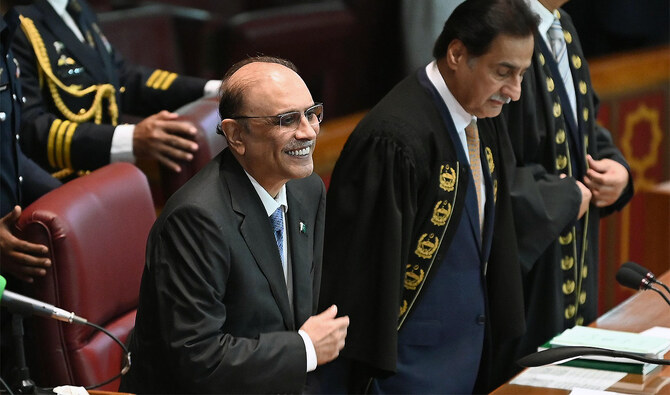

ISLAMABAD: Pakistan’s President Asif Ali Zardari on Monday signed into law the contentious constitutional amendment passed by the country’s parliament that caps the tenure of the country’s top judge at three years and makes other key changes related to the judiciary in the constitution, with the government saying the reforms will empower the parliament amid its tensions with the judiciary.
The ruling coalition government passed the contentious amendment bill on Sunday night from both houses of parliament, something it had been trying to do since last month amid stiff resistance from opposition parties and the legal fraternity, who argued it was an attempt to curtail the independence of the judiciary. The government denies this.
In the Senate, 65 members voted in favor of the constitutional amendment and four against it while in the National Assembly, 225 members supported the amendment and 12 opposed it. Law Minister Azam Nazeer Tarar tabled the bill in both houses of parliament.
The 26th Constitutional Amendment Bill, 2024, states that a 12-member parliamentary panel will appoint the chief justice from a panel of the three most senior judges of the top court, for a period of three years. The committee, comprising eight members from the National Assembly and four from the Senate, will propose the name to the prime minister, who will then forward it to the president for final approval. The top judge will retire upon reaching the age of 65 years.
Another clause of the bill states that the Supreme Court’s judges will be appointed by a Judicial Commission of Pakistan led by the chief justice and three senior judges, which will also comprise two members each from the National Assembly and Senate, federal law minister, the attorney general of Pakistan, and a nominee of the Pakistan Bar Council having not less than 15 years of practice in the Supreme Court. The commission will also monitor judges’ performance and report any concerns to the Supreme Judicial Council.
“This Act shall come into force at once,” a copy of the Gazette of Pakistan seen by Arab News said.
Earlier, Prime Minister Shehbaz Sharif praised the amendments, describing them as “historic” for the country’s parliament.
“This is not just an amendment, it is a spectacular example of national solidarity and consensus,” Sharif said during his speech at the National Assembly session on Monday morning, shortly after the bill had sailed through both houses of parliament. “And god willing, a new sun will rise today.”

Pakistan Prime Minister Shehbaz Sharif signs the advice for presidential assent on the 26th Constitutional Amendment Bill in Islamabad, Pakistan, on October 21, 2024. (Government of Pakistan)
Defense Minister Khawaja Asif praised the amendment as well, saying it would empower elected representatives.
“Mr. Speaker, this amendment that we are about to conclude or pass today empowers the parliament,” Asif said. “It empowers the representatives of 240 million people and gives sanctity to the vote.”
The government secured 225 votes of the required 224 in the National Assembly with the help of a handful of rebel lawmakers from the PTI, the chief rival of the ruling coalition government.

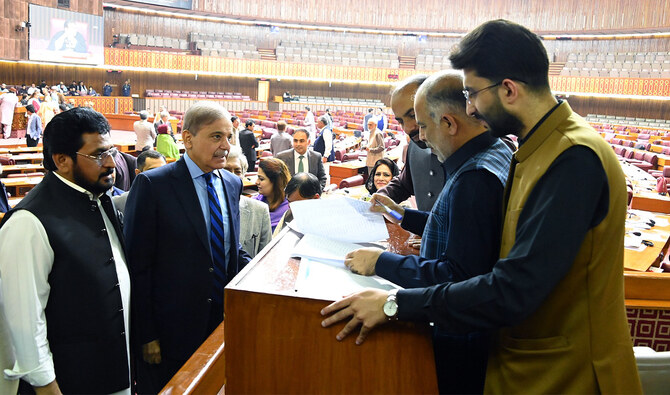
Pakistan Prime Minister Shehbaz Sharif (second left) meets PPP Chairman Bilawal Bhutto-Zardari (right) and Jamiat Ulama-e-Pakistan Fazl (JUI-F) chief Fazl-ur-Rehman (center) in National Assembly in Islamabad, Pakistan, on October 20, 2024. (@NaOfPakistan/X)
PTI Chairman Gohar Ali Khan criticized the bill, saying it will make the judiciary “subservient” for all times to come.
“Mr. Speaker, the way those who are sitting on the treasury benches today criticized our independent judges, they have never criticized India, Modi or Kulbhushan Jhadav the same way,” Khan said, referring to an Indian national undergoing incarceration in Pakistan on charges of espionage.
“These amendments are akin to suffocating a free judiciary. They do not represent the people of Pakistan,” PTI’s Omar Ayub Khan, the leader of the opposition in the National Assembly, said during the session.
“A government formed through rigging cannot amend the constitution.”
TENSIONS WITH THE TOP COURT
The amendment bill fixing the chief justice’s age comes days before Qazi Faez Isa, the incumbent chief justice, is due to retire. Khan’s PTI has accused the chief justice of being aligned with the government, its chief rival, an allegation the government has repeatedly rejected. Khan’s party has repeatedly said the amendments were aimed at granting an extension in tenure to Isa.
Under the previous law, Justice Isa would have been automatically replaced by the most senior judge behind him, currently Justice Mansoor Ali Shah, who has consistently issued verdicts deemed favorable to Khan and the PTI.
Sharif’s government has passed the bill, which it says ensures the parliament will not remain a rubber stamp one, in the wake of its tensions with the judiciary that have been on the rise since the February national election.
In July, Pakistan’s top court ruled that the country’s election commission was wrong to have sidelined Khan’s party in the election campaign by forcing its lawmakers to stand as independents due to a technical violation. It also awarded Khan’s party a handful of non-elected reserved parliamentary seats for women and religious minorities, which would give Khan’s party a majority in parliament, angering the government.
Khan, who was ousted from office after a parliamentary vote in April 2022, remains popular among the masses. He has since waged an unprecedented campaign of defiance against the country’s powerful military, which is thought to be aligned with the government. Khan has been languishing in prison since August 2023 after being convicted on several charges ranging from corruption to treason that he says are politically motivated.