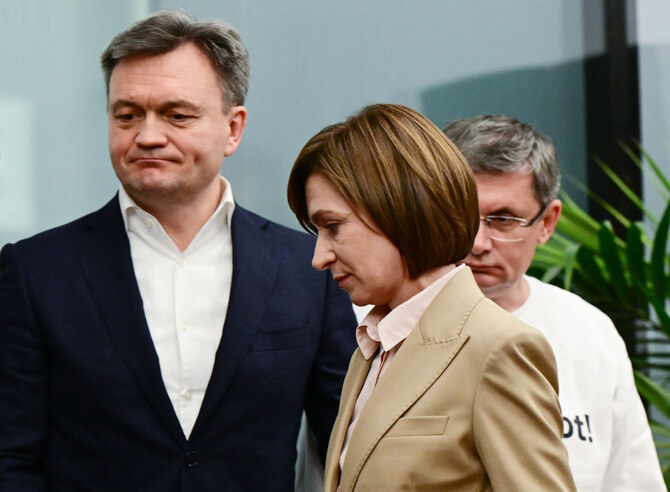

CHISINAU: Moldova’s pro-Western president early Monday looked set to win the first round of a presidential race but accused “criminal groups” of undermining a referendum asking voters to decide whether to secure a path toward European Union membership, which risked being narrowly rejected.
Nearly 95 percent of votes were counted in the EU referendum that asks voters to choose whether to enshrine in the country’s constitution a path toward the EU. About 52 percent of a total 1.2 million ballots voted “no,” while 47 percent voted “Yes.”
However, ballots cast among the country’s large diaspora were still being tallied and tended to favor the EU path.
“Criminal groups, working together with foreign forces hostile to our national interests, have attacked our country with tens of millions of euros, lies and propaganda, using the most disgraceful means to keep our citizens and our nation trapped in uncertainty and instability,” said President Maia Sandu after about 90 percent of the votes had been counted.
“We have clear evidence that these criminal groups aimed to buy 300,000 votes — a fraud of unprecedented scale,” Sandu added. “Their objective was to undermine a democratic process.”
The two pivotal ballots were held amid ongoing claims by Moldovan authorities that Moscow has intensified an alleged “hybrid war” campaign to destabilize the country and derail its EU path. The allegations include funding pro-Moscow opposition groups, spreading disinformation, meddling in local elections and backing a major vote-buying scheme.
In the presidential race of 11 candidates, Sandu looked set to win the first round with 39 percent of the vote but was unlikely to win an outright majority. She will likely face Alexandr Stoianoglo, a Russia-friendly former prosecutor general who outperformed polls with around 28 percent of the vote, in a run-off on Nov. 3.
After polls closed at 9 p.m. local time, more than 1.5 million voters — about 51 percent of eligible voters — had cast ballots, according to the Central Electoral Commission.
Cristian Cantir, a Moldovan associate professor of international relations at Oakland University, told The Associated Press that votes from the diaspora could prove crucial at this late stage.
“If I were a pro-EU politician … that’s where I’d look for signs of good news,” he said. “I think the ideal scenario for them would have been to have something that showed overwhelming support for the EU — and that simply did not happen.”
US national security spokesman John Kirby echoed Russian interference concerns this week, saying in a statement that “Russia is working actively to undermine Moldova’s election and its European integration.” Moscow has repeatedly denied it is interfering in Moldova.
“In the last several months, Moscow has dedicated millions of dollars to influencing Moldova’s presidential election,” Kirby said. “We assess that this money has gone toward financing its preferred parties and spreading disinformation on social media in favor of their campaigns.”
In early October, Moldovan law enforcement said it had uncovered a massive vote-buying scheme orchestrated by Ilan Shor, an exiled pro-Russia oligarch who currently resides in Russia, which paid 15 million euros ($16.2 million) to 130,000 individuals to undermine the two ballots.
Shor was convicted in absentia last year and sentenced to 15 years in prison on fraud and money laundering in the case of $1 billion that went missing from Moldovan banks in 2014. He denied the allegations, saying “the payments are legal” and cited a right to freedom of expression. Shor’s populist Russia-friendly Shor Party was declared unconstitutional last year and banned.
Constantin Celac, a 37-year-old multimedia producer, said in central Chisinau that he cast his ballots in favor of Sandu and EU integration because “it is the best way” forward for Moldova. He said that while he does have concerns about Russian meddling, “I trust our government … to fight against them.”
On Thursday, Moldovan authorities foiled another plot in which more than 100 young Moldovans received training in Moscow from private military groups on how to create civil unrest around the two votes. Some also attended “more advanced training in guerrilla camps” in Serbia and Bosnia, police said, and four people were detained for 30 days.
Sandu cast her own ballot in the capital on Sunday and told the media that “Moldovans themselves must choose their own fate, and not others, nor the dirty money or the lies.”
“I voted for Moldova to be able to develop in peace and liberty,” she said.
A pro-Western government has been in power in Moldova since 2021, a year after Sandu won the presidency. A parliamentary election will be held next year.
Moldova, a former Soviet republic with a population of about 2.5 million, applied to join the EU in the wake of Russia’s full-scale invasion of neighboring Ukraine on Feb. 24, 2022, and was granted candidate status that summer, alongside Ukraine. Brussels agreed in June to start membership negotiations.
Loredana Godorogea, a 29-year-old IT manager who lives in Chisinau, said she also voted in favor of the incumbent president and the path toward the EU. “I think in the next five years we can be more close economically with the European Union, and I also think a big factor will be the war in Ukraine,” she said.
Moldovans voted “no” in a referendum on joining the European Union on Sunday, according to partial results, which if confirmed will mean a major setback to pro-EU President Maia Sandu, who managed to top the first round of presidential elections held at the same time.
The double votes are seen as key tests of the former Soviet republic’s pro-European turn under Sandu but have been overshadowed by fears of Russian meddling amid the war in neighboring Ukraine.
Sandu, who beat a Moscow-backed incumbent in 2020, cut ties with Moscow and applied for her country of 2.6 million people to join the EU following Russia’s invasion of Ukraine in 2022.
In the referendum, with some 70 percent of the vote counted, more than 55 percent had said “no” and almost 45 percent said “yes,” but results could yet change as votes are counted in the capital Chisinau, which is favorable to joining the EU, and abroad.
In the presidential election, Sandu gained 36 percent of the votes, according to the partial results, and is likely to face her closest competitor Alexandr Stoianoglo, a former prosecutor backed by the pro-Russian Socialists, in the second round.
He had picked up a higher-than-expected result of almost 30 percent.
The turnout was close to 50 percent for the referendum asking whether to modify the constitution to include joining the EU as an objective, with Sandu’s camp saying that it was an underestimate because of obsolete voter lists.
A turnout of more than 33 percent was needed for the referendum result to be valid.
Voter turnout for the presidential elections stood at more than 51 percent.
“I have come to cast my vote for prosperity, peace and wellbeing in our country,” said Olga Cernega, a 60-year-old economist in the capital Chisinau.
Sandu, 52, a former World Bank economist and Moldova’s first woman president, had been the clear favorite in the race, with surveys also predicting a “yes” victory in the referendum.
“This election will determine our fate for many years,” Sandu said when she voted.
The “will of the Moldovan people” should be heard, “not that of others, not dirty money,” she added.
An hour from Chisinau in the town of Varnita, a polling booth was set up specifically for inhabitants of the breakaway pro-Russian region of Transnistria.
Nicolai, 33, an IT specialist, who declined to give his full name for fear of repercussions in Transnistria, said he had voted “yes” in the referendum and for Sandu as president.
“I want a life in a free and safe European country,” he said.
The 27-member EU began membership talks with Chisinau in June.
Sandu’s critics say she has not done enough to fight inflation in one of Europe’s poorest countries or to reform the judiciary.
In his campaign, Stoianoglo — who was fired as prosecutor by Sandu — called for the “restoration of justice” and vowed to wage a “balanced foreign policy.”
The 57-year-old abstained from voting in the referendum.
In Chisinau, voter Ghenadie, who declined to give his last name, said he was worried by what he saw as the country’s “western” drift and thought the government was “making the situation worse” economically.
Fears of Russian interference have been looming large.
Washington issued a fresh warning this week about suspected Russian interference, while the EU passed new sanctions on several Moldovans.
Moscow has “categorically” rejected accusations of meddling.
Police made hundreds of arrests in recent weeks after discovering an “unprecedented” vote-buying scheme that could taint up to a quarter of the ballots cast in the country of 2.6 million.
Police said millions of dollars from Russia aiming to corrupt voters were funnelled into the country by people affiliated to Ilan Shor, a fugitive businessman and former politician.
Convicted in absentia last year for fraud, Shor regularly brands Moldova a “police state” and the West’s “obedient puppet.”
In addition to the suspected vote buying, hundreds of young people were found to have been trained in Russia and the Balkans to create “mass disorder” in Moldova, such as using tactics to provoke law enforcement, according to police.