Nine wounded in Russian strikes on Ukraine’s Kharkiv: local officials

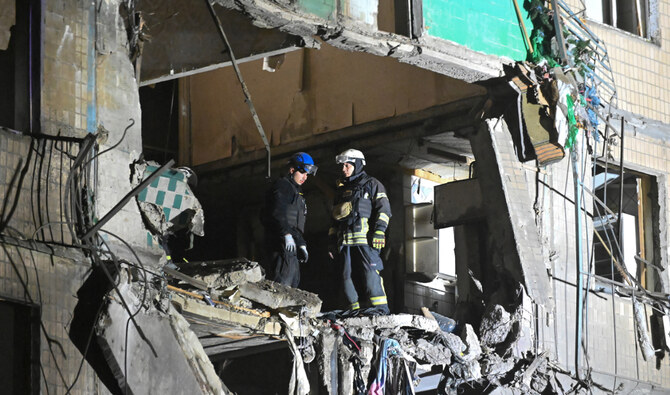
Ukrainian rescuers inspect damage to a residential building following a missile attack in Kharkiv early on October 3, 2024. (AFP/File)
Short Url
Updated 21 October 2024
Follow

Nine wounded in Russian strikes on Ukraine’s Kharkiv: local officials

KYIV: Russian strikes late Sunday on the northeast city of Kharkiv wounded nine people and cut power to part of the city, local officials and police said.
The latest barrage came as Ukrainian officials prepare for a new wave of bombardments they think will target the country’s energy network ahead of winter, as Moscow has done the last two years.
Russia has targeted the country’s power supplies to make the harsh winter harder to endure for the country’s civilian population in an effort to put more pressure on the authorities.
Police said in a statement on Telegram that Russia had launched strikes at around 10:00 p.m. (1900 GMT) injuring four women and five men.
Among the buildings hit were residential buildings, garages, service stations, houses and cars, the statement added.
Medical services were mobilized to help the injured, but the strikes cut power to parts of the city, said police.
Governor of the region and city mayor Oleg Synegubov confirmed in a Telegram post that part of the city was without power.
Neither he, nor the police, said how much of the city had been affected by the power cuts, nor which part of the power network had been hit.
Kharkiv, the main city of the northeast region of the same name, is a regular target of Russian strikes. It lies less than 30 kilometers (19 miles) from the Russian border.
In May, Russia’s army tried to push forward in this border region, officially to create a buffer zone to limit Ukrainian attacks against military and industrial targets on Russian soil.
But the offensive has not succeeded in stopping Kyiv from targeting Russian territory on a daily basis.



Colombia’s ELN guerrillas place communities in lockdown citing Trump ‘intervention’ threats

Updated 2 sec ago
Follow

Colombia’s ELN guerrillas place communities in lockdown citing Trump ‘intervention’ threats

BOGOTA: Colombia’s National Liberation Army (ELN) guerrilla group ordered civilians in areas under its control on Friday to stay home for three days as it carries out military exercises in response to “intervention” threats from US President Donald Trump.
The ELN, the oldest surviving guerrilla group in the Americas, controls key drug-producing regions of Colombia and vowed Friday to fight for the country’s “defense” in the face of Trump’s “threats of imperialist intervention.”
Amid a major US pressure campaign against Venezuela, which many view as an attempt to push out strongman Nicolas Maduro, Trump on Wednesday warned that Colombia’s leftist President Gustavo Petro could “be next” over his country’s mass cocaine production.
“He’s going to have himself some big problems if he doesn’t wise up. Colombia is producing a lot of drugs,” Trump told reporters, when asked if he expected to speak with frequent foe Petro.
“He better wise up, or he’ll be next...I hope he’s listening.”
The ELN urged civilians in areas it controls to stay indoors for 72 hours starting at 6:00 am on Sunday, avoiding main roads and rivers.
“It is necessary for civilians not to mix with fighters to avoid accidents,” the group said in a statement.
Petro criticized the move on social media, saying one “doesn’t protest against anyone by killing peasants and taking away their freedom.”
“You, gentlemen of the ELN, are declaring an armed strike not against Trump, but in favor of the drug traffickers who control you,” he wrote on X.
Colombian Defense Minister Pedro Sanchez dismissed the ELN move as “nothing more than criminal coercion” and vowed the military “will be everywhere — in every mountain, every jungle, every river” to counter its threat.
With a force of about 5,800 combatants, the ELN is present in over a fifth of Colombia’s 1,100-plus municipalities, according to the Insight Crime research center.
The ELN has also taken part in failed peace negotiations with Colombia’s last five governments.
While claiming to be driven by leftist, nationalist ideology, the ELN is deeply rooted in the drug trade and has become one of the region’s most powerful organized crime groups.
It vies for territory and control of lucrative coca plantations and trafficking routes with dissident fighters that refused to lay down arms when the FARC guerrilla army disarmed under a 2016 peace deal.
One ELN stronghold is the Catatumbo region near the Venezuelan border — one of the areas with the most coca crops in the world.
Colombia is the world’s top cocaine producer, according to the UN.

- Souring ties -

Historically strong relations between Bogota and Washington have deeply soured since Trump’s return to office.
Petro, who came to power in 2022 as Colombia’s first-ever leftist president, has openly clashed with Trump calling him “rude and ignorant” and comparing him to Adolf Hitler.
The Colombian leader denounced the Trump administration’s treatment of migrants and what he has termed the “extrajudicial executions” of nearly 90 people in strikes on boats in the Caribbean and Pacific the US claims, without providing evidence, were ferrying drugs.
Petro has also criticized Washington’s military deployment within striking distance of Venezuela, where Maduro fears he is the target of a regime-change plot under the guise of an anti-drug operation.
Washington, in turn, has accused Petro of drug trafficking and imposed sanctions.
Trump removed Bogota from a list of allies in the fight against narco trafficking, but the country has so far escaped harsher punishment.