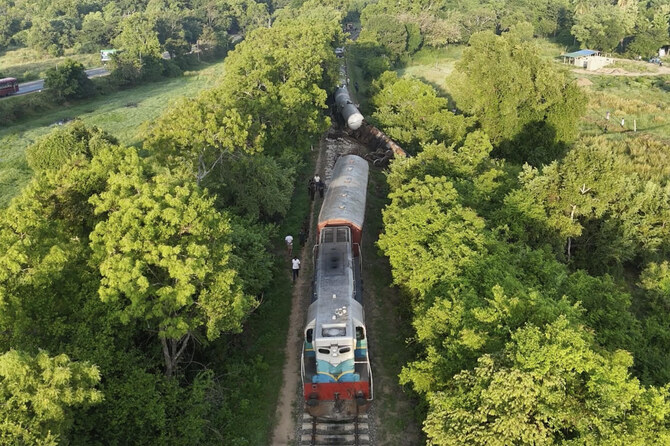
COLOMBO: A train carrying thousands of gallons of fuel hit a herd of wild elephants in northeast Sri Lanka, killing two of the giant mammals and injuring one other as two of its tankers got derailed, authorities said.
The collision happened in the town of Minneriya — about 200 kilometers (124 miles) from the capital, Colombo — renowned for its nature park and wildlife.
The train driver told The Associated Press that the herd of nearly 20 elephants suddenly tried to cross over the railway track Friday.
“There was about 10 meters (32 feet) between us. So, we couldn’t do anything. We pressed the breaks to their maximum capacity, but there was nothing much we could do. At least four elephants were knocked down.” N.W. Jayalath said.
The train had eight tankers — five carrying diesel and another three petrol, each with a capacity of 50,000 liters (about 132,000 gallons), Jayalath said. Two of the petrol tankers got derailed, causing a significant leakage and severely damaging railway tracks and forcing authorities to suspend the train services on that line, he added.
The train compartment harboring the conductor also got derailed. The train also had two other railway personnel besides the driver. None of the four were injured.
“This is the first time I saw this kind of incident,” V.J. Jackson, a Minneriya resident, said. “We came here after hearing the honking of the train and the screaming of the elephants. We saw elephants lying everywhere and the train had derailed.”
Hasini Sarathchandra, the publicity officer of the wildlife department said the two elephants were killed on site while the injured one was treated and released back to its herd.
Minneriya National Park draws thousands of tourists each year hoping to see elephants in their wild habitats. It is part of the “elephant corridor that connects Kaudulla and Wasgamuwa National parks” which allows for elephant sightings year-round.
Though elephants are revered in the Indian Ocean island nation, they are endangered with their numbers dwindling from about 14,000 in the 19th century to 6,000 in 2011, according to the country’s first elephant census.
Elephant-train collisions have gone up in recent years in Sri Lanka, with wild elephants attempting to cross over railway tracks in search of food and water. They are increasingly vulnerable because of the loss and degradation of their natural habitat and many venture closer to human settlements in search of food. Some are killed by poachers or farmers angry over damage to their crops.
According to the government statistics, seven elephants have died this year after being knocked down by trains while 24 died in 2023.

Train hits and kills 2 wild elephants in Sri Lanka
https://arab.news/jjs6q
Train hits and kills 2 wild elephants in Sri Lanka
- The collision happened in the town of Minneriya, renowned for its nature park and wildlife
- Elephant-train collisions have gone up in recent years in Sri Lanka
About 400 immigrant children were detained longer than the recommended limit, ICE admits
- A Dec. 1 report from ICE indicated that about 400 immigrant children were held in custody for more than the 20-day limit during the reporting period from August to September
- Advocates documented injuries suffered by children and a lack of access to sufficient medical care
TEXAS, USA: Hundreds of immigrant children across the nation were detained for longer than the legal limit this summer, US Immigration and Customs Enforcement has admitted in a court filing, alarming legal advocates who say the government is failing to safeguard children.
In a court filing Monday evening, attorneys for detainees highlighted the government’s own admissions to longer custody times for immigrant children, unsanitary conditions reported by families and monitors at federal facilities, and a renewed reliance on hotels for detention.
The reports were filed as part of an ongoing civil lawsuit launched in 1985 that led to the creation of the 1990s cornerstone policy known as the Flores Settlement Agreement, which limits the time children can spend in federal custody and requires them to be kept in safe and sanitary conditions. The Trump administration is attempting to end the agreement.
A Dec. 1 report from ICE indicated that about 400 immigrant children were held in custody for more than the 20-day limit during the reporting period from August to September. They also told the court the problem was widespread and not specific to a region or facility. The primary factors that prolonged their release were categorized into three groups: transportation delays, medical needs, and legal processing.
Legal advocates for the children contended those reasons do not prove lawful justifications for the delays in their release. They also cited examples that far exceeded the 20-day limit, including five children who were held for 168 days earlier this year.
ICE did not immediately respond to a request for comment Tuesday.
Hotel use for temporary detention is allowed by the federal court for up to 72 hours, but attorneys questioned the government’s data, which they believe did not fully explain why children were held longer than three days in hotel rooms.
Conditions at the detention facilities continued to be an ongoing concern since the family detention site in Dilley, Texas, reopened this year.
Advocates documented injuries suffered by children and a lack of access to sufficient medical care. One child bleeding from an eye injury wasn’t seen by medical staff for two days. Another child’s foot was broken when a member of the staff dropped a volleyball net pole, according to the court filing. “Medical staff told one family whose child got food poisoning to only return if the child vomited eight times,” the advocates wrote in their response.
“Children get diarrhea, heartburn, stomach aches, and they give them food that literally has worms in it,” one person with a family staying at the facility in Dilley wrote in a declaration submitted to the court.
Chief US District Judge Dolly Gee of the Central District of California is scheduled to have a hearing on the reports next week, where she could decide if the court needs to intervene.


