For Sikh activists, Canada’s claims of Indian government intimidation campaign validates what they have long been saying

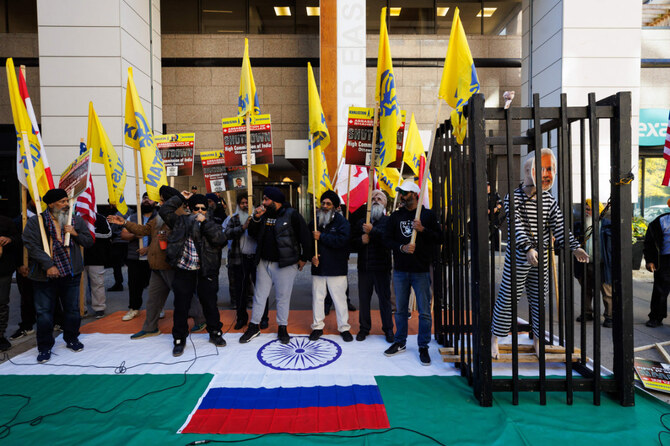
Sikh separatist activists protest beside a placard and mannequin of Indian Prime Minister Narendra Modi outside the Consulate General of India in Toronto, Canada, on October 18, 2024. (AFP)
Short Url
Updated 19 October 2024
Follow

For Sikh activists, Canada’s claims of Indian government intimidation campaign validates what they have long been saying

  • PM Trudeau has said India’s targeting of Canadian Khalistan activists went beyond Nijjar’s killing, and has included a broad campaign of intimidation, violence and other threats

TORONTO, Canada: Ottawa’s accusations this week detailing a deadly Indian campaign against its Canada-based critics may have further derailed bilateral relations — but to Sikh activists, the striking disclosures brought validation.
Canada has accused India of orchestrating the 2023 killing in Vancouver of 45-year-old naturalized Canadian citizen Hardeep Singh Nijjar, a prominent campaigner for “Khalistan,” the fringe separatist movement for an independent Sikh homeland in India’s Punjab state.
In public comments this week, Prime Minister Justin Trudeau and the national police said India’s targeting of Canadian Khalistan activists went beyond Nijjar’s killing, and has included a broad campaign of intimidation, violence and other threats.
India has dismissed the allegations.
“It was very validating,” Harinder Sohi told AFP at a thinly attended protest on Friday outside the Indian consulate in Toronto.
“This is something that we believed in for years and people weren’t listening to us,” the 42-year-old Khalistan activist said.
The dozens of protesters at Friday’s rally waved yellow flags with “Khalistan” written in bold blue letters and repeated a chant branding Indian Prime Minister Narendra Modi “a terrorist.”
They also erected a prison cell around an effigy of the Indian leader.
Sohi said it was meaningful that Canada has now publicly affirmed the “danger” India poses to people living across Canada.
It “is shocking that we as Canadian citizens have to live in fear of a foreign government,” he said.
Testifying Wednesday at an inquiry on foreign interference, Trudeau made clear his government was not looking to blow up relations with a major trading partner with whom Canada has deep ties.
But he said when faced with clear evidence the Indian government had directed acts of violence inside Canada and breached Canadian “sovereignty,” he and the Royal Canadian Mounted Police resolved to go public in the interest of public safety.

The Khalistan campaign dates back to India’s 1947 independence and within India today any support for the movement faces a swift crackdown.
Jatinder Singh Grewal, a director with the Sikhs for Justice advocacy group and a Khalistan supporter, argued that Modi’s government is intent on silencing support for the movement abroad because it fears discussion among the Sikh diaspora could fuel a movement at home.
“If you allow the Canadian Sikhs, or the American Sikhs or the British Sikhs to openly talk about this, you will eventually make the Punjabi Sikh say, ‘Why can’t I talk about this openly?’“
Grewal praised Trudeau’s public disclosures and Canada’s decision to expel Indian diplomats but said more was needed, endorsing the closure of Indian consulates in Toronto and Vancouver, arguing they have been used to coordinate violence against Sikhs.

There are roughly 770,000 Sikhs in Canada, about two percent of the population, the largest Sikh community outside of India.
Sikhs are heavily concentrated in suburban areas, notably around Toronto and Vancouver, and the community’s vote has been pivotal in past national elections.
Last year, days after Trudeau first accused Indian agents of killing Nijjar, one former government foreign policy adviser charged that domestic politics had influenced Trudeau’s decisions on Sikh affairs.
Writing in The Globe and Mail, the former adviser Omer Aziz said Trudeau’s Liberal party was worried about losing votes to the left-wing New Democrats, led by Jagmeet Singh, who is Sikh.
Trudeau’s poll numbers are plummeting and with an election due in the coming months, questions have again surfaced about Trudeau’s efforts to shore up Sikh votes.
Holding a Khalistan flag at Friday’s protest, Inderjeet Singh Gosal dismissed any such political motive.
“I don’t think it’s about that,” he told AFP. “I just think that Justin Trudeau is just following his principles. He believes in rights and he believes in keeping his Canadian citizens safe.”


Thai villagers stay behind to guard empty homes as border clashes force mass evacuations

Updated 58 min 19 sec ago
Follow

Thai villagers stay behind to guard empty homes as border clashes force mass evacuations

  • Appointed by the local administration as Village Security Volunteers, they guarded the empty homes after many residents were forced to flee and with fewer security officials stationed nearby than usual

SURIN: Fighting that has flared along the Thai-Cambodian border has sent hundreds of thousands of Thai villagers fleeing from their homes close to the frontier since Monday. Their once-bustling communities have fallen largely silent except for the distant rumble of firing across the fields.
Yet in several of these villages, where normally a few hundred people live, a few dozen residents have chosen to stay behind despite the constant sounds of danger.
In a village in Buriram province, about 6 miles (10 kilometers) from the border, Somjai Kraiprakon and roughly 20 of her neighbors gathered around a roadside house, keeping watch over nearby homes. Appointed by the local administration as Village Security Volunteers, they guarded the empty homes after many residents were forced to flee and with fewer security officials stationed nearby than usual.
The latest large-scale fighting derailed a ceasefire pushed by US President Donald Trump, which halted five days of clashes in July triggered by longstanding territorial disputes. As of Saturday, around two dozen people had been reported killed in the renewed violence.
At a house on the village’s main intersection, now a meeting point, kitchen and sleeping area, explosions were a regular backdrop, with the constant risk of stray ammunition landing nearby. Somjai rarely flinched, but when the blasts came too close, she would sprint to a makeshift bunker beside the house, built on an empty plot from large precast concrete drainage pipes reinforced with dirt, sandbags and car tires.
She volunteered shortly after the July fighting. The 52-year-old completed a three-day training course with the district administration that included gun training and patrol techniques before she was appointed in November. The volunteer village guards are permitted to carry firearms provided by relevant authorities.
The army has emphasized the importance of volunteers like Somjai in this new phase of fighting, saying they help “provide the highest possible confidence and safety for the public.”
According to the army, volunteers “conduct patrols, establish checkpoints, stand guard inside villages, protect the property of local people, and monitor suspicious individuals who may attempt to infiltrate the area to gather intelligence.”
Somjai said the volunteer team performs all these duties, keeping close watch on strangers and patrolling at night to discourage thieves from entering abandoned homes. Her main responsibility, however, is not monitoring threats but caring for about 70 dogs left behind in the community.
“This is my priority. The other things I let the men take care of them. I’m not good at going out patrolling at night. Fortunately I’m good with dogs,” she said, adding that she first fed a few using her own money, but as donations began coming in, she was able to expand her feeding efforts.
In a nearby village, chief Praden Prajuabsook sat with about a dozen members of his village security team along a roadside in front of a local school. Around there, most shops were already closed and few cars could be seen passing once in a while.
Wearing navy blue uniforms and striped purple and blue scarves, the men and women chatted casually while keeping shotguns close and watching strangers carefully. Praden said the team stationed at different spots during the day, then started patrolling when night fell.
He noted that their guard duty is around the clock, and it comes with no compensation and relies entirely on volunteers. “We do it with our own will, for the brothers and sisters in our village,” he said.
Beyond guarding empty homes, Praden’s team, like Somjai, also ensures pets, cattle and other animals are fed. During the day, some members ride motorbikes from house to house to feed pigs, chickens and dogs left behind by their owners.
Although his village is close to the battlegrounds, Praden said he is not afraid of the sounds of fighting.
“We want our people to be safe… we are willing to safeguard the village for the people who have evacuated,” he said.