Sinwar’s death brings no respite for Gazans

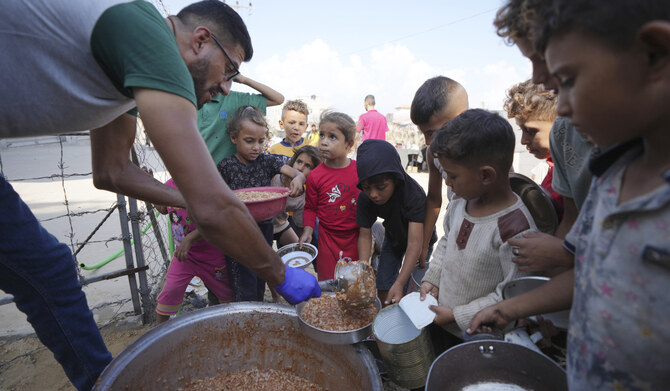
Displaced Palestinian children queue for food in a camp in Deir al-Balah, Gaza Strip, Friday, Oct. 18, 2024. (AP)
Short Url
Updated 18 October 2024
Follow

Sinwar’s death brings no respite for Gazans

  • Civilians remain trapped, hungry, and sick, often under heavy bombardment: UNRWA chief

GAZA CITY: The killing of Hamas chief Yahya Sinwar brought no respite for Palestinians in Gaza, as Israeli airstrikes and shelling continued unabated in the territory already devastated by more than a year of war.

Raids continued in the besieged enclave in the hours after Israel announced the death of the militant leader they have long accused of masterminding the Oct. 7 attack last year — a key war aim for Israel.
Following a strike at dawn, Gaza’s civil defense agency said rescuers recovered the bodies of three Palestinian children from the rubble of their home in the north of the territory.
“We always thought that when this moment arrived, the war would end and our lives would return to normal,” said Jemaa Abou Mendi, a 21-year-old Gaza resident.

NUMBER

42,500

Palestinians have been killed in Israel’s Gaza onslaught.

“But unfortunately, the reality on the ground is quite the opposite. The war has not stopped, and the killings continue unabated.”
Large swaths of northern Gaza remained under siege by Israeli forces, with road closures preventing the delivery of supplies to the area — despite warnings from the United States that failure to end the blockade could trigger a reduction in arms deliveries to Israel.
“While we hear that delivery of aid will increase, people in Gaza are not feeling any difference,” Philippe Lazzarini, the head of the UN agency for Palestinian refugees, wrote on X.
“They continue to be trapped, hungry, and sick, often under heavy bombardment.”
As news of the death of Sinwar sunk in, many in Gaza saw little reason for the Israeli army to press on with its war in the territory.
“If Sinwar’s assassination was one of the objectives of this war, well, today they have killed Yahya Sinwar,” said Mustafa Al-Zaeem, a 47-year-old resident from the Rimal neighborhood in western Gaza City.
“Enough death, enough hunger, enough siege. Enough thirst and starvation, enough bodies and blood.”
Israel’s campaign to crush Hamas and bring back the hostages has killed 42,500 people in Gaza, the majority civilians, according to data from the Health Ministry in the territory, which the UN considers reliable.
US President Joe Biden said on Friday he impressed upon Israeli Prime Minister Benjamin Netanyahu during a conversation to “also make this moment an opportunity to seek a path to peace, a better future in Gaza without Hamas.”
Pressure has also been mounting in Israel to leverage the killing of Sinwar into a tangible plan to secure the release of the remaining hostages held captive in Gaza.
Israeli President Isaac Herzog and Netanyahu met on Friday to discuss the aftermath of Sinwar’s death, including the hostages.
A statement released by the presidency said that “a significant window of opportunity opened — including the promotion of the return of the hostages and the elimination of Hamas.”
Late on Thursday, Netanyahu vowed that those who helped free the hostages in Gaza would be spared.
“Whoever lays down his weapon and returns our hostages — we will allow him to go on living,” he said.
But in Gaza, some remained skeptical over the fate of the hostages and what any deal would entail for their future.
“Today, Israel is lost and will be searching for the hostages,” said Zaeem.
Others saw little reason to trust Netanyahu and only feared more war.
“What we see is that Netanyahu’s focus is on Gaza — on killing, destruction, and eradication, as the bombings and massacres continue across Gaza,” said Mahmoud Obeid, 42, from northern Gaza.
“What we fear most is the continuation of this cursed war.”


Iraq negotiates new coalition under US pressure

Updated 4 sec ago
Follow

Iraq negotiates new coalition under US pressure

BAGHDAD: More than a month after Iraq’s parliamentary elections, the country’s top leaders remain locked in talks to form a government while facing pressure from Washington to exclude Tehran-backed armed groups.
Amid seismic changes in the Middle East, where new alliances are forming and old powers waning, Iraqi leaders face a daunting task: navigating relations with US-blacklisted pro-Iranian factions.

- What does the US want? -

The US has held significant sway over Iraqi politics since leading the 2003 invasion that ousted long-time ruler Saddam Hussein.
But another spectre also haunts Iraq’s halls of power: Washington’s arch-foe, Iran.
Iraq has long been caught between the two, with successive governments negotiating a delicate balance.
Now, after November’s election, Washington has demanded the eventual government must exclude Iran-backed armed groups and instead move to dismantle them, Iraqi officials and diplomats told AFP.
A State Department spokesperson, speaking on condition of anonymity, said: “Iraqi leaders well know what is and is not compatible with a strong US-Iraq partnership.”
Washington, the spokesperson said, “will continue to speak plainly to the urgency of dismantling Iran-backed militias.”
But some of these groups have increased their presence in the new chamber and have joined the Coordination Framework, an alliance of Shiite parties with varying ties to Iran and which holds the majority.
For weeks, the Coordination Framework has been embroiled in talks to nominate the next prime minister.
“The US has put conditions that armed factions should not be part of the new government,” a senior Iraqi official said. The factions must disarm and “sever ties with Iran’s Revolutionary Guard,” he added.
In recent tweets, the US special envoy to Iraq, Mark Savaya said that Iraqi leaders are at a “crossroads.”
Their decision “will send a clear and unmistakable signal to the United States... that Iraq is ready to claim its rightful place as a stable and respected nation in the new Middle East.
“The alternative is equally clear: economic deterioration, political confusion, and international isolation,” Savaya said.

- Which armed groups? -

The US has blacklisted as “terrorist organizations” several armed groups from within the Hashed Al-Shaabi, a former paramilitary alliance now integrated into the armed forces.
They are also part of the Iran-backed so-called “axis of resistance” and have called for the withdrawal of US troops — deployed in Iraq as part of an anti-jihadist coalition — and launched attacks against them.
Most of these groups hold seats in parliament and have seen their political and financial clout increase.
The Asaib Ahl Al-Haq faction, led by Qais Al-Khazali, who is a key figure in the Coordination Framework, won 27 seats in the latest election, making it harder to exclude it from the government.
A potential compromise is to deny it a key portfolio, as in the current government.
“The US has turned a blind eye before, so they might after all engage with the government as a whole but not with ministries held by armed groups,” a former Iraqi official said.
Other blacklisted groups are:
+ Kataeb Hezbollah, one of the most powerful armed groups, supports a parliamentary bloc (six seats).
+ Kataeb Sayyid Al-Shuhada, Kataeb Imam Ali and Harakat Ansar Allah Al-Awfiya.
+ The Al-Nujaba movement is the only group that has steered clear of elections.

- What is at stake? -

Iraq has its economic growth to worry about.
After decades of turmoil, it has only begun to regain a sense of normalcy in recent years.
Washington has already imposed sanctions on several Iraqi entities and banks, accusing them of helping Tehran evade sanctions.
But Iraqi leaders hope for greater foreign investments and support partnerships with US companies.
The most striking endorsement came from Khazali, an opponent of the US military presence who now argues that it would be in Baghdad’s interest for major US companies to invest.
Since the Israel’s war with Hamas in Gaza began in October 2023, Iraq has remained relatively unscathed by the turmoil engulfing the Middle East.
Iraqi armed groups did launch attacks on US troops and largely unsuccessful ones on Israel. Washington responded with heavy strikes, and the attacks have long-since halted.
Iraq remained the only close regional ally of Iran to stay out of Israel’s crosshairs.
So far, the US has acted as a buffer, helping to prevent an Israeli attack, but Iraqis have been warned of strikes against the armed groups, multiple sources said.
But as the presence of American forces dwindles, fears are growing.