

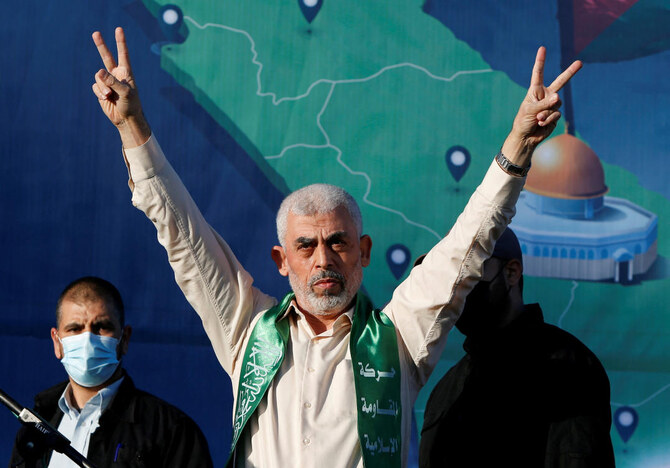

JERUSALEM/CAIRO: Pledges from Israel and its enemies Hamas and Hezbollah to keep fighting in Gaza and Lebanon dashed hopes on Friday that the death of Palestinian militant leader Yahya Sinwar might hasten an end to more than a year of escalating war in the Middle East.
Israel’s arch-foe and the militants’ main backer Iran also said Sinwar’s death would only fuel “the spirit of resistance.”
Hamas leader Sinwar, a mastermind of the Oct. 7, 2023, attack that triggered the Gaza war, was killed by Israeli soldiers in the Palestinian enclave on Wednesday.
Video showed him tossing a stick at a drone as he sat dying.
Israeli Prime Minister Benjamin Netanyahu called his killing a milestone but vowed to keep up the war, which in recent weeks expanded from fighting Hamas in Gaza into an invasion and pursuit of Hezbollah of Lebanon.
“The war, my dear ones, is not yet over,” Netanyahu told Israelis late on Thursday, saying fighting would continue until hostages held by Hamas are released.
“We have before us a great opportunity to stop the axis of evil,” he added, referring to Iran and its militant allies across the region, also in Syria, Iraq and Yemen.
Hamas said hostages would only be released with a halt of hostilities in Gaza, an Israeli withdrawal and the release of its prisoners. “The martyrdom of our brother, the leader Yahya Sinwar ... will only increase the strength and resolve of Hamas and our resistance,” it said, confirming his death in combat.
That rhetoric from the warring parties contrasted with Western leaders, including US President Joe Biden, who said Sinwar’s death offered a chance for negotiations.
US State Department spokesperson Matthew Miller said Sinwar had been refusing talks. “Can’t predict that that means whoever replaces (Sinwar) will agree to a ceasefire, but it does remove what has been in recent months the chief obstacle to getting one,” he said.
Israel’s government has rejected several attempts by its main ally the US at brokering ceasefires in both Gaza and Lebanon, pressing on with its wars. Iran has looked largely powerless to match Israel’s military might, including US arms.
One senior diplomat working in Lebanon told Reuters that hopes Sinwar’s death would end the war appeared misplaced.
“We had hoped, really throughout this, that getting rid of Sinwar would be the turning point where the wars would end ... where everyone would be ready to put their weapons down. It appears we were once again mistaken,” the diplomat said.
The conflict has caused the first direct Iranian-Israeli confrontations, including missile attacks on Israel in April and Oct. 1. Netanyahu has vowed to respond to the October attack, which caused little damage. Washington has pressed Israel to limit targets and not strike Iranian energy facilities or nuclear sites.
TRACKED AND KILLED
Sinwar, Hamas’ overall leader following the assassination of political chief Ismail Haniyeh in Tehran in July, was believed to have been hiding in the warren of tunnels Hamas has built under Gaza.
He was killed during a gunbattle on Wednesday by Israeli troops initially unaware they had caught their number one enemy, Israeli officials said.
The military released drone video of what it said was Sinwar, sitting on an armchair and covered in dust inside a destroyed building. He was tracked by the drone as he lay dying, the video showed, desperately throwing a stick.
The Oct. 7, 2023 attacks he masterminded in Israel killed some 1,200 people, according to Israeli authorities. Israel has subsequently killed more than 42,000 people, according to Palestinian officials. Its offensive has made most of Gaza’s 2.3 million people homeless, maimed tens of thousands, caused widespread hunger and destroyed hospitals and schools.
Hezbollah, which began firing rockets at Israel in support of its Hamas ally on Oct. 8, is the target of Israel’s intensifying assault on Lebanon, which has killed more than 2,000 people and displaced 1.2 million.
Israel has now killed several of Hamas’ top leaders and in a matter of weeks decapitated the Hezbollah leadership, mainly through air strikes.
The killings have dealt a blow to what anti-Israeli forces call the Axis of Resistance: a group of proxy militant groups that Iran has spent decades supporting across the region.
Iran showed no sign Sinwar’s killing would shift its support. “The spirit of resistance will be strengthened,” its mission to the United Nations said.
Hezbollah was also defiant, announcing “the transition to a new and escalating phase in the confrontation with Israel.”
The Israeli military said on Friday it had also killed Muhammad Hassin Ramal, Hezbollah’s commander of the Tayibe area in southern Lebanon.
Families of Israeli hostages said that while the killing of Sinwar was an achievement, it would not be complete while captives are still in Gaza.
Avi Marciano, father of Noa Marciano, who was killed in captivity by Hamas, told Israeli broadcaster KAN that “the monster, the one who took her from me, who had the blood of all our daughters on his hands, finally met the gates of hell.”


