
JEDDAH: Riyadh has been named Arab Environment Capital for the next two years, during a meeting of the Council of Arab Ministers Responsible for the Environment, the Saudi Press Agency reported on Thursday.
The city is making progress on its Green Riyadh initiative, part of Vision 2030, which aims to plant 7.5 million trees across the desert metropolis.
Some of the stated goals of the program include increasing the city’s level of green cover to 9 percent, up from 1.5 percent.
Green Riyadh also hopes to increase the area of green spaces per capita 16-fold, from 1.7 sq. meters to 28 sq. meters.
By 2030, the initiative also hopes to improve air quality in the capital, reducing carbon dioxide levels by 3-6 percent while increasing oxygen levels and reducing temperatures by 1.5C to 2C.
Another significant environmental initiative in the city is the under-construction King Salman Park, which is set to be the largest urban park in the world.
Riyadh takes on the mantle of Arab Environmental Capital from its previous holder, Abu Dhabi.
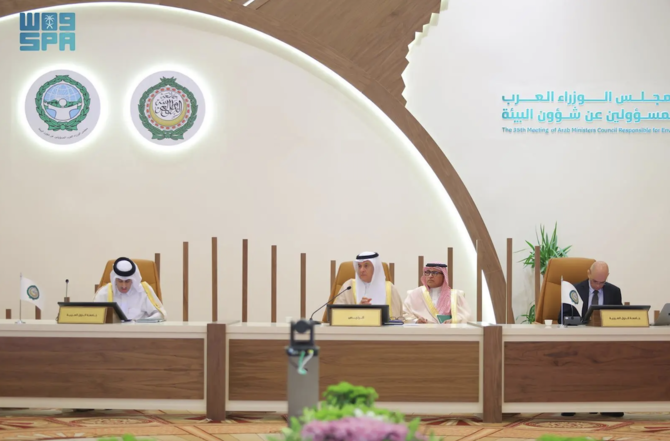
The announcement was made during the 35th session of the Council of Arab Ministers Responsible for the Environment, which took place in Jeddah from Oct. 13 to 17.
The event, organized by the Ministry of Environment, Water and Agriculture in collaboration with the Arab League, brought together environment ministers from Arab countries and representatives from regional and international organizations to discuss pressing environmental issues facing the Arab world.
During his opening speech, Saudi Minister of Environment, Water and Agriculture Abdulrahman Al-Fadhli emphasized the Kingdom’s commitment to advancing environmental goals as part of its Vision 2030.

The under-construction King Salman Park is set to be the largest urban park in the world. (Supplied)
He highlighted the significance of Saudi Arabia’s leadership in launching key initiatives such as the Saudi Green Initiative and the Middle East Green Initiative, which aim to tackle major challenges such as desertification, biodiversity loss and water scarcity.
“We are committed to combating environmental challenges and hope the outcomes of this session will help garner international support for restoring degraded lands and increasing resilience to drought,” Al-Fadhli said.
The minister further stressed the importance of collaboration among Arab nations and international organizations in achieving environmental sustainability.
This was particularly important, he said, in light of Saudi Arabia’s hosting of the 16th session of the Conference of the Parties (COP16) to the UN Convention to Combat Desertification, which will be held in Riyadh in December.
He called for active participation from all sectors, including governments, private companies and civil society, to ensure the success of the conference.
Ibrahim Thiaw, executive secretary of the UN Convention to Combat Desertification, highlighted the water crisis in the Arab region, pointing out that it holds just 2 percent of the world’s renewable water resources, making it one of the regions most affected by drought and desertification.
Thiaw urged the Arab world to invest in land restoration and build resilience against future droughts to meet the increasing food demand, which is expected to double in the coming decades.
The session concluded with a series of key resolutions including the recognition of the Saudi Green Initiative as the Outstanding Environmental Project in the public sector.
The council also urged Arab nations to join the Middle East Green Initiative and to participate actively in COP16.
Discussions covered a wide range of topics, including climate change, biodiversity and cooperation in implementing international environmental agreements.