Bangladeshi tribunal issues arrest warrant for former PM Hasina

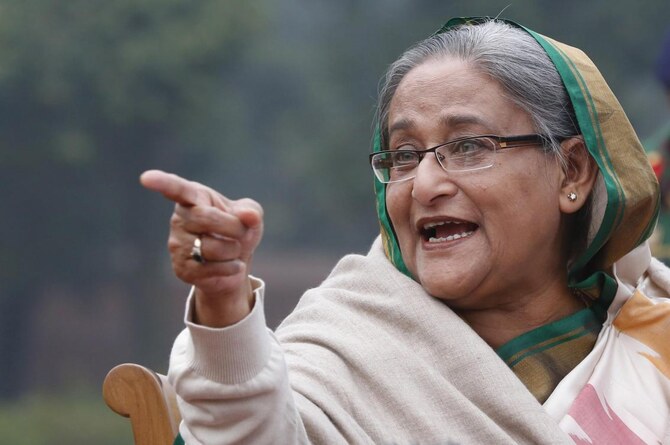
Exiled former prime minister Sheikh Hasina Sheikh Hasina has not been seen in public since fleeing Bangladesh by helicopter. (AP)
Short Url
Updated 17 October 2024
Follow

Bangladeshi tribunal issues arrest warrant for former PM Hasina

  • International Crimes Tribunal begins trial over recent student protest killings
  • Chief prosecutor says arrest warrants issued for 46 people, including Hasina’s ministers

DHAKA: A special tribunal in Dhaka issued an arrest warrant on Thursday for former Prime Minister Sheikh Hasina and began trial procedures in cases related to the killings of hundreds of people during recent student protests that forced her to step down and flee.

Initially peaceful student demonstrations started in Bangladesh in early July, triggered by the reinstatement of a quota system for the allocation of civil service positions.

Two weeks later, they were met with a violent crackdown by security forces, which according to UN estimates left more than 600 people dead. The deaths led to a nationwide uprising, which in early August forced Hasina to resign and leave for neighboring India, ending her 15 years in power.

The names of 46 people linked to the protest killings were in the arrest warrant issued by the International Crimes Tribunal, its chief prosecutor, Tajul Islam, told reporters in Dhaka.

Besides Hasina, he mentioned the names of her Awami League secretary general Obaidul Quader, former law minister Anisul Huq, former home minister Asaduzzaman Khan Kamal, and former foreign minister Hasan Mahmud.

The tribunal, he said, will hear 70 cases related to the July-August violence.

“Most of the main perpetrators are fugitives now, so we can’t disclose their names until they are arrested. But it’s confirmed that former Prime Minister Sheikh Hasina and those who were at the topmost level are accused in many of the cases,” Islam told Arab News.

“We are trying to complete the trial process of the most important crimes related to the prime accused as quickly as possible.”

Established in 2010 during Hasina’s rule, the International Crimes Tribunal is a domestic court responsible for investigating and prosecuting suspects of the 1971 genocide committed by the Pakistan Army and its local collaborators during the Bangladesh Liberation War. It also has jurisdiction over other war crimes and crimes against humanity.

“The crimes Hasina has been charged with will fall under the purview of crimes against humanity according to the ICT Act 1973, and that’s why these cases are being tried in the International Crimes Court instead of as simple murder cases in regular courts,” said Jyotirmoy Barua, advocate at the Supreme Court of Bangladesh.

“I think that is why the authorities considered that this is the best court to try her for the crimes that took place during the student-led protests ... If proven guilty, this court may award capital punishment to the accused.”


UK PM Starmer pressured by own MPs to pay reparations to Palestine for British ‘war crimes’

Updated 08 March 2026
Follow

UK PM Starmer pressured by own MPs to pay reparations to Palestine for British ‘war crimes’

  • Letter states that Britain “gave away Palestine, a land we had no right to give,” when it withdrew in 1948 following the UN-backed plan to partition the territory.

LONDON: British Prime Minister Keir Starmer is facing pressure from a group of MPs within his ruling Labour party to apologize and consider paying reparations to Palestinians for Britain’s role during the period of the British Mandate in Palestine between 1917 and 1948.

In an open letter addressed to the prime minister, nearly 20 Labour parliamentarians called on the government to acknowledge what they described as Britain’s historical responsibility for “war crimes” committed during its administration of the territory, The Telegraph newspaper reported on Saturday.

The initiative was organized by the campaign group Britain Owes Palestine, which argues that the UK must confront its past involvement in the region.

The letter states that Britain “gave away Palestine, a land we had no right to give,” when it withdrew in 1948 following the UN-backed plan to partition the territory.

The withdrawal led to the establishment of the state of Israel and the outbreak of war, events that remain central to the Israeli-Palestinian conflict.

Campaigners say Britain should recognize that its policies during the mandate period contributed to violence and displacement.

The letter alleges that British forces committed abuses including murder, torture, arbitrary detention and home demolitions while governing the territory. According to the signatories, acknowledging these actions through an apology would represent an important symbolic step.

“An apology wouldn’t solve the conflict but is an initial first step to Britain making peace with its own past,” the letter states, urging Starmer to apologise so that “we can move towards healing this open wound.”

The document seen by The Telegraph was signed by 18 Labour MPs and one peer.

Among the signatories are prominent figures from the party’s left wing, including John McDonnell and Richard Burgon, both of whom previously served in the shadow cabinet under former Labour leader Jeremy Corbyn. Several newly elected MPs from the party’s 2024 intake also backed the appeal.

Britain Owes Palestine was launched in 2025 and is campaigning for the UK government to acknowledge what it calls a “century of oppression.”

The group submitted a 400-page legal petition to the government in September arguing that Britain breached international law during its administration of Palestine.

The government has yet to formally respond to the petition and could face legal action, including a potential judicial review in the High Court, if it continues to decline engagement with the claims.

Starmer’s government recognized a Palestinian state in September to increase pressure on Israel to agree to a ceasefire in Gaza.

A ceasefire was reached the following month, although critics, including the opposition Conservatives, argued that the move risked rewarding militant group Hamas.

US Secretary of State Marco Rubio also criticised the recognition decision, saying it would have “no impact whatsoever” on achieving a two-state solution to the Israeli-Palestinian conflict.