

Advanced air mobility to revolutionize Saudi transport, tourism, healthcare: GACA president 

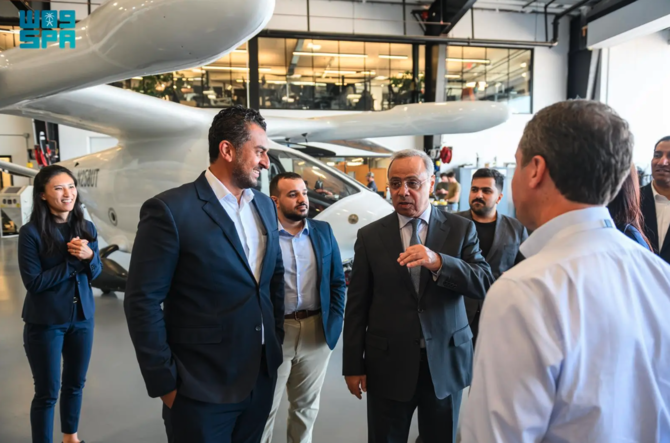
General Authority of Civil Aviation President Abdulaziz bin Abdullah Al-Duailej toured a BETA Technologies Co.'s factory in South Burlington, Vermont as part of his trip to North America. SPA
Short Url
Updated 12 September 2024
Follow

Advanced air mobility to revolutionize Saudi transport, tourism, healthcare: GACA president 

  • Abdulaziz Al-Duailej said the field is vital for addressing climate change
  • In 2023, the industry’s market value reached $9.7 billion, with projections indicating a climb to $50 billion by 2032

RIYADH: Advanced air mobility is on track to transform the transportation, tourism, and health care systems in Saudi Arabia and across the world, a top aviation official has claimed.

Abdulaziz Al-Duailej, president of the General Authority of Civil Aviation, said that the Kingdom is committed to a global leadership role in the field, according to a statement

He was speaking during the International Civil Aviation Organization Advanced Air Mobility Symposium taking place in Montreal, Canada, from Sept. 9 to 12. 

In 2023, the industry’s market value reached $9.7 billion, with projections forecasting a climb to $50 billion by 2032. This corresponds with over 200 cities in 57 countries planning to implement this technology, necessitating a unified global approach in regulation, technology, and investment.

“This field is vital for addressing climate change, offering low-emission alternatives that can significantly reduce carbon footprints,” Al-Duailej said.

“International collaboration is crucial for advancing this technology. It requires coordination between industries and governments to ensure safety and drive innovation,” he added. “In the Kingdom, we are accelerating these technologies, as seen with the air taxi trials in NEOM and during last year’s Hajj season.”

The GACA president went on to say: “Today, we’re on the brink of a remarkable future in innovation and creativity. The choices we make now will shape the world for generations.”

During his visit, Al-Duailej toured a BETA Technologies factory in South Burlington, Vermont, along with a delegation of officials from GACA, the Ministry of Investment, the Public Investment Fund, and the Ministry of Industry and Mineral Resources, as well as representatives from local private-sector companies like NEOM and Saudia Aerospace Engineering Industries.

BETA Technologies specializes in the production of electric, vertical take-off and landing aircraft.

The delegation inspected the production lines for advanced air mobility technologies, the latest infrastructure used by the factory, and operating charging stations. 

They also visited the firm’s research and development centers, where they were briefed on the latest enabling technologies used in carbon-free manufacturing and production, as well as the engines that rely on charging cubes, which reduce operating costs and carbon emissions. These include the vertical take-off and landing aircraft and the fully electric models for vertical and conventional take-off and landing.

The GACA delegation’s visit is part of the Kingdom’s endeavors to reaffirm its commitment to enabling advanced air mobility technologies and sustainable innovations as outlined in the advanced air mobility roadmap launched by the authority earlier this year. 

It also aims to strengthen cooperation and build partnerships with leading companies in the civil aviation sector, explore opportunities for exchanging expertise in the field, pursue the transfer and localization of advanced aviation technologies, and enhance research, development, and innovation cooperation.


Saudi investment hits 32% of GDP, non-oil fixed capital reaches 40%, minister says

Updated 05 January 2026
Follow

Saudi investment hits 32% of GDP, non-oil fixed capital reaches 40%, minister says

RIYADH: Saudi Arabia’s investment now accounts for 32 percent of gross domestic product, with non-oil fixed capital at 40 percent, according to the minister responsible for portfolio.

Speaking during his visit to the Shoura Council, Khalid Al-Falih said that foreign direct investment is expected to grow fivefold, signaling strong Vision 2030 progress.

“Regarding cumulative performance, the Kingdom has exceeded all expectations, achieving high levels of investment,” Al-Falih said, according to a video posted on Al-Ekhbariya’s X account focused on economic matters.

The minister added: “Today, investment accounts for 32 percent of the total GDP. In terms of non-oil GDP, fixed capital represents 40 percent, compared with 41 percent in China, the highest globally.”

If we take the non-oil GDP, he said, fixed capital will make 40 percent. “China is the largest globally with 41 percent. So, we will rank second if we compare it to the non-oil economy and fourth when measured against total GDP,” Al-Falih said.

He emphasized that the Kingdom offers an investment-attractive environment, noting that when focusing on foreign direct investment rather than overall investment, Saudi Arabia ranks among the world’s highest.

The minister of investment added that FDI is expected to grow fivefold by the end of 2025, though these data require confirmation, stressing that this is “a big indicator for the success of Saudi Vision 2030.”

During his address to the session, Al-Falih emphasized that Saudi Vision 2030 prioritizes economic diversification and reducing dependence on oil, through boosting the private sector’s contribution to inclusive economic development, supporting national sectoral priorities, and driving growth in the Kingdom’s GDP.

He highlighted key initiatives enabling the private sector, including the establishment of the Ministry of Investment and the Saudi Investment Promotion Authority, the launch of the “Shareek” program, the development of the National Investment Strategy, and linking all stakeholders in the investment ecosystem.

“The Cabinet’s adoption of the National Investment Strategy, launched by Crown Prince in 2021 and implemented in 2022 as a comprehensive national framework, has played a major role in positioning investment as a driver of economic growth,” he said.

Al-Falih revealed that the ministry has identified more than 2,000 investment opportunities worth over SR1 trillion ($267 billion), noting that 346 of these opportunities have been converted into closed deals valued at over SR231 billion through the “Invest Saudi” platform.

He also highlighted the success of the regional headquarters attraction program, with licenses issued to more than 700 global companies by the end of 2025, surpassing the 2030 target of 500 companies, across diverse sectors that reinforce Saudi Arabia’s role as a regional business hub.

The minister revealed that active investment licenses have grown tenfold, rising from 6,000 in 2019 to 62,000 by the end of 2025, highlighting the role of companies in creating over one million jobs, including numerous positions for Saudi nationals.

Al-Falih noted the Kingdom’s success in attracting 20 of the world’s top 30 banks, as part of efforts to strengthen the presence of leading asset managers and international banks in support of the Saudi banking sector.

He also discussed reforms to enhance the business environment, such as the Civil Transactions Law, Companies Law, and the updated Investment Law issued in mid-2024, which contributed to Saudi Arabia moving up 15 places in the global competitiveness ranking.

The minister also announced the update of the National Investment Strategy in 2025, focusing on quality, productivity, and directing investments toward sectors with the highest economic impact, while developing financing solutions for SMEs.