Saudi crown prince in Brussels as EU holds first summit with GCC

1 / 4
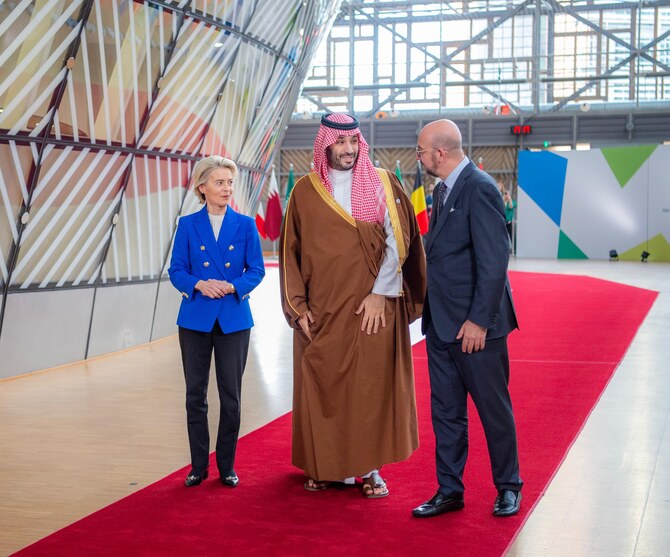
Saudi Crown Prince Mohammed bin Salman received at the summit by Ursula von der Leyen and Charles Michel. (SPA)
2 / 4
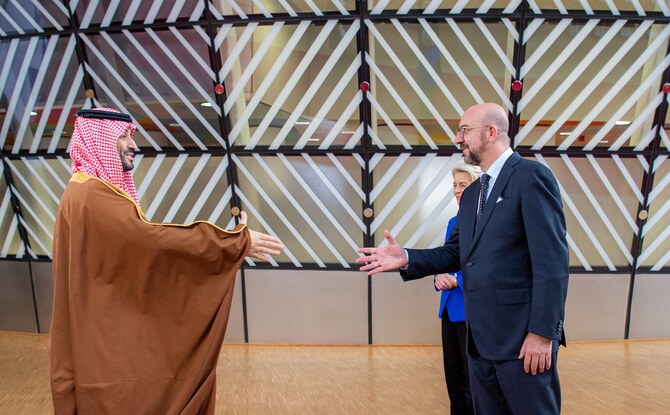
Saudi Crown Prince Mohammed bin Salman received at the summit by Ursula von der Leyen and Charles Michel. (SPA)
3 / 4
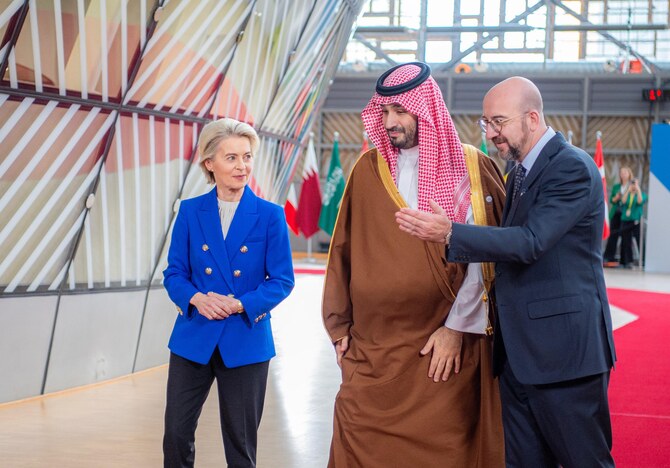
Saudi Crown Prince Mohammed bin Salman received at the summit by Ursula von der Leyen and Charles Michel. (SPA)
4 / 4
Saudi Crown Prince Mohammed bin Salman received at the summit by Ursula von der Leyen and Charles Michel. (SPA)
Short Url
Updated 16 October 2024
Follow

Saudi crown prince in Brussels as EU holds first summit with GCC

  • EU aims to make the relationship with six Gulf states more strategic
  • Prince Mohammed met with EU, French, Spanish and Greek leaders on sidelines of event

BRUSSELS: The European Union opened its first summit with the Gulf states on Wednesday in Brussels.

Saudi Arabia’s Crown Prince Mohammed bin Salman was received by President of the EU Commission Ursula von der Leyen and President of the EU Council Charles Michel on his arrival at the summit.

Prince Mohammed held a meeting with Von der Leyen on the sidelines of the event later on Wednesday, Saudi Press Agency reported.

The crown prince also held meetings with French president Emmanuel Macron, Spanish prime minister Pedro Sanchez and Greek premier Kyriakos Mitsotakis during the event.

Opening the summit, Michel affirmed the bloc's readiness to build a strategic partnership with the GCC countries, noting that the first summit held at the level of heads of state and government since the launch of official relations between the two sides in 1989, was a message of unity and hope.

He said that hope was needed more than ever considering that global stability is now threatened by the situation in the Middle East region.

Since Moscow’s invasion of Ukraine, the 27-member EU has reached out to other regional blocs, holding its first summit with ASEAN countries and its first for eight years with the CELAC community of Caribbean and Latin American countries.

Its aim in meeting the six Arab states in the Gulf Cooperation Council is to make the relationship more strategic, recognizing those countries’ influence particularly in conflicts in Ukraine and the Middle East.

“The Gulf region is at the crossroads between Asia, Europe and Africa. It plays a very important role in many of the crisis of today,” a senior EU official said.

An EU partnership with Bahrain, Kuwait, Oman, Qatar, Saudi Arabia and the United Arab Emirates would cover trade and investment, renewable energy, regional security and citizen issues such as visas.

Though Brussels wants the GCC partners to agree strong language on Russia’s military assault on Ukraine, it is not expecting them to fully adopt its position in blaming Moscow. The two blocs are arguably closer on the Middle East, where the EU is calling for a ceasefire in Gaza and broader de-escalation.

One request from the Gulf side is visa liberalization. Currently, no EU visas are required for short stays for UAE citizens, while those of other Gulf nations need to secure a visa valid for five years.

* With Reuters


Budget impasse shuts down US Department of Homeland Security

Updated 4 sec ago
Follow

Budget impasse shuts down US Department of Homeland Security

  • Thousands of government workers, from airport security agents to disaster relief officials, will either be furloughed or forced to work without pay
WASHINGTON: The Department of Homeland Security entered a partial shutdown Saturday as US lawmakers fight over funding the agency overseeing much of President Donald Trump’s immigration crackdown.
Thousands of government workers, from airport security agents to disaster relief officials, will either be furloughed or forced to work without pay until funding is agreed upon by Congress.
At the center of the budget dispute is the department’s Immigration and Customs Enforcement (ICE), whose agents killed two US citizens amid sweeping raids and mass protests in Minneapolis.
Democrats oppose any new funding for DHS until major changes are implemented over how ICE conducts its operations.
In particular, they have demanded curtailed patrols, a ban on ICE agents wearing face masks during operations and the requirement that they obtain a judicial warrant to enter private property.
“Donald Trump and Republicans have decided that they have zero interest in getting ICE under control,” House Minority Leader Hakeem Jeffries said Friday.
“Dramatic changes are needed,” Jeffries told a news conference. “Absent that, Republicans have decided to shut down parts of the federal government.”
White House Press Secretary Karoline Leavitt put the blame on the opposition, telling Fox News that “Democrats are barreling our government toward another shutdown for political and partisan reasons.”
But while DHS faces a shutdown, ICE itself will remain operational, under funds approved in last year’s government spending bill.
Senator John Fetterman pushed against his fellow Democrats, saying: “This shutdown literally has zero impact on ICE.”
The primary impact would land on other agencies, including the Federal Emergency Management Agency (FEMA), which oversees emergency response to natural disasters.
The Transportation Security Administration, which runs airport safety, warned on X that a prolonged shutdown could result in longer wait times and canceled flights.
Negotiations stalled
The shutdown would be the third of Trump’s second term, including a record 43-day government closure last October and November.
The government just reopened from a smaller, four-day partial shutdown earlier this month, also over DHS funding.
Even if all 53 Republican senators vote to fund DHS, Senate rules require support from 60 of the body’s 100 members to advance the budget bill, meaning several Democrats would need to get on board.
In response to the Democrats’ demands, the White House said it was ready to negotiate over immigration enforcement policy.
Senate Majority Leader John Thune called it “an extremely serious offer,” but warned Democrats are “never going to get their full wish list.”
Some concessions were made during the previous shutdown amid Democratic pressure and national outcry after federal agents shot and killed Renee Good, a mother of three, and Alex Pretti, a nurse who worked with military veterans, in Minneapolis last month.
Homeland Security Secretary Kristi Noem said federal agents in the city would wear body cameras “effective immediately” in a move that would be later “expanded nationwide.”
The Senate went into recess for a week starting Thursday, but senators could be called back to Washington in case of a rapid leap in negotiations.
For the moment, however, talks between the White House and Democrats appear to be at a standstill.