


JEDDAH: Saudi-Italian mining relations are set to strengthen following meetings between senior officials in Rome focused on sustainable solutions, clean energy, and attracting investment to the Kingdom’s expanding exploration sector.
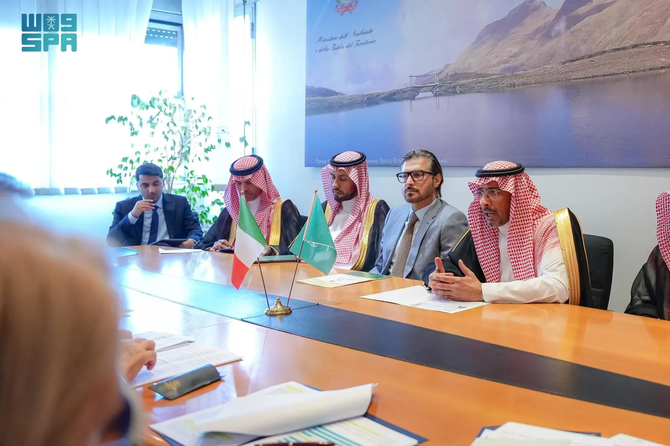
Saudi Minister of Industry and Mineral Resources Bandar Alkhorayef commenced his three-day visit on Oct. 14, meeting with Italy’s Minister of Environment and Energy Security Gilberto Pichetto Fratin.
The meeting, attended by Prince Faisal bin Sattam bin Abdulaziz, Saudi ambassador to Italy, and Saleh Al-Sulami, CEO of the National Industrial Development Center, emphasized the importance of collaborative development and the strategic partnership between the two nations across various sectors, the Saudi Press Agency reported.
The official trip aims to bolster industrial and mining cooperation and explore joint opportunities aligned with the Kingdom’s National Industrial Strategy.
This comes on the back of Saudi Arabia’s increasing non-oil exports to Italy, which reached SR2.8 billion ($747 million) in 2023, while total non-oil imports from Italy amounted to SR21.8 billion.
In a post on his X account, Alkhorayef said: “At the beginning of my visit to Italy, I met the minister of environment and energy security, and we talked about the important partnership between Saudi Arabia and Italy in various sectors.”
He underscored the “mutual desire” to strengthen collaboration for the benefit of both countries.
During the talks, Alkhorayef outlined the promising prospects within the Kingdom’s mining sector, detailing all stages from exploration to processing. He highlighted Saudi Arabia’s untapped mineral resources, estimated at approximately $2.5 trillion, and emphasized the availability of 80 years’ worth of geological data to support informed investment decisions.
The minister also explored opportunities to enhance collaboration, share expertise, and attract joint investments in renewable energy, stressing the need for improved supply chain integration to meet local, regional, and global demands. He encouraged Italian companies to expand their operations in the Kingdom, urging the private sector to leverage significant developmental projects.
Alkhorayef extended an invitation to Fratin to attend the International Mining Conference in Riyadh in early 2025, anticipating substantial participation from Italy given its crucial role in the global mining sector.
The Italian Ministry of Environment and Energy Security expressed its commitment to supporting the transition to a low-carbon economy while promoting sustainable mineral resource management, SPA reported.
On the same day, Alkhorayef engaged in bilateral meetings with major Italian and global companies, focusing on localizing electric vehicle manufacturing opportunities, enhancing cooperation in the aviation and shipbuilding sectors, and exploring smart manufacturing solutions.
Discussions highlighted the unique opportunities presented by 12 strategic sectors central to the National Industrial Strategy and incentives designed to attract global investors, facilitating value creation for the national economy.
In his meeting with the founder and CEO of Swiss electric vehicle manufacturer Piech, Alkhorayef discussed the potential for transferring advanced automotive manufacturing technologies to the Kingdom.
He emphasized the country’s commitment to nationalizing this industry, referencing the Lucid project, which aims to produce 155,000 electric vehicles annually by 2027, and the Ceer company, targeting 170,000 vehicles by 2034.
The minister outlined Arabian Tiger Holding Co.’s plans to localize aviation manufacturing technologies in the Kingdom during discussions with its CEO, focusing on establishing a facility for aircraft component production after acquiring Piaggio Aerospace, a leader in commercial and drone aircraft.
Alkhorayef also met with officials from Fincantieri, an Italian shipbuilding firm, to explore collaboration in the maritime industry, addressing all stages of the value chain from design to delivery.
In a meeting with the international market director at AlmavivA, he discussed the latest automation solutions for industrial facilities aimed at enhancing productivity and promoting smart manufacturing cooperation between the Kingdom and Italy, with a particular focus on integrating robotics into manufacturing processes.
Alkhorayef also engaged in talks with Yousef Al-Mimni, vice chairman of the Saudi-Italian Business Council, commending the Council’s role in strengthening trade and economic ties between the Kingdom and Italy.
He encouraged Italian private sector companies to invest in promising sectors in Saudi Arabia, particularly in industrial and mining.


