Philippines seeks to enhance energy security with new Saudi cooperation

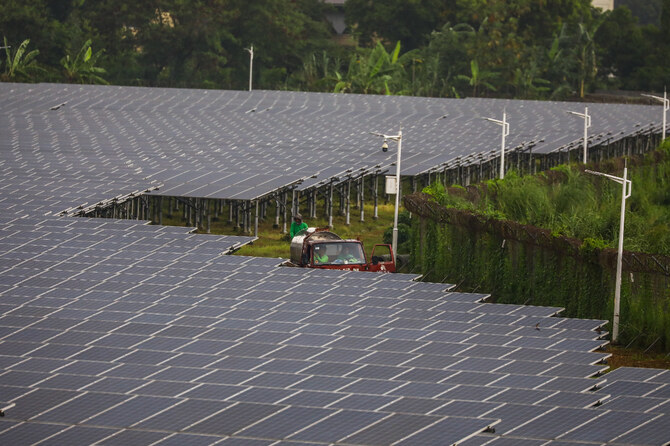
Workers in a utility truck ride past solar panels at a solar energy farm in Valenzuela, suburban Manila. (AFP/File)
Short Url
Updated 14 October 2024
Follow

Philippines seeks to enhance energy security with new Saudi cooperation

  • Under national energy plan, Manila wants to increase renewable sources to 50 percent by 2040 
  • Saudi-Philippine cooperation can also explore tech, solutions related to climate change mitigation 

MANILA: The Philippines wants to expand its international energy partnerships and improve energy security with a new cooperation with Saudi Arabia, its Department of Energy said on Monday ahead of an official trip to the Kingdom.

Manila has been exploring clean and sustainable options to generate power as the country regularly suffers outages and faces high tariffs. Coal remains the main source of electricity in the Southeast Asian nation, accounting for more than half of its power generation. 

A Philippine energy mission was headed to Saudi Arabia on Monday for a two-day trip “aimed at enhancing energy security, driving economic growth, and fostering sustainable development,” the DoE said in a statement. 

“A major highlight of the mission is the signing of a memorandum of understanding with the Ministry of Energy of the KSA.” 

The latest mission follows President Ferdinand Marcos Jr.’s trip to Riyadh last October, during which a $4.26 billion investment agreement was signed with Saudi business leaders. 

At the time, some Saudi state-owned enterprises had expressed interest in investing in the Philippine energy sector, the DoE said. 

The preliminary agreement will provide “a framework for cooperation on key areas,” including renewable energy and natural gas, as well as relevant technologies and solutions related to climate change mitigation. 

Under the Philippine Energy Plan, the government aims to increase the share of renewable sources in the energy mix from 22 percent currently to 50 percent by 2040. 

Philippine authorities expect the country’s power demand to increase almost fourfold from 2020 to 2040, especially as it remains dependent on imported fossil fuels and has insufficient renewables.

“Partnerships with Saudi Arabia extend beyond addressing the current energy needs,” the energy department said, adding that the two countries can explore possibilities for joint research and development projects, policy exchange, and capacity building in areas such as carbon capture, use and storage, and hydrogen.

“As global efforts to transition to cleaner and more sustainable energy sources intensify, the Philippines and Saudi Arabia can cooperate in the development and deployment of low-carbon technologies.”


Australia to deploy long-range reconnaissance plane to Gulf

Updated 59 min 33 sec ago
Follow

Australia to deploy long-range reconnaissance plane to Gulf

  • The government says there are about 115,000 Australian nationals across the Middle East, of whom about 2,600 have returned home.

SYDNEY: Australia will deploy a long-range military reconnaissance plane to the Gulf to protect civilians, Prime Minister Anthony Albanese said Tuesday.
An E-7A Wedgetail aircraft and supporting defense force personnel will be sent for an initial period of four weeks to help “protect and secure the airspace above the Gulf,” Albanese told a news conference.
Australia also plans to provide advanced, medium-range air-to-air missiles to the United Arab Emirates “in response to a request,” the prime minister said.
The UAE, in which there are an estimated 24,000 Australians, has shot down more than 1,500 rockets and drones fired by Iran in reprisal following US-Israeli strikes, he said.
Albanese said he decided to send the advanced radar surveillance plane to the Gulf following a discussion with UAE President Mohammed bin Zayed Al Nahyan.
“The first priority of my government is, and always will be, to keep Australians safe,” the prime minister said.
“Helping Australians means also helping the UAE and other Gulf nations to defend themselves against what are unprovoked attacks,” he added.
“My government has been clear that we’re not taking offensive action against Iran, and we’ve been clear that we are not deploying Australian troops on the ground in Iran.”
The government says there are about 115,000 Australian nationals across the Middle East, of whom about 2,600 have returned home.
“Significant challenges remain, and further work is underway to support those still seeking to leave,” Albanese said.
Australia said last week it had deployed a heavy transport plane and a fuel transport plane to the Middle East as part of plans to get its citizens out of the region.
Canberra has been careful to make clear that its forces are not engaging in offensive operations against Iran.
On Friday, Albanese revealed that Australian military personnel were aboard an American submarine that sank an Iranian navy ship off Sri Lanka.
The personnel were on the submarine as part of training arrangements under AUKUS, a multi-decade defense pact with Britain and the United States, he said, stressing that they did not take part in the attack.