

Caves in Saudi Arabia’s northern region are windows to history, gates to adventure

1 / 3
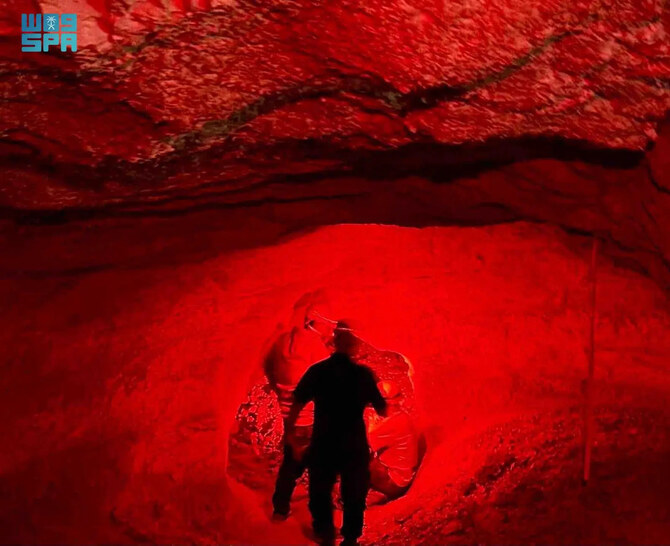
Caves and sinkholes offer a glimpse into the past, often revealing the secrets of humanity and unique geological formations. (SPA)
2 / 3
The rock structures, often featuring stalactites and stalagmites, create breathtaking views. (SPA)
3 / 3
Caves and sinkholes offer a glimpse into the past, often revealing the secrets of humanity and unique geological formations. (SPA)
Short Url
Updated 14 October 2024
Follow

Caves in Saudi Arabia’s northern region are windows to history, gates to adventure

  • Caves and sinkholes offer glimpse into the past with their unique geological formations
  • Kingdom’s 1,826 caves have underground tunnels formed naturally in dry limestone areas

Riyadh: At least 542 caves and sinkholes discovered in Saudi Arabia’s Northern Borders region offer more destinations for the increasing number of tourists, adventurers and researchers interested in these structures, the Saudi Press Agency reported on Sunday.

Of varying shapes, these structures offer a glimpse into the past with their unique geological formations, said the report, quoting Burjas Al-Falih, a speleologist and a member of the Afaq Society for Astronomy.

Among the most famous caves in the Kingdom are the Jabal Qarah in Hufuf, Dahl Heet in Riyadh city, and Shuwaimis in Hail region.


Caves and sinkholes offer a glimpse into the past, often revealing the secrets of humanity and unique geological formations. (SPA)

Saudi Arabia’s National Center for Wildlife has recently begun examining these structures in the Northern Borders region as a part of its Caves Exploration Program, which began in 2022.

According to the center, there are at least 1,826 caves in the Kingdom.

These consist of underground passages and tunnels formed by natural processes in dry limestone areas — evidence of a historical era that experienced prolonged rainy conditions.

The breathtaking rock structures often feature stalactites and stalagmites.


The rock structures, often featuring stalactites and stalagmites, create breathtaking views. (SPA)

Al-Falih emphasized the importance of documenting cave explorations. By classifying locations, types and access, adventurers can explore these sites responsibly, he said.

Organizing official trips to these locations can also help ensure their protection, he added.

In an earlier SPA report, Dr. Mohammed Ali Qurban, the chief executive officer of the NCW, explained that the discoveries in the caves hold significant environmental value for the Kingdom.

“The cave ecosystems serve as a historical museum, providing evidence of the biological diversity that has existed in the Kingdom throughout various historical eras, as well as the spatial, environmental, and climatic changes in the Arabian Peninsula,” he was quoted as saying.

He said the center’s earlier discovery of Arabian cheetah mummies in a cave — with some skeletons estimated to be over 4,000 years old — provided the first evidence of the species’ presence in the Kingdom.

Researchers from the center had also discovered rare bats and the remains of several extinct animals, he said.

The cave ecosystem is one of the rarest and most important of its kind in the world, recognized as a part of a nation’s natural heritage by UNESCO.


18,000 personnel mobilized in Makkah, Madinah as itikaf begins

Updated 09 March 2026
Follow

18,000 personnel mobilized in Makkah, Madinah as itikaf begins

  • Worshipers who completed registration and obtained permits have started performing the ritual of itikaf at the Prophet’s Mosque
  • General Authority for the Care of the Affairs of the Grand Mosque and the Prophet’s Mosque has provided a range of services

JEDDAH: More than 18,000 personnel and nearly 6,000 vehicles and pieces of equipment have been deployed across Makkah and Madinah as authorities intensify preparations for the final 10 days of Ramadan, while worshipers began observing itikaf at the Prophet’s Mosque.

Worshipers who completed registration and obtained permits have started performing the ritual of itikaf at the Prophet’s Mosque, according to the Saudi Press Agency.

The General Authority for the Care of the Affairs of the Grand Mosque and the Prophet’s Mosque has provided a range of services, including guidance, organization, healthcare, translation, hospitality and essential supplies to ensure a comfortable and spiritually enriching experience.

Field teams have also been deployed to manage entry and exit points, and oversee service delivery so worshippers can dedicate themselves fully to prayer and reflection.

Meanwhile, the Madinah Municipality has intensified efforts to provide services to visitors at the Prophet’s Mosque and other major mosques across the city.

More than 5,700 personnel, 1,230 operational vehicles and pieces of equipment have been mobilized to support municipal services during the busy period.

The operational plan focuses on improving facility cleaning and environmental sanitation, strengthening infrastructure services, and intensifying inspections of commercial and food establishments to ensure compliance with health standards and product safety.

Electronic platforms have also been activated to enhance monitoring and speed up responses to municipal service reports.

Authorities are also conducting field campaigns to combat commercial fraud and regulate street vendors as visitor numbers rise in the city.

Through these plans, the Ministry of Municipalities and Housing has raised municipal readiness to provide services for Umrah performers and visitors, and enable them to perform their rituals in a safe and organized environment.

In Makkah, the municipality has deployed more than 13,000 personnel working round the clock to support cleaning and operational activities in the central area, and around the Grand Mosque.

Five parking areas with a capacity of more than 42,000 vehicles have also been prepared to ease access to the Grand Mosque and reduce congestion.