

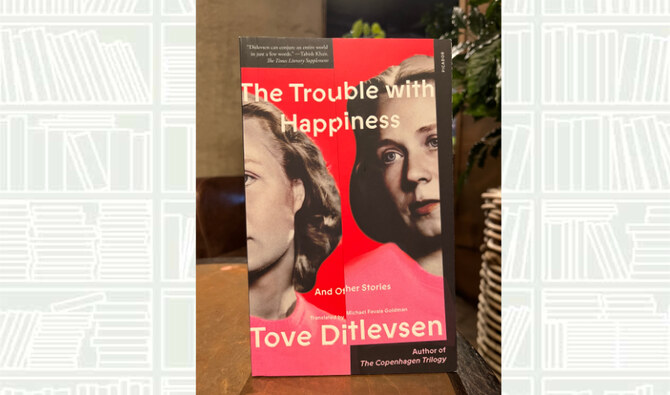
What We Are Reading Today: ‘The Trouble with Happiness’

Photo/Supplied
Short Url
Updated 13 October 2024
Follow

What We Are Reading Today: ‘The Trouble with Happiness’

  • Each story delves into the inner lives of regular people

Author: Tove Ditlevsen

I don’t often read fiction; real-life stories are much more interesting and usually compelling enough. However, Danish author Tove Ditlevsen’s work intrigued me. On a recent trip to Denmark, I picked up a copy of “The Trouble with Happiness and Other Stories” and spiraled into her dark world — in the most enlightening way.

A collection of short stories, each with its own moody and simple sensibility that oozes authenticity, the book is small but mighty. Known for her deeply psychological and slightly melancholic writing style, Ditlevsen brings us along for the lonely, disappointing, and often fleeting moments of happiness.

The book is aptly named.

Each story delves into the inner lives of regular people. Her chosen narratives of everyday women are a powerful exploration of human vulnerability and longing for connection. The writing is witty and drenched in emotional honesty. It is quite depressing at times, as the author indeed struggled with depression during her 59 years of life, before her death in 1976.

The version I read was translated by Michael Favala Goldman. Although I was unable to read it in its original form, this translated version allowed me to get a sense of who Ditlevsen was. Many of the stories in this book were published previously, in the 1950s and 60s, albeit in slightly different iterations, in prestigious publications such as The New Yorker, Apple Valley Review and Hunger Mountain Review. But to have them contained in one book was powerful, and I had a hard time putting it down.

In “The Cat,” Ditlevsen plainly writes about ordinary people and places but infuses the mundane with her poetic sense: “They sat across from one another on the train, and there was nothing special about either of them.”

She continues: “They weren’t the kind of people your eyes would land on if you tired of staring at the usual scenery, which appears to rush toward the train from a distance and then stand still for a second, creating a calm picture of soft green curves and little houses and gardens, whose leaves vibrate and turn grayish in the smoke streaming back from the train, like a long billowing pennant.”

The stories are short and sharp, cutting you in a way a knife cannot.


Decoding villains at an Emirates LitFest panel in Dubai

Updated 25 January 2026
Follow

Decoding villains at an Emirates LitFest panel in Dubai

DUBAI: At this year’s Emirates Airline Festival of Literature in Dubai, a panel on Saturday titled “The Monster Next Door,” moderated by Shane McGinley, posed a question for the ages: Are villains born or made?

Novelists Annabel Kantaria, Louise Candlish and Ruth Ware, joined by a packed audience, dissected the craft of creating morally ambiguous characters alongside the social science that informs them. “A pure villain,” said Ware, “is chilling to construct … The remorselessness unsettles you — How do you build someone who cannot imagine another’s pain?”

Candlish described character-building as a gradual process of “layering over several edits” until a figure feels human. “You have to build the flesh on the bone or they will remain caricatures,” she added.

The debate moved quickly to the nature-versus-nurture debate. “Do you believe that people are born evil?” asked McGinley, prompting both laughter and loud sighs.

Candlish confessed a failed attempt to write a Tom Ripley–style antihero: “I spent the whole time coming up with reasons why my characters do this … It wasn’t really their fault,” she said, explaining that even when she tried to excise conscience, her character kept expressing “moral scruples” and second thoughts.

“You inevitably fold parts of yourself into your creations,” said Ware. “The spark that makes it come alive is often the little bit of you in there.”

Panelists likened character creation to Frankenstein work. “You take the irritating habit of that co‑worker, the weird couple you saw in a restaurant, bits of friends and enemies, and stitch them together,” said Ware.

But real-world perspective reframed the literary exercise in stark terms. Kantaria recounted teaching a prison writing class and quoting the facility director, who told her, “It’s not full of monsters. It’s normal people who made a bad decision.” She recalled being struck that many inmates were “one silly decision” away from the crimes that put them behind bars. “Any one of us could be one decision away from jail time,” she said.

The panelists also turned to scientific findings through the discussion. Ware cited infant studies showing babies prefer helpers to hinderers in puppet shows, suggesting “we are born with a natural propensity to be attracted to good.”

Candlish referenced twin studies and research on narrative: People who can form a coherent story about trauma often “have much better outcomes,” she explained.

“Both things will end up being super, super neat,” she said of genes and upbringing, before turning to the redemptive power of storytelling: “When we can make sense of what happened to us, we cope better.”

As the session closed, McGinley steered the panel away from tidy answers. Villainy, the authors agreed, is rarely the product of an immutable core; more often, it is assembled from ordinary impulses, missteps and circumstances. For writers like Kantaria, Candlish and Ware, the task is not to excuse cruelty but “to understand the fragile architecture that holds it together,” and to ask readers to inhabit uncomfortable but necessary perspectives.