SCO summit: Authorities issue three-day traffic diversion plan for Islamabad, Rawalpindi

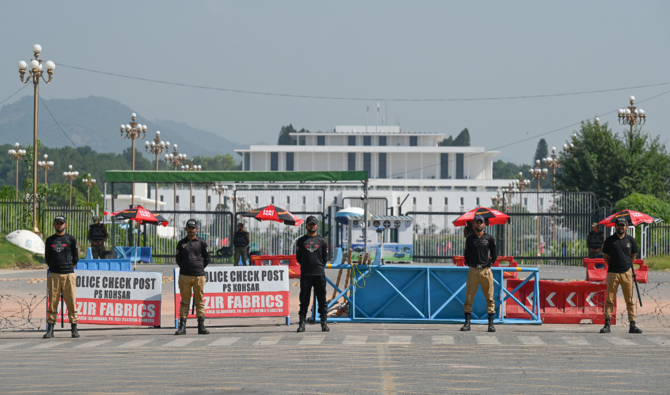
Security personnel stand guard in front of the Presidential Palace ahead of a Shanghai Cooperation Organisation (SCO) summit in Islamabad on October 13, 2024. (AFP)
Short Url
Updated 13 October 2024
Follow

SCO summit: Authorities issue three-day traffic diversion plan for Islamabad, Rawalpindi

  • Pakistan is hosting the SCO Council of Heads of Government summit in Islamabad on Oct. 15-16 under its rotating chairmanship of the organization
  • The summit comes amid heightened security concerns due to a rise in militant attacks as well as a protest call by jailed ex-PM Imran Khan’s party

ISLAMABAD: The Islamabad police on Sunday issued a traffic plan for the twin cities of Islamabad and Rawalpindi from Oct. 14 till Oct. 16 on account of a meeting of representatives of the Shanghai Cooperation Organization (SCO) member states.
Pakistan is hosting the SCO Council of Heads of Government summit in Islamabad on Oct. 15-16 under its rotating chairmanship of the organization, with the participants expected to discuss issues related to trade, economic cooperation, security, and regional stability.
The summit comes amid heightened security concerns due to a rise in militant attacks across the South Asian country as well as a call for protest by jailed former prime minister Imran Khan’s Pakistan Tehreek-e-Insaf (PTI) party over a denial by authorities to visit him.
In a statement on Sunday, the Islamabad traffic police advised residents of the twin cities and travelers to take alternate routes to avoid any inconvenience, saying more than 1,100 traffic officials will be on duty for the SCO summit from Oct. 14 till Oct. 16.
“People traveling from Peshawar to Rawat via GT Road should go through Taxila, Motorway, Chakri Interchange and Chak Baili Road,” they said in the statement.
“Those traveling from Lahore to Peshawar via GT Road should take the Rawat, Chak Baili Road, Chakri Interchange, Motorway and Taxila route.”
People traveling from Islamabad to Rawalpindi via Margalla Road were asked to use 9th Avenue as traffic from Faisal Avenue to Zero Point would be diverted toward 9th Avenue, according to the statement.
Those who wish to travel from Bharakahu to Rawalpindi may go via Qur’ang Road, Bani Gala and Lehtrar Road, while those coming to Islamabad from Rawalpindi may use Murree Road from Saddar.
“[Islamabad] Expressway will remain closed for all traffic from Zero Point, Faisal Avenue till Koral Chowk,” the statement read. “Those coming to Faizabad via Col. Sher Khan Shaheed Road should use Stadium Road from the 9th Avenue signal.”
For heavy traffic vehicles en route to Lahore from Peshawar, the traffic police urged drivers to take the Taxila, Motorway, Tarnol Railway Crossing, Fateh Jung Road Interchange and Motorway.
Similarly, heavy traffic coming to the twin cities from Lahore would be redirected through Chak Baili Road, Chakri Interchange and Motorway.
In the weeks leading up to the summit, Pakistan’s authorities have cracked down hard on dissent, banning an ethnic nationalist movement and introducing new laws that restrict protest in the capital. They have also arrested hundreds of supporters of Khan who attempted to march on Islamabad earlier this month. Islamabad has authorized the deployment of troops on the streets for the duration of the summit.
The SCO is sometimes touted as an alternative to the Western-dominated NATO military alliance. While the bloc has a mandate to discuss security, the Islamabad summit is due to focus on trade, humanitarian and cultural issues.


Firefighter killed in Karachi blaze leaves family to mourn second generation lost in line of duty

Updated 4 sec ago
Follow

Firefighter killed in Karachi blaze leaves family to mourn second generation lost in line of duty

  • Father of fallen firefighter also died in service years earlier, leaving family to mourn second line-of-duty death
  • Chronic shortages of fire engines, protective gear and trained staff strain Karachi’s emergency response

KARACHI: When flames tore through Karachi’s Gul Plaza last weekend, 29-year-old firefighter Furqan Shaukat moved deeper into the burning building as its structure weakened, responding to calls for help from inside moments before the plaza collapsed.

The category-three fire gutted around 1,200 shops in one of Karachi’s busiest commercial districts, killed scores of people and left dozens missing. It also exposed, once again, the extreme risks faced by firefighters in Pakistan’s largest city, particularly when battling intense blazes inside sealed commercial structures built with little regard for safety standards.

Karachi, home to more than 20 million people, operates with just over 20 fire stations and an estimated 120–140 fire tenders, many of them aging or partially functional, according to figures cited by the Karachi Metropolitan Corporation and provincial officials over the years. The city’s fire brigade is believed to have fewer than 2,000 firefighters, far below international benchmarks for a megacity of its size, with no citywide hydrant system and chronic shortages of modern protective gear.

“We are told that someone shouted from inside [the building], saying, ‘Save me,’” Shaukat’s brother Muhammad Nauman told Arab News. “Many people were standing outside, but it was him who said, ‘No, I have to save this man.’”

For Shaukat’s family, the loss is not a single tragedy, but the second in a line of service stretching across generations.

Born into a household tied to Karachi’s Fire Brigade, Shaukat followed his father into a profession defined by danger and limited protection. His father served for 35 years, was paralyzed on duty, and later died while still in service in 2018.

“Furqan was my youngest brother,” his sister Shumaila Shaukat said, struggling to contain her grief. “He was very talented, good and intelligent.”

“Since childhood, he had a passion for helping people,” she added. “We didn’t know that our brother would pass away so soon.”

Shaukat had joined the Karachi Fire Brigade just three years ago and was the youngest member of his team. He leaves behind a young widow and an infant son, Muhammad Rahim.

“Furqan wanted to make him [Rahim] a lawyer,” Shumaila said. “I will teach him law.”

SEALED INFERNOS

Fires inside enclosed commercial buildings like Gul Plaza are among the most dangerous scenarios firefighters face anywhere in the world. In Karachi, those dangers are magnified by overcrowded markets, illegal structural modifications, poor access routes and the absence of sprinkler systems, fire exits and heat-resistant materials.

Compounding those risks is the lack of equipment. Fire officials and court submissions have repeatedly pointed to shortages of breathing apparatus, fire-resistant suits, thermal imaging cameras and high-rise rescue training, leaving firefighters to confront extreme heat and toxic smoke with minimal protection.

On the night of the fire, Shaukat’s family remained awake, tracking updates and waiting anxiously.

“We were all restless that night,” Nauman recalled. “We knew he was in the fire, and we were all worried.”

Veteran fire officer Wajid Ali, who was working alongside Shaukat, said he spoke to him shortly before the collapse.

“He told me to be careful … I told him, ‘You do the same as you are young and a newcomer,’” Ali said.

As the blaze intensified and the building’s integrity failed, Ali said Shaukat attempted to retreat.

“When the building collapsed his team ran away,” he said. “Furqan also tried to run but stumbled and fell. The debris fell all over him and he died because of that.”

His injuries reflected both the intensity of the fire and the lack of protective equipment.

“His entire back was burned. His face was burned. His hands were burned. His entire body was burned,” Nauman said, rejecting claims circulating online that firefighters had been idle during the operation.

Nauman said Shaukat and his colleagues were confronting a modern, high-risk blaze without the gear such conditions demand.

“Firefighters must care about their safety,” he said. “As I told you they should get a [protective] suit as we saw Furqan going inside in a uniform only.”

“What safety did he have,” he asked. “Furqan would not have burned so badly if he had some safety. Give them the equipment they need.”

Ali said fires like Gul Plaza increasingly fall into the most dangerous category, requiring specialized training, protective suits and breathing equipment, resources firefighters in Pakistan often lack.

Karachi Chief Fire Officer Muhammad Humayun Khan said negligence in basic fire-safety measures continues to fuel deadly blazes across the city.

“If you are doing a business, then try to get a fire extinguisher or get some consultancy, there is no harm in that,” he said.

For Shaukat’s family, however, the policy failures and structural weaknesses translate into something deeply personal.

“We lost our little hero,” Shumaila said. “He left the world, but he will always be with us.”