ISLAMABAD: Pakistan authorities were on Sunday preparing to shut down the capital ahead of a Shanghai Cooperation Organization summit, overshadowed by recent militant violence and political unrest.
The Indian Foreign Minister Subrahmanyam Jaishankar, Russian Prime Minister Mikhail Mishustin and Chinese Premier Li Qiang will be among senior regional government officials attending the two-day conference on Tuesday and Wednesday.
In the weeks leading up to the summit, Pakistan’s authorities have cracked down hard on dissent, banning an ethnic nationalist movement and introducing new laws that restrict protest in the capital.
They have also arrested hundreds of supporters of jailed opposition leader Imran Khan who attempted to march in Islamabad earlier this month.
A deadly attack on a convoy of Chinese engineers in the mega port city of Karachi last week has also deepened security fears in a country where separatist groups routinely target Chinese nationals.
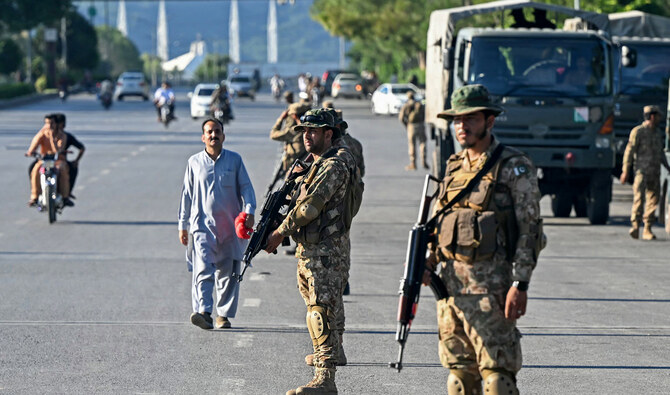
Islamabad has authorized the deployment of troops on the streets for the duration of the summit.
Imtiaz Gul, a security analyst and executive director of the Center for Research and Security Studies, said the meeting holds great significance for a country that’s “not seen as safe.”
“The government claims to have made elaborate security arrangements and understandably so because it has to make sure that the event passes off peacefully without any untoward incident,” he told AFP.
The SCO comprises China, India, Russia, Pakistan, Iran, Kazakhstan, Kyrgyzstan, Tajikistan, Uzbekistan and Belarus — with 16 more countries affiliated as observers or “dialogue partners.”
All visiting member nations are expected to send government heads apart from Pakistan’s arch-rival India, who will dispatch its foreign minister in a rare visit to its neighbor.
The SCO is sometimes touted as an alternative to the Western-dominated NATO military alliance.
As China’s claim over Taiwan and Russia’s invasion of Ukraine have seen them clash with the US and Europe, analysts say the SCO is one forum where they are trying to curry regional influence.
While the SCO has a mandate to discuss security, the Islamabad summit is due to focus on trade, humanitarian and cultural issues.
Pakistan’s domestic concerns are likely to dominate the sidelines of the summit, however.
Khan’s Pakistan Tehreek-e-Insaf (PTI) party has threatened to stage protests, a week after scattered demonstrations by supporters saw the capital locked down for three days with mobile phone signal cut and exit and entry points blocked.
“The PTI doesn’t want to showcase the positive side of Pakistan to the world,” accused Ahsan Iqbal Chaudhary, minister for planning, during a press conference Saturday.
“Instead, they aim to present a picture of the country filled with tear gas and unrest.”
Authorities have declared a three-day public holiday for Islamabad and the neighboring city of Rawalpindi starting Monday, along with road closures to reduce movement around the area.
The “red zone” government quarter hosting the summit meanwhile has been spruced up with manicured lawns ringed by razor wire.
Cash-strapped Pakistan is particularly at pains to protect citizens from China because it is a major investor, sending funds and staff for million-dollar infrastructure projects.
Pakistan is grappling with a broad uptick in militancy coinciding with the Taliban’s 2021 return to power in neighboring Afghanistan, where Islamabad claims attackers are now taking shelter.


![]()

Pakistan frets over security ahead of SCO summit
Short Url
https://arab.news/b3de2
Pakistan frets over security ahead of SCO summit
- Prime ministers of Russia, China among senior regional government officials attending SCO summit
- Pakistan’s authorities have cracked down hard on dissent in the weeks leading up to the event
Latest updates


© 2026 SAUDI RESEARCH & PUBLISHING COMPANY, All Rights Reserved And subject to Terms of Use Agreement.