How Filipino content creator makes country’s natural heritage a TikTok hit

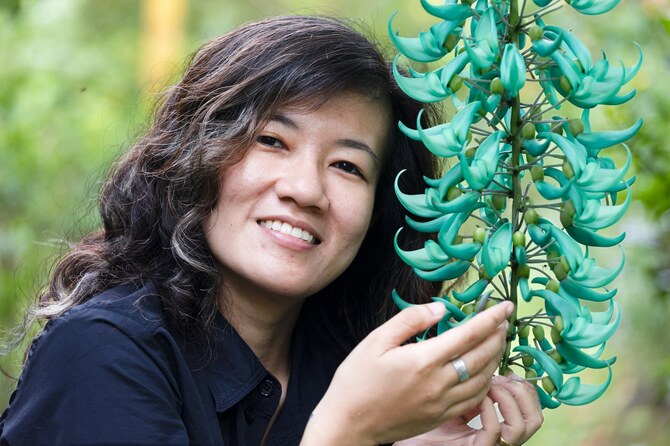
Celine Murillo holds jade vine in San Roque, Bulusan, Sorsogon province of the Philippines, February 2024. (Celine Murillo)
Short Url
Updated 12 October 2024
Follow

How Filipino content creator makes country’s natural heritage a TikTok hit

  • Environment and travel writer Celine Murillo moved to TikTok platform in 2022
  • With 620,000 followers, she sheds light on little-known flora and fauna of the Philippines

MANILA: When Celine Murillo traded the bustling streets of Manila for the nature of Bicol region 400 km south, she began to use TikTok to share her journey — a decision that soon shot her to social media fame.

Almost three years later, Murillo’s account has over 620,000 followers. Filled with conversational content and tidbits in under two minutes, her content resonates with viewers of all ages who appreciate learning more about the plants and animals they see around them.

An experienced travel writer, she was creating long-form content for years. But the outreach was not yet enough to make a difference. It was her social media venture that changed it.

“For almost a decade, I’ve been creating stories about the natural world — written features, photo stories, and, ultimately, documentaries. While these have been fulfilling, I felt like they were reaching the people that already cared. There was this dread of being in an echo chamber,” she told Arab News.

“(I asked myself), ‘Where’s the audience? How can I make the message reach more of them?’ These were the questions I consistently mulled over. And the answer I came to was TikTok.”

It all clicked as Filipinos were eager to learn about their country’s rich biodiversity.

Murillo travels with her husband Dennis, who shoots and edits their content as they explore the Philippines’ natural wonders — from hiking in the mountains to documenting endangered species.

One of the videos about a yellow-vented bulbul, a common bird in the Philippines, has earned 12 million views, while the views on her series called “Saribuhay sa Salapi” (Biodiversity in Local Currency) range from over 1 million to 3 million views for each clip.



Celine Murillo and her husband and video producer Dennis during one of their field trips. (Celine Murillo)

With the number of her followers growing, Murillo realized there was great interest among Filipinos to learning about their own natural heritage — something that many were never introduced to, as the Philippines’ native flora and fauna was not a subject typically covered in school curricula.

“It makes me sad and a little angry that foreign species like lions and cherry blossoms are more known to Filipinos and more prominent in popular culture than our own local biodiversity,” she said.

“This should be taught in schools. This should be inculcated in our psyche.”

The lack of knowledge and awareness stems, according to her, from a systemic issue of long-held colonial narratives.

“For so long, all of our institutions forward colonial ideas. This is true in all aspects of our lives as Filipinos, even in the way we perceive our environment,” she said.

“We see nature as something to profit from, and ultimately exploit and abuse. That’s why I’m proud of my work because it has started a resurgence in interest, a remembering that our natural heritage is just as amazing and worthy of attention, that it’s inherently valuable, even without factoring in how much money we can profit from it.”

Living with indigenous communities and working, among others, with Climate Tracker Asia — a non-profit committed to enhancing climate journalism — Murillo has witnessed the situation on the ground and the fight of those trying to stop the destruction of the environment, which to her was linked to the continuing presence of “colonial systems” that “allow the wanton abuse and oppression of people, communities, and our natural treasures.”

She is trying to address this, making more people aware by sharing online the knowledge of experts, conservation institutions and grassroots groups she has learnt from.

“My work as a storyteller and communicator is built on the collective knowledge and experiences of scientists and Indigenous communities. I am a proud product of their legacies ... “I’m so happy that the online community is empowered to share their experiences, in the context of their cultural and personal history,” she said.

“I know my work in social media is barely scratching the surface, but I hope this will instill a sense of wonder to the viewer, and hopefully, this will turn into love. In time, we will collectively harness this love to create a better, kinder, more compassionate world.”


Israel is risking global security, warns Somali Information Minister

Updated 6 sec ago
Follow

Israel is risking global security, warns Somali Information Minister

  • Tel Aviv’s actions boost terror groups he tells Arab News in exclusive interview
  • Jama accuses Tel Aviv of wanting to relocate Palestinians from Gaza to region

RIYADH: Israel’s recognition of Somaliland and its presence in the region risks inflaming the situation there, allowing terrorist groups to undermine regional security and stability, according to Somali Information, Culture and Tourism Minister Daud Aweis Jama.

In a special interview with Arab News, Jama insisted that Israel’s unprecedented Dec. 26 move to recognize Somaliland as a sovereign state represents a major setback for Mogadishu’s fight against terrorist organizations like Al-Shabab and Daesh.

“The presence of Israel will be used by the terrorist groups to expand their operations in the region. (They will) have a pretext to spread their ideologies in the region,” he said.

“That is another factor that is also risking global security and regional stability, because we have been in the last stage of overcoming the challenges of the terrorist groups Al-Shabab and ISIS,” he added, using another term for Daesh.

Jama added: “We have been putting all our resources and all our time into making sure that we finalize the final stages of the fight against Al-Shabab. So, if something else interrupts us, that means that we are not going to focus fully on the operations against Al-Shabab. And that means we are giving more opportunities to Al-Shabab or other organizations.”

The consequences of this hit to Somalia’s ability to fight terror will not be restricted to the country’s borders, according to Jama, but will spread across the region and beyond.

“This might invite other, external terrorist groups to the region, because they will take advantage of this crisis and will make sure that they take over all the areas that have been defeated before,” the minister said.

“We believe this has come at a time that is going to affect our security as a Somali government, the security of the Horn of Africa, the security of the Gulf of Aden, the security of the Red Sea, the security of the Middle East and global stability. This is a very important location that holds the trade of the world.”

The minister underlined that Israel’s recognition and larger presence in the region are leading to more challenges, “putting more fuel on the ongoing challenges that exist in the region, especially in Somalia.” He added: “And at this time, it is not only limited to Somalia, but it’s going to be a challenge that is going to spread like a fire all over the region and all over the world.”

Jama told Arab News that Israel has other strategic motives for its recognition of Somaliland — including the forced resettlement of Palestinians from Gaza.

“According to reliable sources that our intelligence gathered, one of the conditions that Israel put forward (for recognizing Somaliland) was to have a place that they can settle the people from Gaza,” he said.

“We find that it is a violation also of the people of Palestine, because we believe that the people of Palestine have the right to self-determination. The two-state solution that has been the call of the international community has to be adhered to and implemented.”

Israel’s coalition government, the most right-wing ‌and religiously conservative in its history, includes far-right politicians who advocate the ‍annexation of both Gaza and the West ‍Bank and encouraging Palestinians to leave their homeland.

Somalia’s UN Ambassador Abukar Dahir Osman said ‍Security Council members Algeria, Guyana, Sierra Leone and Somalia “unequivocally reject any steps aimed at advancing this objective, including any attempt by Israel to relocate the Palestinian population from Gaza to the northwestern region of Somalia.”

Israel last month became the first country to recognize Somaliland as an independent nation. In the three-plus decades since its self-declaration of independence in 1991, no state had recognized the northwestern territory as being separate from Somalia.

Mogadishu immediately rejected the Israeli move, alongside countries all over the world.

Saudi Arabia affirmed its rejection of any attempts to impose parallel entities that conflict with the unity of Somalia. It also affirmed its support for the legitimate institutions of the Somali state and its keenness to preserve the stability of Somalia and its people.

A group of foreign ministers from Arab and Islamic countries, alongside the Organization of Islamic Cooperation, also firmly rejected Israel’s announcement. In a joint statement, the ministers warned that the move carries “serious repercussions for peace and security in the Horn of Africa and the Red Sea region” and undermines international peace and security.

The 22-member Arab League rejected “any measures arising from this illegitimate recognition aimed at facilitating forced displacement of the Palestinian people or exploiting northern Somali ports to establish military bases,” the organization’s UN Ambassador Maged Abdelfattah Abdelaziz told the UN Security Council.

In the most recent development in Israel-Somaliland relations, less than two weeks after Tel Aviv’s recognition, Israeli Foreign Minister Gideon Saar visited the region on Tuesday to publicly formalize diplomatic relations.

“It was a blatant violation of Somalia’s sovereignty that Israel recognized a region within the Somali Federal Republic as an independent state,” Jama underlined. “That was a total violation of international laws. It was a violation of the territorial integrity and sovereignty of Somalia.

“From the beginning, our path was to follow diplomatic efforts. And we kind of started with a successful UN Security Council meeting that supported Somalia’s territorial integrity and sovereignty. (This was) followed by other international actors like the Arab League, the Organization of Islamic Cooperation, the African Union and regional bodies like the East African Community and IGAD.

“Also, the Peace and Security Council of the African Union has reiterated the importance of supporting Somali sovereignty and territorial integrity.”