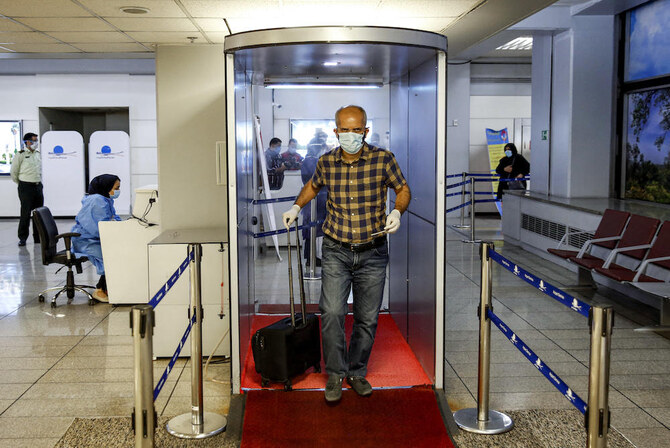
TEHRAN: Iran has banned pagers and walkie-talkies on all flights, local media reported Saturday, weeks after deadly sabotage attacks in Lebanon which were blamed on Israel.
“The entry of any electronic communication device, except mobile phones, in flight cabins or ... in non-accompanied cargo, has been banned,” ISNA news agency reported, citing the spokesman for Iran’s Civil Aviation Organization Jafar Yazerlo.
The decision came over three weeks since sabotage attacks targeting members of the Iran-allied Hezbollah group in Lebanon that saw pagers and walkie-talkies explode, killing at least 39 people.
Nearly 3,000 others were wounded in the attack, which Iran and Hezbollah blamed on Israel, including Tehran’s ambassador to Lebanon Mojtaba Amani.
Earlier this month, Dubai-based airline Emirates banned pagers and walkie-talkies onboard its planes.
Regional tensions have soared since the outbreak of the Gaza war in October last year, drawing in Iran-aligned groups from Lebanon, Iraq, Syria and Yemen.
Multiple airlines have in recent weeks suspended flights to Iran following Tehran’s missile attack on Israel on October 1.
Iran fired some 200 missiles at Israel to retaliate against the killing of Tehran-aligned militant leaders in the region and a general in Iran’s Revolutionary Guards.
Israel has since vowed to retaliate, with defense minister Yoav Gallant saying the response will be “deadly, precise, and surprising.”

Iran bans pagers, walkie-talkies on flights after Lebanon attacks
https://arab.news/pnmnr
Iran bans pagers, walkie-talkies on flights after Lebanon attacks
- Ban imposed weeks after deadly sabotage attacks in Lebanon which were blamed on Israel
Trump says Iran government change ‘best thing that could happen’
- US president's comments come after he ordered a second aircraft carrier to head to the Middle East
FORT BRAGG, United States: US President Donald Trump said a change of government in Iran would be the “best thing that could happen,” as he ordered a second aircraft carrier to head to the Middle East.
“Seems like that would be the best thing that could happen,” Trump told reporters at the Fort Bragg military base in North Carolina when a journalist asked if he wanted “regime change” in Iran.
“For 47 years, they’ve been talking and talking and talking. In the meantime, we’ve lost a lot of lives while they talk,” he told reporters.
Trump declined to say who he would want to take over in Iran from supreme leader Ayatollah Ali Khamenei, but he added that “there are people.”
He has previously backed off full-throated calls for a change of government in Iran, warning that it could cause chaos, although he has made threats toward Khamenei in the past.
Speaking earlier at the White House, Trump said that the USS Gerald R. Ford — the world’s largest warship — would be “leaving very soon” for the Middle East to up the pressure on Iran.
“In case we don’t make a deal, we’ll need it,” Trump said.
The giant vessel is currently in the Caribbean following the US overthrow of Venezuela’s Nicolas Maduro. Another carrier, the USS Abraham Lincoln, is one of 12 US ships already in the Middle East.
When Iran began its crackdown on protests last month — which rights groups say killed thousands — Trump initially said that the United States was “locked and loaded” to help demonstrators.
But he has recently focused his military threats on Tehran’s nuclear program, which US forces struck last July during Israel’s unprecedented 12-day war with Iran.
The protests have subsided for now but US-based Reza Pahlavi, the son of Iran’s last shah, urged international intervention to support the Iranian people.
“We are asking for a humanitarian intervention to prevent more innocent lives being killed in the process,” he told the Munich Security Conference.
It followed a call by the opposition leader, who has not returned to his country since before the revolution, for Iranians at home and abroad to continue demonstrations this weekend.
Iran and the United States, who have had no diplomatic relations since shortly after the revolution, held talks on the nuclear issue last week in Oman. No dates have been set for new talks yet.
The West fears the program is aimed at making a bomb, which Tehran denies.
The head of the UN nuclear watchdog, Rafael Grossi, said Friday that reaching an accord with Iran on inspections of its processing facilities was possible but “terribly difficult.”
Trump said after talks with Israeli Prime Minister Benjamin Netanyahu earlier this week that he wanted to continue talks with Iran, defying pressure from his key ally for a tougher stance.
The Israeli prime minister himself expressed skepticism at the quality of any agreement if it didn’t also cover Iran’s ballistic missiles and support for regional proxies.
According to the US-based Human Rights Activists News Agency, 7,008 people, mostly protesters, were killed in the recent crackdown, although rights groups warn the toll is likely far higher.
More than 53,000 people have also been arrested, it added.
The Norway-based Iran Human Rights (IHR) NGO said “hundreds” of people were facing charges linked to the protests that could see them sentenced to death.
Figures working within the Iranian system have also been arrested, with three politicians detained this week from the so-called reformist wing of Iranian politics supportive of President Masoud Pezeshkian.
The three — Azar Mansouri, Javad Emam and Ebrahim Asgharzadeh — were released on bail Thursday and Friday, their lawyer Hojjat Kermani told the ISNA news agency.


