PARIS: Nuclear-armed powers have no intention of giving up the atom bomb as part of their military strategy, experts said after the Nobel Peace Prize committee urged against any weakening of the nuclear “taboo.”
Awarding this year’s peace prize to Japan’s Nihon Hidankyo, a grassroots movement of Hiroshima and Nagasaki survivors pushing for a nuclear weapons ban, the committee said on Friday the atom bomb attacks on both Japanese cities in 1945 had led to a “nuclear taboo” which had, however, come under “pressure” since.
While none of the countries possessing nuclear weapons have used them in war since 1945, the implicit or even explicit threat to do so is part of their arsenal.
Moscow has repeatedly brandished the nuclear threat in a bid to dissuade the West from supporting Ukraine, which has been fending off Russia’s invasion since February 2022.
According to Alexander Gabuev, Director at the Carnegie Russia Eurasia Center, it was “no coincidence” that Russian President Vladimir Putin made a nuclear threat on the eve of a meeting between US President Joe Biden and Ukraine President Volodymyr Zelensky about Kyiv’s possible use of missiles capable of striking Russian territory.
The Nobel committee wanted to send “a strong signal” to Russia, said Bruno Tertrais, political scientist at France’s Strategic Research Foundation.
Russia, he said, had “normalized,” even “trivialized,” talk of a nuclear weapons use since its invasion of Ukraine.
The Kremlin is not alone.
North Korean leader Kim Jong Un said last week his country would use nuclear weapons “without hesitation” if attacked by South Korea and it ally, the United States.
And in the Middle East, Israel, the region’s only nuclear-armed state, has vowed a “deadly, precise and surprising” response to Iran’s direct strike on Israeli territory on October 1.
Tehran, meanwhile, has significantly ramped up its nuclear program and now has enough material to build more than three atomic bombs, according to the International Atomic Energy Agency (IAEA).
Tehran insists its nuclear activities are entirely peaceful and designed to produce energy.
“The logic of deterrence is firmly entrenched in countries that have nuclear weapons,” said Tertrais, adding however that the risk of atomic bomb use “is no greater now than five years ago.”
Standard nuclear doctrine — developed during the Cold War between super powers the United States and the Soviet Union — is based on the assumption that such weapons will never have to be used because their impact is so devastating, and because nuclear retaliation would probably bring similar destruction on the original attacker.
This is why China has never given up its “no first strike” doctrine, said Lukasz Kulesa, Director of Proliferation and Nuclear Policy at the Royal United Services Institute (RUSI).
Other countries have also signalled that nuclear arms use would be a last resort while not ruling it out completely to maintain credibility in the eyes of opponents, said Kulesa.
But keeping a safe balance between threat and restraint can never be risk-free, he warned.
“There is always a possibility of failure. There is also a possibility of inadvertent escalation that can go all the way to the nuclear level,” Kulesa said.
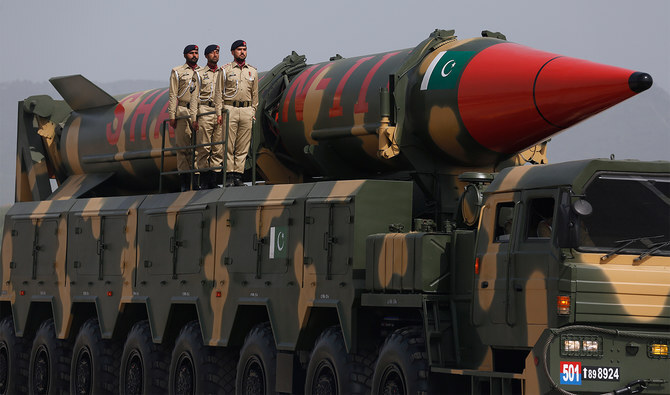
Countries possessing nuclear weapons today are the United States, Russia, Britain, France, China, India, Pakistan and North Korea.
Israel is also widely assumed to have an arsenal of nuclear weapons, although it has never officially acknowledged this.


![]()


Nuclear deterrence still at heart of great power strategy — experts
Short Url
https://arab.news/65mz9
Nuclear deterrence still at heart of great power strategy — experts
- While none of the countries possessing nuclear weapons have used them in war since 1945, the implicit or even explicit threat to do so is part of their arsenal
- Moscow has repeatedly brandished the nuclear threat in a bid to dissuade the West from supporting Ukraine, which has been fending off Russia’s invasion since 2022
Rohingya ‘targeted for destruction’ by Myanmar, Gambia tells ICJ
THE HAGUE: Myanmar's military deliberately targeted the Rohingya minority in a bid to destroy the community, Gambia's Justice Minister Dawda Jallow told the International Court of Justice on Monday.
"It is not about esoteric issues of international law. It is about real people, real stories and a real group of human beings. The Rohingya of Myanmar. They have been targeted for destruction," Jallow told ICJ judges.
Gambia has dragged Myanmar before the ICJ, claiming its 2017 crackdown against the Rohingya minority was in breach of the 1948 UN Genocide Convention.


Latest updates


© 2026 SAUDI RESEARCH & PUBLISHING COMPANY, All Rights Reserved And subject to Terms of Use Agreement.