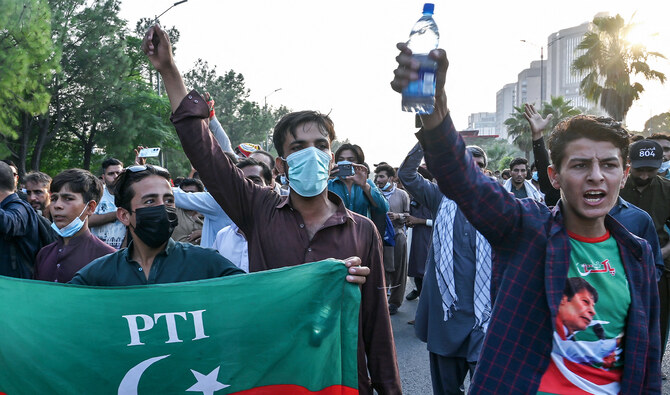
ISLAMABAD: Former Prime Minister Imran Khan’s Pakistan Tehreek-e-Insaf (PTI) party on Friday announced another protest in the federal capital for the coming week, saying it would proceed with the plan if the government failed to grant Khan access to doctors and lawyers.
The development follows restrictions imposed by the Punjab provincial administration on meetings with inmates at Adiala Jail in Rawalpindi, where the ex-premier is imprisoned on multiple charges.
The provincial government issued instructions to enhance jail security after the police counterterrorism department circulated a threat alert in the lead-up to the Shanghai Cooperation Organization (SCO) Summit on October 15 and 16.
PTI filed a petition challenging the restrictions on meetings with Khan, calling it a tactic to suppress his voice and expressing concern for his safety in prison amid ongoing tensions with the government and establishment. However, the Islamabad High Court (IHC) only directed the authorities to provide adequate medical facilities in prison and arrange meetings after the ban on visits expires following the SCO Summit.
“The politic committee comprising key members of PTI has announced a protest call at D Chowk Islamabad for Oct. 15, 2024, if access to Former Chairman Imran Khan is not given to his legal team & physician,” the party said in a statement after holding an emergency meeting on the subject.
Referring to an earlier court judgment in March, it noted the authorities were citing security reasons to prevent access to Khan, though Justice Sardar Ijaz of the IHC had ordered video link access if physical interaction with Khan was not possible.
The statement maintained PTI respected the law of the land, but it was “imperative that an access of some kind may be granted [to Khan], as some reports suggested his health was not well,” which was causing unrest within the party.
PTI’s previous protest at Islamabad’s D-Chowk, near some of the most sensitive government installations, brought life in the capital to a standstill as authorities sealed the city with shipping containers, alleging that Khan’s party was trying to “sabotage” the SCO Summit.
After the recent court order in response to its petition, the party has threatened another protest, this time coinciding with the international conference.
PTI’s last protest also led to clashes between its workers and law enforcement personnel, leading to dozens of arrests and injuries to a large number of cops one of whom died after being subjected to alleged torture by the protesters.
Khan, jailed since August last year, was ousted from the PM’s office in 2022 in a parliamentary vote of no confidence after what is widely believed to be a falling out with Pakistan’s powerful military, which denies being involved in politics.
Since his removal, Khan and his party have waged an unprecedented campaign of defiance against the military.


![]()

Party of Imran Khan threatens march to Islamabad amid ban on meeting jailed leader
Short Url
https://arab.news/rhfds
Party of Imran Khan threatens march to Islamabad amid ban on meeting jailed leader
- The Punjab administration has banned meetings with jail inmates in Rawalpindi, citing security reasons
- PTI’s protest call on October 15 coincides with the Shanghai Cooperation Organization Summit in capital
Latest updates


© 2026 SAUDI RESEARCH & PUBLISHING COMPANY, All Rights Reserved And subject to Terms of Use Agreement.