

Tesla CEO Musk unveils ‘Cybercab’, ‘Robovan’ as focus shifts to automation

1 / 2
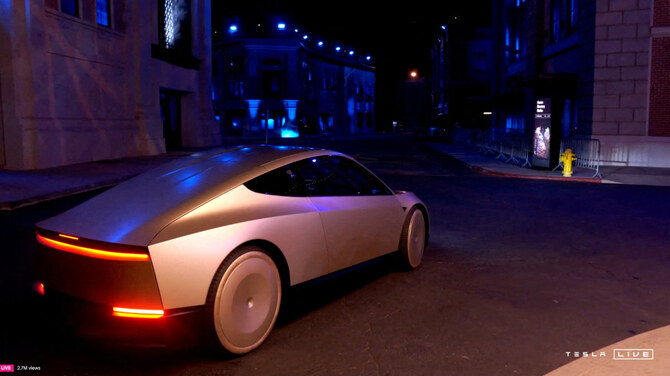
In this still image taken from video, Tesla CEO and X owner Elon Musk rides in Tesla's robotaxi at an unveiling event in Los Angeles, California, on October 10, 2024o. (Tesla/Handout via REUTERS)
2 / 2
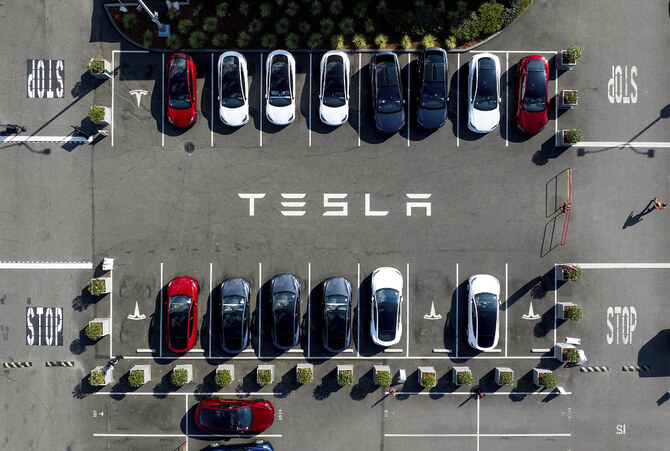
Tesla vehicles line a parking lot at the company's factory in Fremont, California. (AP/File)
Short Url
Updated 11 October 2024
Follow

Tesla CEO Musk unveils ‘Cybercab’, ‘Robovan’ as focus shifts to automation

  • Cybercab production to start in 2026, to cost less than $30,000
  • Also showcased were the Robovan, capable of carrying up to 20 people, and Tesla's Optimus humanoid robot

Tesla CEO Elon Musk showcased a two-door robotaxi with gull-wing doors and no steering wheel or pedals at a much-hyped event on Thursday, sticking to long-held promises of autonomous cars driving long-term growth at the electric vehicle maker.
Musk traveled to the stage in a "Cybercab" and said production will start in 2026 with the vehicles being available to buy for less than $30,000.
"The autonomous future is here," Musk said. "We have 50 fully autonomous cars here tonight. You'll see model Ys and the Cybercab. All driverless."
The Cybercab will cost 20 cents a mile to operate over time, use inductive chargers and not require any plugs. They will also rely only on cameras and artificial intelligence, without the need for other hardware that robotaxi players use.
Musk also showcased a larger, self-driving vehicle — called Robovan — capable of carrying up to 20 people, and showed off Tesla's Optimus humanoid robot.


Tesla's robovan is unveiled at an event in Los Angeles, California, on October 10, 2024. (Tesla/Handout via REUTERS)

Enthusiasm around the event has been on display across social media for weeks, with screenshots of invites and speculation on what might be disclosed. But investors and analysts have flagged challenges with the technology and reined in expectations.
Musk's plan is to operate a fleet of self-driving Tesla taxis that passengers can hail through an app. Individual Tesla owners will also be able to make money on the app by listing their vehicles as robotaxis.
Thursday's event at the Warner Bros studio near Los Angeles, California, is titled "We, Robot" - an apparent nod to the "I, Robot" science-fiction short stories by American writer Isaac Asimov, but also echoes Musk's insistence that Tesla "should be thought of as an AI robotics company" rather than an automaker.
Those attending included investors, stock analysts and Tesla fans.
"Everything looks cool, but not much in terms of time lines, I'm a shareholder and pretty disappointed. I think the market wanted more definitive time lines," said Dennis Dick, equity trader at Triple D Trading. "I don't think he said much about anything... He didn't give much info."


Tesla's Optimus robots walk on the day of an unveiling event in Los Angeles, California,on October 10, 2024. (Tesla/Handout via REUTERS)

Missed promises
Musk said in 2019 he was "very confident" the company would have operational robotaxis by the next year. After missed promises, Musk this year diverted his focus to developing the vehicles after scrapping plans to build a smaller, cheaper car widely seen as essential to countering slowing EV demand.
Tesla is at risk of posting its first-ever decline in deliveries this year as buying incentives have failed to attract enough customers to its aging EV lineup. Steep price cuts meant to offset high interest rates have also squeezed profit margins.
Complicated technology and tight regulation have led to billion of dollars in loss for other companies attempting to crack the robotaxi market, forcing some to shut shop.
Some are still pushing, including General Motors' Cruise, Amazon's Zoox and Chinese firms such as WeRide.
Unlike expensive hardware such as lidar that others use, Musk is relying only on cameras and AI to run FSD to keep costs down. But FSD, which requires constant driver attention, has faced regulatory and legal scrutiny with at least two fatal accidents involving the technology.


UK pays Guantanamo detainee ‘substantial’ compensation over US torture questions

Updated 12 January 2026
Follow

UK pays Guantanamo detainee ‘substantial’ compensation over US torture questions

  • Abu Zubaydah has been held at Guantanamo Bay without charge for 20 years
  • British security services knew he was subjected to ‘enhanced interrogation’ but failed to raise concerns for 4 years

LONDON: A Saudi-born Palestinian being held without trial by the US has received a “substantial” compensation payment from the UK government, the BBC reported.

Abu Zubaydah has been imprisoned at Guantanamo Bay in Cuba for almost 20 years following his capture in Pakistan in 2002, and was subjected to “enhanced interrogation” techniques by the CIA.

He was accused of being a senior member of Al-Qaeda in the aftermath of the Sept. 11 terror attacks on the US. The allegations were later dropped but he remains in detention.

The compensation follows revelations that UK security services submitted questions to the US to be put to Abu Zubaydah by their US counterparts despite knowledge of his mistreatment.

He alleged that MI5 and MI6 had been “complicit” in torture, leading to a legal case and the subsequent compensation.

Dominic Grieve, the UK’s former attorney general, chaired a panel reviewing Abu Zubaydah’s case.

He described the compensation as “very unusual” but said the treatment of Abu Zubaydah had been “plainly” wrong, the BBC reported.

Grieve added that the security services had evidence that the “Americans were behaving in a way that should have given us cause for real concern,” and that “we (UK authorities) should have raised it with the US and, if necessary, closed down co-operation, but we failed to do that for a considerable period of time.”

Abu Zubaydah’s international legal counsel, Prof. Helen Duffy, said: “The compensation is important, it’s significant, but it’s insufficient.”

She added that more needs to be done to secure his release, stating: “These violations of his rights are not historic, they are ongoing.”

Duffy said Abu Zubaydah would continue to fight for his freedom, adding: “I am hopeful that the payment of the substantial sums will enable him to do that and to support himself when he’s in the outside world.”

He is one of 15 people still being held at Guantanamo, many without charge. Following his initial detention, he arrived at the prison camp having been the first person to be taken to a so-called CIA “black site.”

He spent time at six such locations, including in Lithuania and Poland, outside of US legal jurisdiction. 

Internal MI6 messages revealed that the “enhanced interrogation” techniques he was subjected to would have “broken” the resolve of an estimated 98 percent of US special forces members had they been subjected to them.

CIA officers later decided he would be permanently cut off from the outside world, with then-President George W. Bush publicly saying Abu Zubaydah had been “plotting and planning murder.”

However, the US has since withdrawn the allegations and no longer says he was a member of Al-Qaeda.

A report by the US Senate Select Committee on Intelligence said Abu Zubaydah had been waterboarded at least 83 times, was locked in a coffin-like box for extended periods, and had been regularly assaulted. Much of his treatment would be considered torture under UK law.

Despite knowledge of his treatment, it was four years before British security services raised concerns with their American counterparts, and their submission of questions within that period had “created a market” for the torture of detainees, Duffy said.

A 2018 report by the UK Parliament’s Intelligence and Security Committee was deeply critical of the behavior of MI5 and MI6 in relation to Abu Zubaydah. 

It also criticized conduct relating to Guantanamo detainee Khalid Sheikh Mohammed, widely regarded as a key architect of the Sept. 11 attacks, warning that the precedent set by Abu Zubaydah’s legal action could be used by Mohammed to bring a separate case against the UK.

MI5 and MI6 failed to comment on Abu Zubaydah’s case. Neither the UK government nor Mohammed’s legal team would comment on a possible case over his treatment.