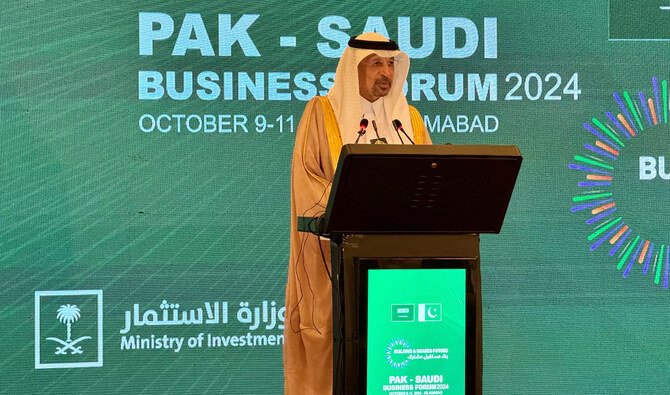

ISLAMABAD: Saudi Arabia’s Investment Minister Khalid bin Abdulaziz Al-Falih said on Thursday 27 agreements and memorandums of understanding (MoU) worth $ 2 billion would be signed today, Thursday, with Pakistan, and the Kingdom hoped to give a large share of $200 billion in annual construction and material procurement contracts to Islamabad in the future.
Al-Falih was addressing a joint business forum in Islamabad during a three-day visit with a delegation of over 130 members, including representatives from Saudi companies specializing in energy, mining, minerals, agriculture, business, tourism, industry, and manpower.
“Pakistani Prime minister will be speaking to the Saudi delegation later this evening and will be presiding over an exchange of agreements and MOUs totaling 27 that will be signed throughout the day,” Al Falih said as he addressed the Pak-Saudi Business Forum 2024.
He said many of the $2 billion agreements had already been negotiated and agreed upon.
The investment minister said Saudi Arabia, the largest construction site in the world, would in the next few years be awarding construction and material procurement contracts to the tune of around $1.8 trillion.
Saudi Arabia is set to become the world’s largest construction market as the Kingdom pours vast amounts of money into projects aimed at overhauling and diversifying the economy. The country’s total construction output value is forecast to reach $181.5 billion by the end of 2028, up almost 30 percent from 2023 levels, according to a 2024 report by global property consultancy Knight Frank.
“Last year, the value of construction and EPC [engineering, procurement, and construction] procurement, including materials, was $150 billion, this year that’s $180 billion and it will be about $200 billion annually of contract and material procurement awards year after year,” Al-Falih said.
“Fortunately for our partners here in Pakistan, a lot of the input into those contracts is going to be imported and we want it to be imported from Pakistan. All things being equal, in fact, we will compromise a little bit to make it come from Pakistan.”
Al-Falih said trade between Pakistan and the Kingdom had increased by 80 percent from $3 billion in 2019 to $5.4 billion dollars currently, adding that Saudi Arabia was “encouraged” by the number of Pakistani investment licenses, which had more than doubled in the last couple of years, reaching 2,000 Pakistani investors in Saudi Arabia.
“The Foreign Direct Investment (FDI) stock in Saudi Arabia of Pakistani investment is already exceeding $1.6 dollars and we are committed to and extremely encouraged by the announcement by His Royal Highness the Crown Prince, committing the front end of Saudi investment into Pakistan, which is $5 billion,” the minister said.
Al-Falih’s visit to Islamabad comes as Pakistan seeks closer cooperation in trade, infrastructure, energy and other sectors with friendly countries and regional allies, with the aim to attract foreign investment and shore up its $350 billion economy, beset by a prolonged economic crisis that has drained foreign exchange reserves and weakened the national currency.
Pakistan and Saudi Arabia in particular have been working closely in recent months to increase bilateral trade and investment, with Crown Prince Mohamed bin Salman reaffirming the Kingdom’s commitment this year to expedite a $5 billion investment package for the South Asian country.
Last month, the International Monetary Fund’s board approved a long-awaited $7 billion bailout deal for Pakistan’s struggling economy. The IMF said the new program will require “sound policies and reforms” to strengthen macroeconomic stability and address structural challenges alongside “continued strong financial support from Pakistan’s development and bilateral partners.”
“STRATEGIC PARTNERSHIP”
Addressing the business forum, Pakistani Deputy Prime Minister Ishaq Dar said Pakistan had vast potential in sectors such as mining, information technology, agriculture, and renewable energy, inviting Saudi businesses to participate in “mutually beneficial” opportunities and ventures.
“The MOUs signed today include a wide range of sectors, mainly semiconductors, energy, livestock, manpower and IT and these MOUs are the result of dedicated follow-up by your side and our side, public and private sector entities, of the direction given by the leadership of both countries,” Dar said.
The deputy PM said Pakistanis were “eagerly awaiting” the visit of the Saudi Crown Prince Mohammed bin Salman to Pakistan.
“This visit will not only further strengthen and put a strong bond in our strategic partnership but will also be a way for more collective efforts in various sectors we are currently located,” he added.
Inaugurating the forum, Pakistan’s Commerce Minister Jam Kamal said Pakistan would organize a single country exhibition in Jeddah in 2025 to promote its trade potential and attract investment.
“Pakistan’s exports are only two percent of Saudi Arabia’s total trade, and an increase in Pakistani exports to the Kingdom is essential,” he said, adding that Pakistani companies could play an important role in the construction, IT and agriculture sectors in the Kingdom.