

Pakistan warns Pashtun rights group against stoking ethnic division as clashes kill 3

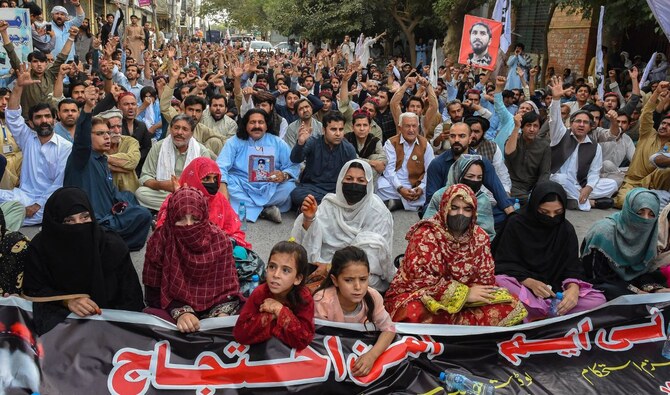
Supporters and activists of Pashtun Tahafuz Movement (PTM) take part in a protest against the military operations in Khyber Pakhtunkhwa, in Quetta on July 7, 2024. (AFP/File)
Short Url
Updated 09 October 2024
Follow

Pakistan warns Pashtun rights group against stoking ethnic division as clashes kill 3

  • Pashtun Tahafuz Movement organizes protest in northwestern Jamrud town against government’s ban on group 
  • PTM is a fierce critic of the powerful military, accusing it of abusing Pashtuns’ rights in northwestern Pakistan

ISLAMABAD: Pakistan’s Interior Minister Mohsin Naqvi warned a prominent Pashtun rights group against stoking ethnic division in the country on Wednesday, as protests in the country’s northwestern province claimed the lives of three people. 

At least three protesters were killed on Wednesday afternoon as clashes erupted between Pakistani police and supporters of the Pashtun Tahafuz Movement (PTM) in the northwestern town of Jamrud near Peshawar city.

The clashes erupted during protests by the PTM against a ban placed on the group by Pakistan’s interior ministry on Sunday. The ministry said it had banned the PTM, alleging that the group was found to be involved in activities prejudicial to the peace and security of the country. 

The PTM alleges Pashtuns have faced rights abuses during Pakistan’s war against militants, mainly in its northwestern Khyber Pakhtunkhwa province. It blames Pakistan’s powerful military for rights abuses in the northwestern province, a charge the institution has consistently denied.

“The main reason for banning them two days ago was that you, on the one hand, are abusing your state institutions and police. You are promoting ethnic discrimination and talking to the nation about division,” Naqvi said at a press conference. 

The minister pointed out that as per Pakistani law, if an organization is declared a proscribed entity its offices are sealed, bank accounts closed, arms licenses, passports, and identity cards are canceled and restrictions are placed on it regarding its media interactions and travel.

“Anyone who helps them [PTM] or facilitates them will face the same restrictions,” Naqvi warned. 

The PTM plans to hold a tribal jirga or tribal council gathering of thousands of people from Oct. 11-13 in defiance of the state’s ban in Jamrud. Naqvi warned the Pashtun rights group against holding the event, saying that the government would share important details of the PTM’s funding in the upcoming days. 

“On the one hand you are calling it a jirga and then also calling it a court,” he said. “This is the decision of Pakistan’s government that we cannot allow any parallel judicial system in the country.”

Formed by veterinary sciences student Manzoor Pashteen in 2014, the PTM was a pressure group that shot to national prominence when they spearheaded protests against the killing of Naqeebullah Mehsud, a young garment trader and aspiring model shot dead by police in Karachi in 2018.

In the 2018 election, PTM leaders Mohsin Dawar and Ali Wazir were elected to parliament from Pakistan’s restive North and South Waziristan districts, respectively.

The PTM says it has faced harassment, intimidation and censorship at the hands of Pakistan’s powerful military, which has ruled the country directly for over 30 years since it gained independence in 1947.

The military denies the PTM’s accusations and has often accused it of being funded by foreign intelligence agencies, notably Afghanistan’s National Directorate of Security (NDS) and India’s Research and Analysis Wing (RAW). The PTM denies these allegations. 


Pakistan mulls 'Super App' for public services, document verification in major technology push

Updated 15 February 2026
Follow

Pakistan mulls 'Super App' for public services, document verification in major technology push

  • Pakistan has been urging technology adoption in public, private sectors as it seeks to become a key tech player globally
  • The country this month launched the Indus AI Week to harness technology for productivity, skills development and innovation

KARACHI: Pakistan is planning to launch a “Super App” to deliver public services and enable digital document verification, the country's information technology (IT) minister said on Sunday, amid a major push for technology adoption in public and private sectors.

Pakistan, a country of 240 million people, seeks to become a key participant in the global tech economy, amid growing interest from governments in the Global South to harness advanced technologies for productivity, skills development and innovation.

The country's information and communications technology (ICT) exports hit a record $437 million in Dec. last year, according to IT Minister Shaza Fatima Khawaja. This constituted a 23% increase month on month and a 26% increase year on year.

Pakistan's technology sector is also advancing in artificial intelligence (AI) and cloud computing, marked by the launch of Pakistan’s first sovereign AI cloud in November, designed to keep sensitive data domestic and support growth in the broader digital ecosystem.

“In developed countries, citizens can access all government services from a mobile phone,” Fatima said, announcing plans for the Super App at an event in Karachi where more than 7,000 students had gathered for an AI training entrance test as part of the ‘Indus AI Week.’

“We will strive to provide similar facilities in the coming years.”

Khawaja said the app will reduce the need for in-person visits to government offices such as the National Database and Registration Authority (NADRA) and the Higher Education Commission (HEC).

The Indus AI Week initiative, which ran from Feb. 9 till Feb. 15. was aimed at positioning Pakistan as a key future participant in the global AI revolution, according to the IT minister.

At the opening of the weeklong initiative, Prime Minister Shehbaz Sharif announced that Pakistan would invest $1 billion in AI by 2030 to modernize the South Asian nation’s digital economy.

“These initiatives aim to strengthen national AI infrastructure and make the best use of our human resource,” Khawaja said, urging young Pakistanis to become creators, inventors and innovators rather than just being the consumers of technology.