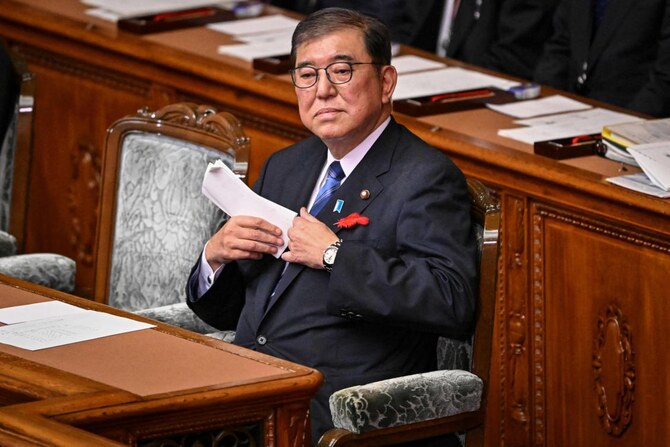
TOKYO: Prime Minister Shigeru Ishiba dissolved Japan’s lower house of parliament Wednesday to set up an Oct. 27 snap election and seek a mandate from voters for his 9-day-old government.
Ishiba took office last week as Fumio Kishida resigned after leading the governing Liberal Democratic Party for three years as it was dogged by corruption scandals.
With the early election, Ishiba is seeking to secure a majority in the lower house for his governing party while he is still fresh and before the congratulatory mood fades.
The move has been criticized as prioritizing an election rather than policies and for allowing little debate. But Japan’s opposition has remained too fractured to push the governing party out of power.
Ishiba announced his plans for an election even before he won the party leadership vote and became prime minister. His Cabinet planned later Wednesday to formally announce the election date and the start of campaigning next Tuesday.
Ishiba and his Cabinet will stay in office until they win the election and are reappointed.
The speaker of the house, Fukushiro Nukaga, announced the dissolution of the lower, more powerful of the two parliamentary chambers at a plenary session. All 465 lawmakers stood up, cheered “banzai” and rushed out of the assembly room.
“We will act fairly and squarely in order to win the people’s endorsement for the current administration,” Ishiba told reporters. “Even while the lower house is dissolved the Japanese government must fully function” in tackling national security, disaster response and deflation, he said. “We will devote all our body and soul for the people.”
Ishiba planned to explain the election plans at a news conference late Wednesday, just before heading to Laos to make his diplomatic debut at the Association of Southeast Asian Nations summit.
Opposition leaders have criticized him for rushing to hold an election allowing only three days of parliamentary debate on his policies and before achieving any results.
Even though opposition parties are too fractured to topple the governing party’s almost uninterrupted postwar rule, the first public support ratings for Ishiba as prime minister were only about 50 percent or even lower, the lowest levels for a new leader, according to Japanese media.
Ishiba is increasingly seen as backpedaling on a number of proposals he previously advocated so as not to create controversy ahead of the election.
In his first policy speech at parliament Friday, he did not touch on his goal of establishing a stronger regional military framework and a more equal Japan-US security alliance, a dual surname option for married couples, and other issues seen as controversial or opposed by conservatives within the governing party.
Ishiba is unaffiliated with factions led and controlled by party heavyweights, which some experts say could make his tenure as party leader unstable.
None of his Cabinet ministers is from the late Shinzo Abe’s faction that has been linked to damaging misconduct. He also plans to not endorse some members of the Abe faction in the upcoming election to show his determination for cleaner politics. Opponents have said that’s still too lax, but Ishiba is getting backlash within the party for being too strict.


Ishiba dissolves Japan’s lower house to set up Oct. 27 parliamentary election
https://arab.news/4z2c3
Ishiba dissolves Japan’s lower house to set up Oct. 27 parliamentary election

- Prime Minister Shigeru Ishiba is seeking to secure a majority in the lower house for his governing party while he is still fresh and before the congratulatory mood fades


Iran war unsettles India’s packaged water makers as bottles, caps get pricey
- Higher polymer prices hurt bottled water industry
- Industry worth $5 billion has big multinational players like Pepsi, Coca-Cola
NEW DELHI: The Iran war is rattling India’s $5 billion packaged water market just ahead of the sweltering summer season.
One of the world’s fastest growing bottled water markets is seeing some manufacturers hike prices for distributors, as supply disruptions linked to the war fuel higher costs in everything from plastic bottles to caps, labels and cardboard boxes.
Though retail prices are yet to feel the heat and bigger companies are absorbing the pain, about 2,000 smaller bottled water makers have increased rates for their resellers by around 1 rupee per bottle, a 5 percent hike, which will rise by a further 10 percent in coming days, according to the Federation of All India Packaged Drinking Water Manufacturers’ Association.
Consumers usually pay less than 20 rupees, or around 20 US cents, for a one-liter bottle.
“There is chaos and within the next 4-5 days, this will start impacting customer prices,” said Apurva Doshi, the federation’s secretary general.
Rising oil prices have increased the cost of polymer, which is made from crude oil and is a key material for the industry’s plastic bottles. The cost of material used in making plastic bottles has risen by 50 percent to 170 rupees per kilogram, while the price of the caps has more than doubled to 0.45 rupees apiece. Even corrugated boxes, labels and adhesive tape are costing much more, industry letters showed.
Clean water is a privilege in the country of 1.4 billion people where researchers say 70 percent of the groundwater is contaminated, leaving people reliant on bottled water. Companies including Bisleri, Coca-Cola’s Kinley, Pepsi’s Aquafina, billionaire Mukesh Ambani’s Reliance and Tata all compete for a share of the $5 billion market. The companies did not respond to Reuters request for comment.
PREMIUM WATER FACES HEAT TOO
Within the broad bottled water market, natural mineral water is a $400 million business in India and a new, fast-growing wellness product for India’s wealthy.
The premium water segment accounted for 8 percent of the bottled water market last year in India, compared to just 1 percent in 2021, Euromonitor says.
Aava, which sells mineral water sourced from the foothills of the Aravalli mountains, has increased prices of its water bottles by 18 percent for resellers, Shiroy Mehta, CEO of the company, told Reuters.
“Most manufacturers are absorbing 40-50 percent of the cost to ensure that they don’t lose clients. It’s a poor situation for the beverage industry ahead of the summer season,” he said.
The mass market, however, is dominated by companies that produce “drinking water” to be sold in 1-liter bottles to customers. Clear Premium Water, a brand of India’s Energy Beverages, said in a notice to its distributors there had been an “unprecedented and continuous surge” in prices of key raw materials used in packaging and production.
“It is no longer possible for us to absorb the escalating costs while maintaining existing product prices,” the notice said.


