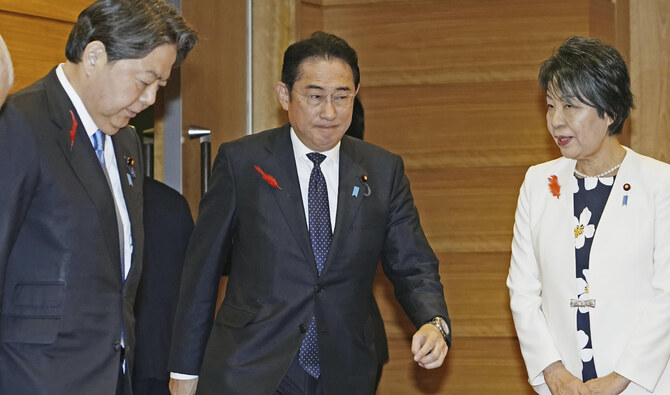
TOKYO: Japan’s Prime Minister Fumio Kishida resigned with his Cabinet on Tuesday, paving the way for his likely successor Shigeru Ishiba to take office.
Kishida took office in 2021 but is leaving so his party can have a fresh leader after his government was dogged by scandals. Ishiba plans to call a parliamentary election for Oct. 27 after he is formally chosen as prime minister later in the day.
“I believe it is important to have the new administration get the public’s judgment as soon as possible,” Ishiba said Monday in announcing his plan to call a snap election. Opposition parties criticized Ishiba for allowing only a short period of time for his policies to be examined and discussed in parliament before the vote.
Ishiba was chosen as the governing Liberal Democratic Party’s leader on Friday to replace Kishida, who announced in August he would resign at the end of his three-year term.
Ishiba is assured of becoming prime minister later Tuesday in a vote by parliament because it is dominated by his party’s ruling coalition.
Kishida and his ministers stepped down at a Cabinet meeting in the morning, Chief Cabinet Secretary Yoshimasa Hayashi said.
Hayashi, who is Kishida’s top confidante, said the world has high expectations for Japan’s diplomatic role, noting a deepening global divide over Russia’s war in Ukraine and the conflict in the Middle East. “We hope the next administration will pursue an active and powerful diplomacy while placing importance on (Japan’s) main pillars such as achieving a free and open Indo-Pacific,” Hayashi said.
Ishiba earlier announced his party’s leaders ahead of naming his Cabinet, once he becomes prime minister. Former Environment Minister Shinjiro Koizumi, who came in third in the party leadership race, will head the party’s election task force. He is expected to name defense experts Takeshi Iwaya as foreign minister and Gen Nakatani as defense chief.
The majority of his Cabinet ministers, like Ishiba, are expected to be unaffiliated with factions led and controlled by party heavyweights, and none are from former Prime Minister Shinzo Abe’s powerful group linked to damaging scandals.
Ishiba’s lack of stable power base could also mean a fragility of his government, and “could quickly collapse” even though Ishiba hopes to build up party unity as it prepares for the upcoming election, the liberal-leaning Asahi newspaper said.
The move is also seen as a revenge by Ishiba, who was largely pushed to the side during most of Abe’s reign.
Ishiba has proposed an Asian version of the NATO military alliance and more discussion among regional partners about the use of the US nuclear deterrence. He also suggested a more equal Japan-US security alliance, including joint management of US bases in Japan and having Japanese Self Defense Force bases in the United States.
Ishiba outlined his views in an article to the Hudson Institute last week. “The absence of a collective self-defense system like NATO in Asia means that wars are likely to break out because there is no obligation for mutual defense. Under these circumstances, the creation of an Asian version of NATO is essential to deter China by its Western allies,” he wrote.
Ishiba proposes combining of existing security and diplomatic groupings, such as the Quad and other bilateral and multilateral frameworks involving the United States, Australia, New Zealand, South Korea and the Philippines.
He also noted that the Asian version of NATO can also consider sharing of the control of US nuclear weapons in the region as a deterrence against growing threats from China, North Korea and Russia.
Ishiba on Friday stressed Japan needs to reinforce its security, noting recent violations of Japanese airspace by Russian and Chinese warplanes and repeated missile launches by North Korea.
He pledged to continue Kishida’s economic policy aimed at pulling Japan out of deflation and achieving real salary increases, while tackling challenges such as Japan’s declining birthrate and population and resilience to natural disasters.
The LDP has had a nearly unbroken tenure governing Japan since World War II. The party members may have seen Ishiba’s more centrist views as crucial in pushing back challenges by the liberal-leaning opposition and winning voter support as the party reels from corruption scandals that drove down Kishida’s popularity.
Ishiba, first elected to parliament in 1986, has served as defense minister, agriculture minister and in other key Cabinet posts, and was LDP secretary general under Abe.


![]()

Japan’s Prime Minister Kishida steps down to make way for likely successor Shigeru Ishiba
Short Url
https://arab.news/6tuyt
Japan’s Prime Minister Kishida steps down to make way for likely successor Shigeru Ishiba
- Kishida took office in 2021 but is leaving so his party can have a fresh leader after his government was dogged by scandals
- Ishiba plans to call a parliamentary election for Oct. 27 after he is formally chosen as prime minister later in the day


Latest updates


© 2026 SAUDI RESEARCH & PUBLISHING COMPANY, All Rights Reserved And subject to Terms of Use Agreement.