TOKYO: Japan’s new prime minister will be formally elected by parliament on October 1 following next week’s leadership contest, a ruling party official said Wednesday.
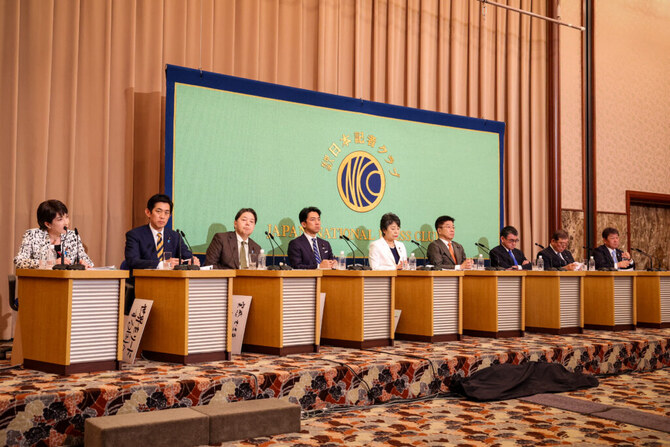
Polls indicate that three frontrunners are emerging among the nine candidates to succeed Fumio Kishida as head of the Liberal Democratic Party (LDP) in the September 27 internal vote.
They are conservative economic security minister Sanae Takaichi, 63, former LDP secretary general Shigeru Ishiba, 67, and Shinjiro Koizumi, 43, son of former premier Junichiro Koizumi.
The conservative LDP — which has governed almost uninterrupted for decades — holds a majority in parliament, meaning the winner of the party election is essentially guaranteed to become premier.
Yasukazu Hamada, a LDP lawmaker in charge of parliament affairs, told his opposition counterpart that the party “plans to convene a parliament session on October 1” to elect the new prime minister, a LDP official told AFP.
The opposition party accepted the date, which will be formally announced by the government on Monday, media reports said.
Kishida, 67, whose three-year term was tarnished by scandals, voter anger over rising prices and sliding poll ratings, announced last month that he was stepping down.
In the leadership election, each of the LDP’s 367 parliament members cast a vote, and another 367 votes will be determined based on the preferences of rank-and-file party members and supporters.
Polls by different Japanese media have put Takaichi, Ishiba and Koizumi in the lead, although this is no guarantee any of them will emerge as the eventual winner.
Koizumi would be Japan’s youngest-ever premier while Takaichi, a vocal nationalist popular with the LDP’s conservative wing, would be the country’s first woman leader.
As a regular visitor to the Yasukuni shrine to Japan’s war dead, which includes convicted war criminals — her nomination would likely rile victims of Japan’s wartime aggression such as China and South and North Korea.


Japan to formally elect new prime minister on October 1
https://arab.news/g6es6
Japan to formally elect new prime minister on October 1

- Polls indicate that three frontrunners are emerging among the nine candidates to succeed Fumio Kishida as head of the Liberal Democratic Party (LDP)


Russia committed ‘crimes against humanity’ in deporting Ukrainian children: UN inquiry
- The inquiry said Russia had deported or transferred “thousands” of children from occupied areas of Ukraine, of which it had so far confirmed 1,205 cases
- “Four years on, 80 percent of the children deported or transferred in the cases investigated by the commission have not returned,” it said
GENEVA: Moscow’s deportation and forcible transfer of children from Ukraine to Russia amounts to a crime against humanity, a United Nations team of investigators said Tuesday.
The UN’s Independent International Commission of Inquiry on Ukraine said it had collected evidence leading it to conclude that “Russian authorities have committed the crimes against humanity of deportation and forcible transfer, as well as of enforced disappearance of children.”
The probe was established by the UN Human Rights Council shortly after Moscow launched its full-scale invasion of Ukraine in February 2022.
The inquiry said Russia had deported or transferred “thousands” of children from occupied areas of Ukraine, of which it had so far confirmed 1,205 cases.
“Four years on, 80 percent of the children deported or transferred in the cases investigated by the commission have not returned,” it said.
Moscow has failed to establish a system facilitating returns, and has instead focused on long-term placement of the children with families or institutions in Russia, while relatives were not informed of their fate.
The commission confirmed its previous finding that Russian authorities had unlawfully deported and transferred children — as a war crime — “and that they have unjustifiably delayed their repatriation, which is also a war crime.”
These measures “were not guided by the best interests of the child,” and have violated international law, the probe found.
- Putin cited -
It said the involvement of Russian President Vladimir Putin, “including through his direct authority over entities that have steered and executed this policy, has been visible from the outset.”
In 2023, the International Criminal Court issued a war crimes arrest warrant against Putin, accusing him of “unlawfully deporting” Ukrainian children.
The issue is highly sensitive in Ukraine and remains central to negotiations for a potential peace agreement between Kyiv and Moscow.
According to Kyiv, nearly 20,000 Ukrainian children have been forcibly removed since Russia’s full-scale invasion.
Russia insists it has moved some Ukrainian children from their homes or orphanages to protect them from hostilities.
As for Russian trials in the context of its invasion of Ukraine, the commission found that Russian authorities have “systematically fabricated evidence” and “systematically violated a range of fair trial guarantees,” while judges “have not acted with independence and impartiality.”
- ‘Extreme violence’ -
The commission also probed the situation of nationals from 17 countries who were recruited — either voluntarily or through deception — to fight with Russian troops in Ukraine.
They included men from Azerbaijan, Belarus, Brazil, Cuba, Egypt, Ghana, India, Iraq, Kazakhstan, Kenya, Nepal, Somalia, Sri Lanka, Tajikistan, Turkiye and Yemen.
“After training, usually lasting between one week and 30 days, they were forced to serve on frontlines in Ukraine, often assigned extremely dangerous duties,” the commission said in its report.
Commanders arbitrarily imposed “extreme violence” as punishment for refusing orders that meant almost certain death, with soldiers describing being treated like “cannon fodder,” sent on “meat assaults” without training or necessary equipment, and “forced to advance at all costs.”
“The evidence collected demonstrates abusive behavior, cruelty, humiliation, inhuman treatment, and a total disregard for human life and dignity, perpetrated with a sense of impunity,” the report said.
Regarding Ukraine, the report voiced concern about the overly broad definition and sometimes distorted interpretation of the crime of “collaboration.”
The commission also said reports regarding violent treatment of conscientious objectors during Ukrainian mobilization were “a source of concern.”
The report will be presented at the Human Rights Council in Geneva on Thursday.
Moscow does not recognize the commission and does not answer its requests for access, information and meetings.


