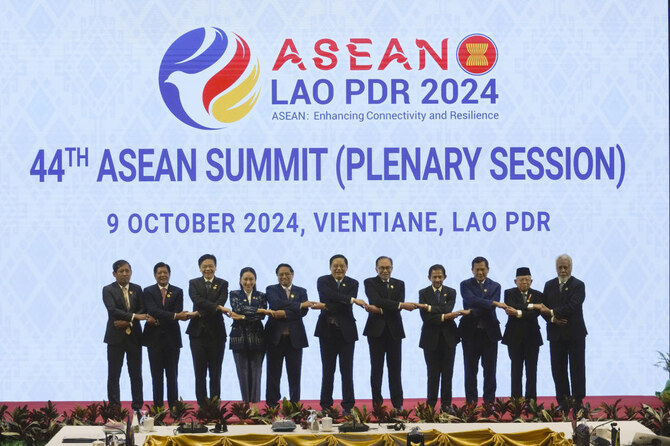
VIENTIANE, Laos: Southeast Asian leaders gathered in the capital of Laos on Wednesday for an annual regional forum that will focus on tackling the prolonged civil war in Myanmar and territorial tensions in the South China Sea, two key challenges that have long tested the bloc’s credibility.
The Association of Southeast Asian Nations summit will also be followed by meetings with global powers including China, the United States and Russia, which are contending for influence in the region.
The timing of the meetings in Vientiane makes it likely that talks will also touch on the escalation of violence in the Middle East, although Southeast Asia has faced only indirect fallout.
ASEAN’s influence has historically been limited even among its own members, but the forum has often served as a platform for dialogues among superpowers looking to engage with the region.
The 10-member states of ASEAN – Indonesia, Thailand, Singapore, Philippines, Vietnam, Malaysia, Myanmar, Cambodia, Brunei and Laos – will also hold talks with their dialogue partners from elsewhere in the region including Japan, South Korea, India and Australia on topics ranging from the economy to climate change and energy.
Lao Prime Minister Sonexay Siphandone welcomed new leaders from Thailand and Singapore to the summit in his opening speech. He said Lao, one of the poorest countries in the bloc, aims to help members work together to manage geopolitical and economic challenges under its chairmanship.
“We help one another, and work together the ASEAN way,” he said. “We will discuss and strengthen cooperation between ASEAN members and other dialogue partners, along with upholding the unity and centrality of ASEAN.”
Thailand’s Paetongtarn Shinawatra, who took the premiership in August, is the bloc’s youngest leader at 38. Singapore’s Prime Minister Lawrence Wong took over in May from Lee Hsien Loong, who stepped down after 20 years. Vietnam also has a new leader after President To Lam took office in August, but the country is being represented by Prime Minister Pham Minh Chinh.
President Joko Widodo of Indonesia, ASEAN’s biggest member, is skipping the forum as his successor Prabowo Subianto prepares to take office later this month, sending Vice President Ma’ruf Amin in his stead. It will also be the first overseas trip for Japan’s new prime minister Shigeru Ishiba, who was confirmed just last week.
US Secretary of State Antony Blinken will fill in for President Joe Biden at the meetings, while China will be represented by Premier Li Qiang.
Frayed US-China relations, particularly over Beijing’s increasing assertiveness in the disputed South China Sea, will be a major agenda item for Blinken, said Dan Kritenbrink, the top US diplomat for Asia. He could not say if Blinken plans to hold separate meetings in Laos with Chinese officials.
“A number of (China)-related issues are likely to come up in the context of the ASEAN meetings, including the situation in the South China Sea and China’s continuing to take a number of escalatory and irresponsible steps designed to coerce and pressure many in the South China Sea claimants,” Kritenbrink said.
ASEAN members Vietnam, the Philippines, Malaysia and Brunei, along with Taiwan have overlapping claims with China, which claims sovereignty over virtually all of the South China Sea and has become increasingly aggressive in attempts to enforce them. ASEAN members and China are negotiating a non-binding code of conduct to govern behavior in the sea, but progress has been slow.
Chinese and Philippine vessels have clashed repeatedly this year, and Vietnam charged last week that Chinese forces assaulted its fishermen in disputed areas in the South China Sea. China has also sent patrol vessels to areas that Indonesia and Malaysia claim as exclusive economic zones. The Philippines, a longtime US ally, has been critical of other ASEAN countries for not doing more to get China to back away.
Muhammad Faizal Abdul Rahman, research fellow at Singapore’s S. Rajaratnam School of International Studies, said there’s little chance of clear outcomes as those not in direct conflict with China – the region’s top trade and investment partner – will likely prioritize ties with Beijing,
“It is the preference for conflict avoidance while getting geostrategic benefits where possible,” he said. “In reality, national interests matter more than regional interests.”
ASEAN’s credibility has also been severely tested by the crisis in Myanmar, where close to 6,000 people have been killed and over 3 million displaced since the army ousted the elected government of Aung San Suu Kyi in February 2021.
Myanmar’s junta has agreed to an ASEAN peace plan that calls for ceasefire and mediation, but hasn’t followed through as it continues battling pro-democracy guerillas and ethnic rebels. It’s widely believed that considerably less than half the country’s territory is under the army’s control.
Thailand is expected to host an informal regional consultation on the Myanmar crisis in December, although it is unclear who will attend from Myanmar. Foreign Ministry spokesperson Nikorndej Balangura said the meeting will be open to all ASEAN members at a ministerial level and possible to countries with a shared border with Myanmar.
“Thailand is ready to coordinate to create a concerted ASEAN effort that will lead to peace in Myanmar,” he told reporters.
Myanmar sent Foreign Ministry permanent secretary Aung Kyaw Moe to the summit, its first high-level representative at the summit in three years, after ASEAN barred it from sending political representatives in late 2021.
Allowing a senior diplomat from Myanmar to join the meetings “will be perceived as ASEAN is compromising, confirming the concern that ASEAN is experiencing fatigue in dealing with the crisis,” said Lina Alexandra, senior researcher at Indonesia’s Center for Strategic and International Studies. Chances for any significant breakthrough on the crisis remain slim, she said.


![]()

ASEAN leaders meet in Laos summit to tackle Myanmar, South China Sea
Short Url
https://arab.news/8jbrr
ASEAN leaders meet in Laos summit to tackle Myanmar, South China Sea
- ASEAN summit will also be followed by meetings with global powers including China, the United States and Russia
- ASEAN’s influence has historically been limited even among its own members, but the forum has often served as a platform for dialogues among superpowers


Latest updates


Recommended


© 2026 SAUDI RESEARCH & PUBLISHING COMPANY, All Rights Reserved And subject to Terms of Use Agreement.