Russia, China FMs to meet as ASEAN talks get underway in Laos

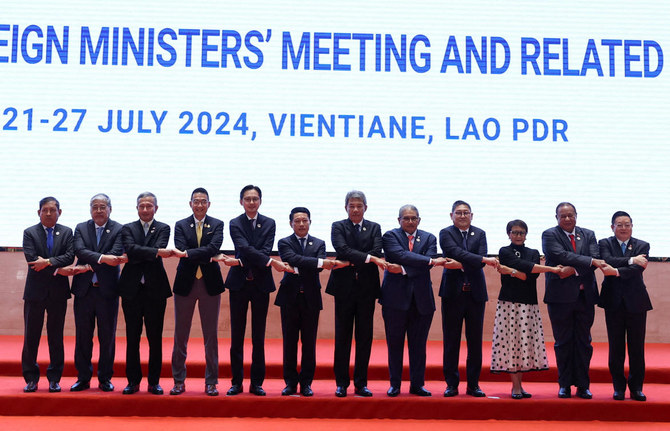
ASEAN foreign ministers pose for a family photo on the day of the 57th ASEAN Foreign Ministers’ Meeting at the National Convention Center in Vientiane, Laos on July 25, 2024. (Reuters)
Short Url
Updated 25 July 2024
Follow

Russia, China FMs to meet as ASEAN talks get underway in Laos

  • ASEAN ministers thrashing out a common position on the civil war raging in member state Myanmar on Thursday

VIENTIANE: The foreign ministers of Russia and China will meet on the sidelines of Association of Southeast Asian Nations (ASEAN) foreign ministers talks in Laos on Thursday, according to a schedule seen by AFP.
The three-day meeting of the 10-member ASEAN bloc started in the capital Vientiane on Thursday, with tensions in the South China Sea and the conflict in Myanmar high on the agenda.
Sergei Lavrov will meet Wang Yi at 6 p.m. local time (1100 GMT) for a 40-minute “ministerial meeting,” according to the schedule.
Both men have already arrived in Vientiane, journalists said, to attend the ASEAN talks as observers along with foreign ministers from the United Kingdom and Canada.
India’s Foreign Minister Subrahmanyam Jaishankar arrived in Vientiane on Thursday and US Secretary of State Antony Blinken is also expected to attend.
ASEAN ministers were thrashing out a common position on the civil war raging in member state Myanmar on Thursday, a Southeast Asian diplomat at the talks said.
“Myanmar is not resolved yet but we’re almost there,” the source said, requesting anonymity in order to speak to the media.
A draft ASEAN communique seen by AFP said ministers “strongly condemned” the continued violence unleashed by the military’s coup in 2021 that has plunged the country into turmoil.
The junta is struggling to crush armed opposition to its coup and has been barred from high-level ASEAN meetings over its crackdown on dissent.
It had previously refused to send “non-political representatives” to attend high-level ASEAN meetings but two senior bureaucrats are representing Myanmar at the talks in Vientiane.
The military’s readiness to re-engage diplomatically was a sign of its “weakened position,” the diplomatic source told AFP.
An ethnic minority armed group claimed on Thursday its fighters had captured a town and a military regional command in northern Shan state, although the junta said it was still in control.
Indonesia’s foreign minister slammed on Thursday the Myanmar junta’s unwillingness to engage with a regional peace plan to resolve the crisis sparked by its coup.
Retno Marsudi made the remarks after meeting her Singaporean counterpart on the sidelines of the Vientiane meeting.
Weeks after it seized power, the junta agreed to a five-point peace plan with ASEAN that it has since ignored as it wages a crackdown on dissent and battles armed opposition to its rule.
“We shared the same view on the lack of commitment of Myanmar military junta to implement the 5PC (five point consensus),” Marsudi wrote on social media platform X.
A series of clashes between Philippine and Chinese vessels at flashpoint reefs in the South China Sea in recent months is also on the ASEAN agenda, the diplomatic source said.
Beijing claims the waterway, through which trillions of dollars of trade passes annually, almost in its entirety despite an international court ruling that its assertion has no legal basis.
A Filipino sailor lost a thumb in a June 17 confrontation when Chinese coast guard members wielding knives, sticks and an axe foiled a Philippine Navy attempt to resupply its troops on a remote outpost.
The source said the Philippines was trying to insert a mention of injuries to its people in the joint communique, expected later Thursday.
Blinken is also expected to “discuss the importance of adherence to international law in the South China Sea” when he arrives in Laos, according to the US State Department.


’Only a miracle can end this nightmare’: Eritreans fear new Ethiopia war

Updated 6 sec ago
Follow

’Only a miracle can end this nightmare’: Eritreans fear new Ethiopia war

  • Now the fractious Horn of Africa rivals have begun trading barbs and accusations of war-mongering once more
  • It is extremely difficult to gather testimonies from Eritrea, where dissidents often disappear to prison

ADDIS ABABA: Tewolde has fought multiple times for Eritrea, one of the most closed societies on Earth, and is now praying another war is not about to break out with neighboring Ethiopia.
“If the war starts, many people will go to the front and, as before, many children will lose their fathers, mothers will lose their husbands, parents will lose their children,” said Tewolde, who is in his 40s and lives in the Eritrean capital Asmara.
He fought first in the late 1990s during Eritrea’s horrific border war with Ethiopia, and more recently during clashes against rebels in the Ethiopian region of Tigray.
Now the fractious Horn of Africa rivals have begun trading barbs and accusations of war-mongering once more.
“We’ve already experienced this (before) and we know the losses are severe,” said Tewolde, who gave a false name to protect his identity in a country regularly described by rights groups as the North Korea of Africa.
It is extremely difficult to gather testimonies from Eritrea, where dissidents often disappear to prison. To obtain a few words from Tewolde, AFP had to pass questions and answers through an intermediary.

- ‘Incessant aggression’ -

Eritrea, a country of around 3.5 million, has been ruled by President Isaias Afwerki since independence from Ethiopia in 1993 and ranks near the bottom of every rights indicator.
Civilians are conscripted into the army for life or forced into a national service program that the United Nations has compared to slavery.
Ethiopian Prime Minister Abiy Ahmed won a Nobel Peace Prize in 2019 for signing a long-awaited peace deal with Eritrea shortly after coming to power and, in darkly ironic fashion, the two sides joined forces in the brutal war against the Tigrayans from 2020 to 2022.
Eritrea was not pleased that Ethiopia sued for peace without its input and has accused its landlocked neighbor of planning to seize its port at Assab.
For its part, Ethiopia has lately complained that Eritrea has been “actively preparing” for renewed conflict.
Ethiopian Foreign Minister Gedion Timothewos last month said that “Eritrean aggression and provocation is making further restraint more and more difficult.”

- ‘Fleeing en masse’ -

Mehari, an Eritrean in his 30s, fought in the Tigray war, where his army was accused of horrific war crimes.
“Young people are fleeing en masse to Ethiopia... and to Sudan to avoid a possible war,” he told AFP.
Another Eritrean, Luwan, left the country several years ago and now lives in an east African country, which she did not want to name for fear of reprisals against her family back home.
She says her family are terrified after a relative was summoned to a meeting and told to “prepare herself, her sons and daughters because she was told Abiy will start a war against her and the Eritrean people,” she said.
Some mothers at the meeting “still haven’t been informed about where their children are from the last war in Tigray, but still they are being asked to send their remaining children to the front,” Luwan added.
Eritrean Information Minister Yemane Ghebremeskel did not respond to a request for comment from AFP.
A former independence activist now in exile, researcher Mohamed Kheir Omer, said young people are split between their fear of conflict and of being overrun by Ethiopia, whose wartime atrocities are still in recent memory.
“We are torn between Isaias who does not care about his population, and Abiy who thinks only of his own legacy,” he said.
Luwan said she was desperate.
“Only a miracle can end this nightmare.”