

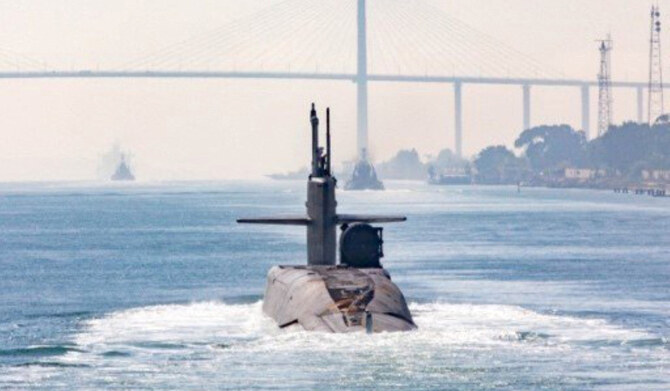

JERUSALEM: Israel has promised to retaliate for Iran’s massive missile attack last week. How it does so involves great risk, and could have major repercussions for the archenemies, the Middle East and the world.
Israel’s options range from symbolic strikes on military targets to crippling attacks on Iran’s vital oil industry or its secretive and heavily fortified nuclear program.
The intensity and timing of any retaliatory strike was expected to top the agenda of a planned meeting this week at the Pentagon between Israel’s defense minister and his US counterpart. But late Tuesday, the Pentagon said the meeting was abruptly postponed.
In a sign of possible disagreement over the right approach, President Joe Biden has already urged Israel not to hit Iran’s nuclear program and discouraged it from hitting the oil industry.
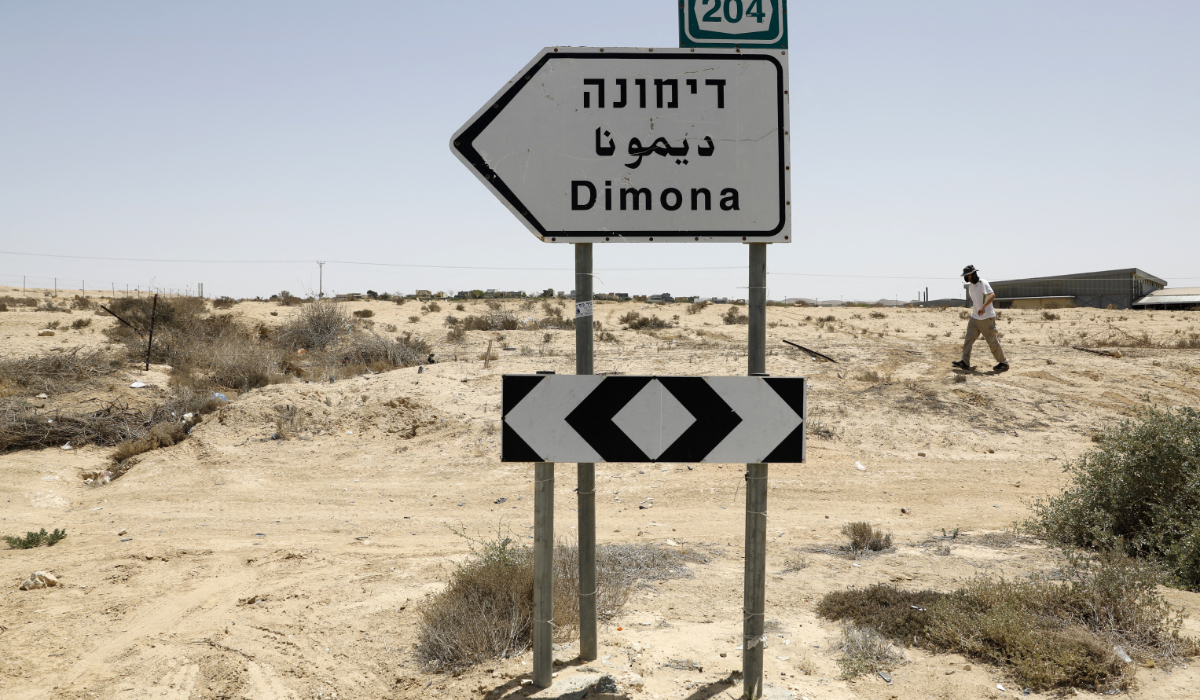
A view of a road sign directing towards the city of Dimona, close to the nuclear power plant in the southern Israeli Negev desert. (AFP file photo)
The Associated Press spoke to two former Israeli prime ministers and other experts to explore Israel’s options. There is broad consensus that Israel must strike back, but deep disagreement over the best way to do so.
“The question is not whether Israel will retaliate or respond,” former Prime Minister Ehud Olmert told AP. “The question is which way.”
Why is Israel threatening Iran?
Israel and Iran have been involved in a bitter shadow war for years — primarily through Israel’s battles against Iranian-backed militant groups across the region. Israel also has been suspected of killing Iranian nuclear scientists and carrying out attacks on Iranian nuclear facilities, but it rarely acknowledges involvement.
Direct clashes have been rare. But things changed after Hamas attacked Israel from the Gaza Strip on Oct. 7, 2023, and Hezbollah began firing rockets at Israel the following day. Both groups receive support from Iran.
In April, Iran fired over 300 drones and missiles toward Israel after accusing it of killing two Iranian generals in a diplomatic compound in Syria. Nearly all of the missiles malfunctioned or were intercepted, and Israel responded with a limited strike that signaled it did not want any further escalation.
After last week’s Iranian attack, Israel signaled its next response would be different.
Iran said the barrage of at least 180 ballistic missiles was to avenge a series of Israeli strikes against its close allies, Hamas and Hezbollah, including the assassination of the group’s longtime leader. Although the missiles caused little damage or casualties, Prime Minister Benjamin Netanyahu said Iran had made a “big mistake and it will pay for it.” Members of his hard-line coalition have called for a harsh response.
What options does Israel have?
Israel has a broad range of choices of targets – from Iranian government buildings and military bases to sensitive oil installations to heavily fortified nuclear facilities hidden deep below ground. Israel accuses Iran of developing nuclear weapons — a charge Iran denies.
Striking anywhere in Iran is a logistical challenge for Israel. Warplanes would need to fly over 1,500 kilometers (about 1,000 miles) to their target, requiring a complicated midair refueling operation, potentially over hostile skies. Any strike would also mean confronting Iran’s Russian-made air-defense systems.
“Remember that Iran is 1,500, 1,600 kilometers (about 1,000 miles) away from Israel, and you have countries in between — Jordan, Iraq, Saudi Arabia. Some are friends. Some are foes,” said Yoel Guzansky, a senior researcher at the Institute for National Security Studies in Tel Aviv and a former adviser on Iranian affairs on Israel’s National Security Council.
“You don’t want to embarrass your friends. You don’t want to get hostile fire from other countries,” he said.
Olmert, who served as prime minister from 2006 to 2009, said Israel is more than capable of coping with these challenges.
“We have the capabilities,” he said. “I’m not certain it would be wise and responsible to expose them.”
Even if Israel has the means, there are diplomatic considerations. A strike on the oil sector, Iran’s economic backbone, or on the nuclear program would almost certainly guarantee an Iranian response and raise the risk of further escalation.
Such strikes could rattle global oil markets and shake the US economy on the eve of a presidential election. They also could risk Iranian retaliation not only against Israel, but against American troops stationed in the region or Gulf Arab countries aligned with the West.
“Unlike Lebanon and Gaza, every Israeli attack on Iran has international and global repercussions,” said Menahem Merhavy, an Iran expert at Hebrew University in Jerusalem.
So how will Israel respond?
Former leaders are divided on what path Israel should choose.
Olmert said a strike on multiple military targets, spread across Iran’s vast territory, would be more than enough to send a message. The goal, he said, is to show that Israel can strike anywhere and anytime.
“That’s precisely what deterrence is all about,” he said.
Olmert said hitting Iran’s oil sector would be an unnecessary escalation that invites a response, and that striking the nuclear program is not worth the risk. Not only would it trigger Iranian retaliation, but the odds of success are uncertain, he said.
“Trying to attack the nuclear program will be a mistake,” he said.
Another former prime minister, Yair Lapid, believes Israel should strike Iran’s oil industry infrastructure.
“That is the most painful target for the Iranian regime,” Lapid, who served as premier in 2022, said in a written response to a question from The Associated Press.
“Iran’s ballistic missile attack against Israel must be met with a forceful response,” he said, adding that Iran must understand “there is a high cost to its regional aggression.”
In an interview with the Israeli news site Ynet, Lapid said a strike on Iran’s nuclear facilities should only be done as part of an international coalition in coordination with the United States.
Lapid’s predecessor as prime minister and former governing partner, Naftali Bennett, takes an even tougher line, saying now is the time for Israel to bomb the Iranian nuclear project.
Bennett said in a video posted on social media Tuesday that Iran and its allies have been weakened, and that Israel has a rare chance to deliver a decisive blow to Iran’s leadership, economy and nuclear program.
“We must not settle for Iranian military bases or noisy-yet-meaningless actions that are meant only to deliver a message,” Bennett said. “The time for messages is over.”
Olmert, however, said he hopes cooler heads will prevail.
“What do we want to achieve and how far do we want to go and how arrogant do we want to be?” he said. His advice: “Try to be smart.”


