Government justifies ban on Pashtun rights group, cites alleged militant links, anti-state activities

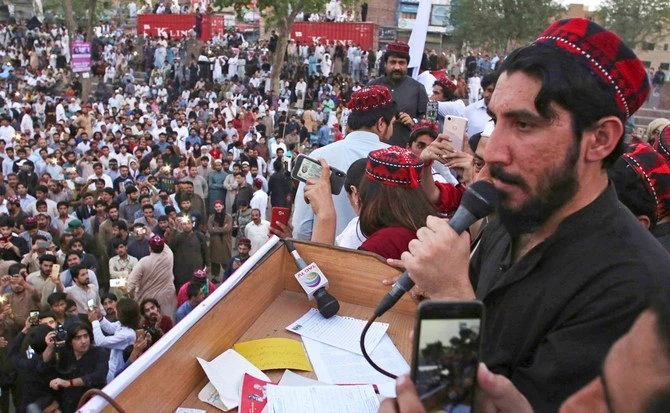
In this file photo, Manzoor Pashteen, a leader of Pashtun Protection Movement addresses his supporters during a rally in Lahore, Pakistan on April 22, 2018. (AP/ File)
Short Url
Updated 08 October 2024
Follow

Government justifies ban on Pashtun rights group, cites alleged militant links, anti-state activities

  • Pakistan’s Interior Ministry recently declared the Pashtun Tahafuz Movement a ‘proscribed organization’
  • Information minister says PTM ‘burned the Pakistani flag, attacked Pakistani embassies’ in other states

ISLAMABAD: Federal Minister for Information and Broadcasting Attaullah Tarar announced on Tuesday that the government’s decision to ban the Pashtun Tahafuz Movement (PTM) stemmed from its alleged links to militant groups and involvement in anti-state activities.
PTM, a prominent Pashtun rights group, has long advocated against extrajudicial killings and enforced disappearances of Pashtuns and other ethnic minorities in Pakistan. While its leaders have contested and won national elections in the country’s northwestern region, the movement has yet to gain significant influence in Pakistan’s parliament.
On Sunday, Pakistan’s Interior Ministry declared the PTM a “proscribed organization,” citing activities harmful to the nation’s peace and security.
“If you look at the activities of the Pashtun Tahafuz Movement over the past six months, [you will see] how they have burned the Pakistani flag, attacked Pakistan’s embassies abroad and not only attacked embassies but also actively funded the promotion of an anti-Pakistan narrative,” Tarar said in a televised statement.
He said the PTM had carried out such activities with the help of Afghan nationals.
“Not only do they have links with TTA or Tehreek-e-Taliban Afghanistan but also Tehreek-e-Taliban Pakistan,” he continued while referring to the Taliban administration in Kabul and a banned militant network reportedly operating from Afghanistan while targeting Pakistani civilians and security forces.
Earlier this year in July, a group of Afghan nationals stormed the Pakistani consulate in Frankfurt, Germany, pelting stones at the building and desecrating the Pakistani flag.
The administration in Islamabad formally lodged a protest with the German authorities, urging them to arrest and prosecute those responsible and to ensure better security for its diplomatic missions.
PTM has previously denied any links with militant groups or violent entities, pointing out that it believes in waging peaceful struggle for the rights of Pashtuns in Pakistan.
“Whenever an organization is declared proscribed,” the minister added, “it is done on the basis of evidence.”
The PTM alleges Pashtuns have faced rights abuses during Pakistan’s war against militants, mainly in its northwestern Khyber Pakhtunkhwa province. It blames Pakistan’s powerful military for rights abuses in the northwestern province, a charge the institution has consistently denied.
Imran Khan not a ‘national security threat,’ ex-PM’s party responds to Pakistan military

Updated 06 December 2025
Follow

Imran Khan not a ‘national security threat,’ ex-PM’s party responds to Pakistan military

  • Pakistan’s military spokesperson on Friday described Khan’s anti-army narrative as a “national security threat”
  • PTI Chairman Gohar Ali Khan says words used by military spokesperson for Khan were “not appropriate”

ISLAMABAD: Former prime minister Imran Khan’s Pakistan Tehreek-e-Insaf (PTI) party on Saturday responded to allegations by Pakistan military spokesperson Lt. Gen. Ahmed Sharif Chaudhry from a day earlier, saying that he was not a “national security threat.”

Chaudhry, who heads the military’s media wing as director general of the Inter-Services Public Relations (ISPR), spoke to journalists on Friday, in which he referred to Khan as a “mentally ill” person several times during the press interaction. Chaudhry described Khan’s anti-army narrative as a “national security threat.”

The military spokesperson was responding to Khan’s social media post this week in which he accused Chief of Defense Forces Field Marshal Asim Munir of being responsible for “the complete collapse of the constitution and rule of law in Pakistan.” 

“The people of Pakistan stand with Imran Khan, they stand with PTI,” the party’s secretary-general, Salman Akram Raja, told reporters during a news conference. 

“Imran Khan is not a national security threat. Imran Khan has kept the people of this country united.”

Raja said there were several narratives in the country, including those that created tensions along ethnic and sectarian lines, but Khan had rejected all of them and stood with one that the people of Pakistan supported. 

PTI Chairman Gohar Ali Khan, flanked by Raja, criticized the military spokesperson as well, saying his press talk on Thursday had “severely disappointed” him. 

“The words that were used [by the military spokesperson] were not appropriate,” Gohar said. “Those words were wrong.”

NATURAL OUTCOME’

Speaking to reporters earlier on Saturday, Pakistan’s Defense Minister Khawaja Asif defended the military spokesperson’s remarks against Khan.

“When this kind of language is used for individuals as well as for institutions, then a reaction is a natural outcome,” he said. 

“The same thing is happening on the Twitter accounts being run in his [Khan’s] name. If the DG ISPR has given any reaction to it, then I believe it was a very measured reaction.”

Khan, who was ousted after a parliamentary vote of confidence in April 2022, blames the country’s powerful military for removing him from power by colluding with his political opponents. Both deny the allegations. 

The former prime minister, who has been in prison since August 2023 on a slew of charges he says are politically motivated, also alleges his party was denied victory by the army and his political rivals in the 2024 general election through rigging. 

The army and the government both deny his allegations.