

Pakistani woman, cousin arrested for poisoning 13 family members over marriage dispute

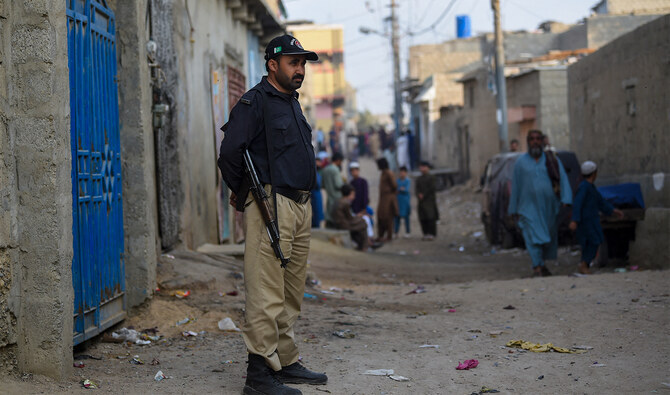
A police personnel stands guard during a search operation to identify alleged illegal immigrants, on the outskirts of Karachi on November 17, 2023. (AFP/File)
Short Url
Updated 08 October 2024
Follow

Pakistani woman, cousin arrested for poisoning 13 family members over marriage dispute

  • Incident took place in a settlement in Sindh after the girl’s father opposed the marriage
  • Police initially suspected that the family had died after consuming contaminated milk

KARACHI: Pakistani police have arrested a woman and her cousin for allegedly poisoning 13 family members to death after facing opposition to their marriage, a police official said on Tuesday.

Ameer Bux Brohi and Shaista Brohi, cousins from a small settlement in Sindh, had hoped to marry each other, but their families disapproved of their decision. Last month, Ameer brought poison, which Shaista mixed into the dough, killing six people instantly. Seven more died later while receiving medical treatment.

Initially, authorities believed the victims had died from consuming contaminated milk. However, chemical analysis conducted by the Sukkur Chemical Laboratory confirmed the presence of toxic substances, including insecticide and benzodiazepine, in the bodies of the deceased.

“We have arrested both Ameer Bux Brohi and Shaista Brohi, who have confessed to their crime,” Dr. Samiullah Soomro, Senior Superintendent of Police in Khairpur, told Arab News. “They told the police that they loved each other and together poisoned their family members.”

Talib Hussain Junejo, Station House Officer in the area where the incident happened, said both families lived together in the same house and consumed the poisoned food. He also informed that 15 members of both families, including Ameer and Shaista, were present when the meals were served, making the law enforcement officials suspicious.
The couple informed the police that Gul Baig, Shaista’s father, had refused the marriage.

“We both decided not to flee to get married,” the police officer said while quoting the suspects’ statement. “Instead, we chose to kill everyone so we could marry freely.”

Junejo said that man and the woman also expressed regret over the actions during the interrogation.

The incident echoes a similar case from 2017, when 21-year-old Aasia Bibi was accused of poisoning her husband’s milk, resulting in the deaths of 17 members of his extended family.

Bibi had repeatedly rejected the man’s marriage proposal but was ultimately forced to marry him. After the wedding, she decided to poison her husband but also caused the death of the rest of the family.


At ECO meeting, Pakistan proposes ‘Regional Innovation Hub’ to curb natural disasters

Updated 21 January 2026
Follow

At ECO meeting, Pakistan proposes ‘Regional Innovation Hub’ to curb natural disasters

  • Pakistan hosts high-level 10th ECO Ministerial Meeting on Disaster Risk Reduction in Islamabad
  • Innovation hub to focus on early warning technologies, risk informed infrastructure planning

ISLAMABAD: Pakistan has proposed to set up a “Regional Innovation Hub on Disaster Risk Reduction” that focuses on early warning technologies and risk informed infrastructure planning, the Press Information Department (PID) said on Wednesday, as Islamabad hosts a high-level meeting of the Economic Cooperation Organization (ECO).

The ECO’s 10th Ministerial Meeting on Disaster Risk Reduction (DRR) is being held from Jan. 21-22 at the headquarters of the National Disaster Management Authority (NDMA) in Pakistan’s capital. 

The high-level regional forum brings together ministers, and senior officials from ECO member states, representatives of the ECO Secretariat and regional and international partner organizations. The event is aimed to strengthen collective efforts toward enhancing disaster resilience across the ECO region, the PID said. 

“Key agenda items include regional cooperation on early warning systems, disaster risk information management, landslide hazard zoning, inclusive disaster preparedness initiatives, and Pakistan’s proposal to establish a Regional Innovation Hub on Disaster Risk Reduction, focusing on early warning technologies, satellite data utilization, and risk-informed infrastructure planning,” the statement said. 

The meeting was attended by delegations from ECO member states including Pakistan, Türkiye, Azerbaijan, Iran, Kyrgyzstan, Tajikistan, Turkmenistan and Uzbekistan. Representatives of regional and international organizations and development partners were also in attendance.

Discussions focused on enhancing regional coordination, harmonizing disaster risk reduction frameworks, and strengthening collective preparedness against transboundary and climate-induced hazards impacting the ECO region, the PID said. 

ECO members states such as Pakistan, Türkiye, Afghanistan and others have faced natural calamities such as floods and earthquakes in recent years that have killed tens of thousands of people. 

Heavy rains triggered catastrophic floods in Pakistan in 2022 and 2025 that killed thousands of people and caused damages to critical infrastructure, inflicting losses worth billions of dollars. 

Islamabad has since then called on regional countries to join hands to cooperate to avert future climate disasters and promote early warning systems to avoid calamities in future.