

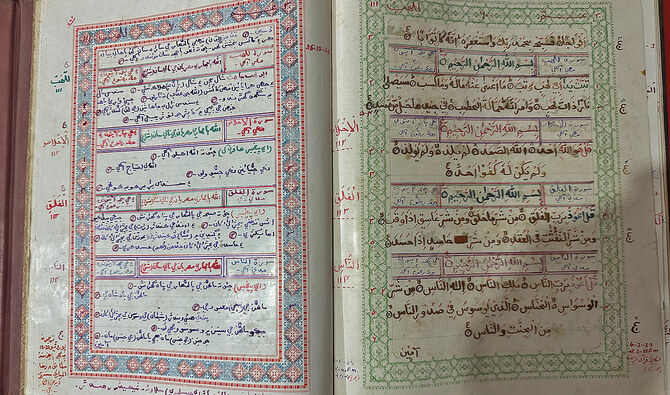
A hand-written Qur’an with Sindhi translation passed down over generations in Pakistan’s Karachi

The picture taken on October 6, 2024, shows a hand-written Qur’an with Sindhi translation at Saghir Hussain Bhojani's, a 76-year-old retired statistician, house in Karachi, Pakistan. (AN photo)
Short Url
Updated 08 October 2024
Follow

A hand-written Qur’an with Sindhi translation passed down over generations in Pakistan’s Karachi

  • Abdul Latif Sultan Dino Bhojani completed the manuscript in 1932 after working on it for two decades
  • Rajasthani-speaking family tries to daily read from Sindhi Qur’an copy to keep grandfather’s work alive

KARACHI: Saghir Hussain Bhojani, a 76-year-old retired statistician, read out the Sindhi translation at his home in Karachi earlier this month as his teenage nephew Mashhood Shoaib Bhojani recited an Arabic verse from a handwritten copy of the Holy Qur’an.

This daily ritual serves not only as a spiritual practice for the Marwari family but also as a bridge to connect them with the Qur’an translation Bhojani’s grandfather, Abdul Latif Sultan Dino Bhojani, took over two decades to write by hand and complete in 1932.

“This [copy of] Holy Qur’an, which Allah has given us through our grandfather, is the greatest treasure for us,” Bhojani, the current custodian of the holy book, told Arab News about the handwritten Qur’anic copy with Sindhi translation. 


The undate photo shows Abdul Latif Sultan Dino Bhojani (right) and Jawar Singh, the ruler of Jaislemere, India. (Saghir Hussain Bhojani)

Bhojani, whose family is Rajasthani-speaking, said he had received the copy from his mother who had gotten it from her father-in-law when she was 20. 

“My father-in-law trusted me,” Zaitoon Bhojani, 95, told Arab News, recalling how Abdul Latif believed she would take care of the translation he had spent decades preparing and handed her the holy book in 1948, just months before he passed away on January 20, 1949, at age 65.


Saghir Hussain Bhojani (left), a 76-year-old retired statistician, shows hand-written Qur’an with Sindhi translation at his house in Karachi, Pakistan on October 6, 2024. (AN photo)

Zaitoon said her father-in-law sought help in preparing the book from a trunk-full of papers that he carried with him as he moved homes in the cities of Hyderabad, Rohri and finally Karachi, where the Silawat community from Jaisalmer in present day India settled after migrating for business to the region some two centuries ago.

Zaitoon preserved the Qur’an copy and made it a point to ensure her nine children, three daughters and six sons, read it regularly, but as she grew older, she decided to pass it on to her eldest son, Bhojani.
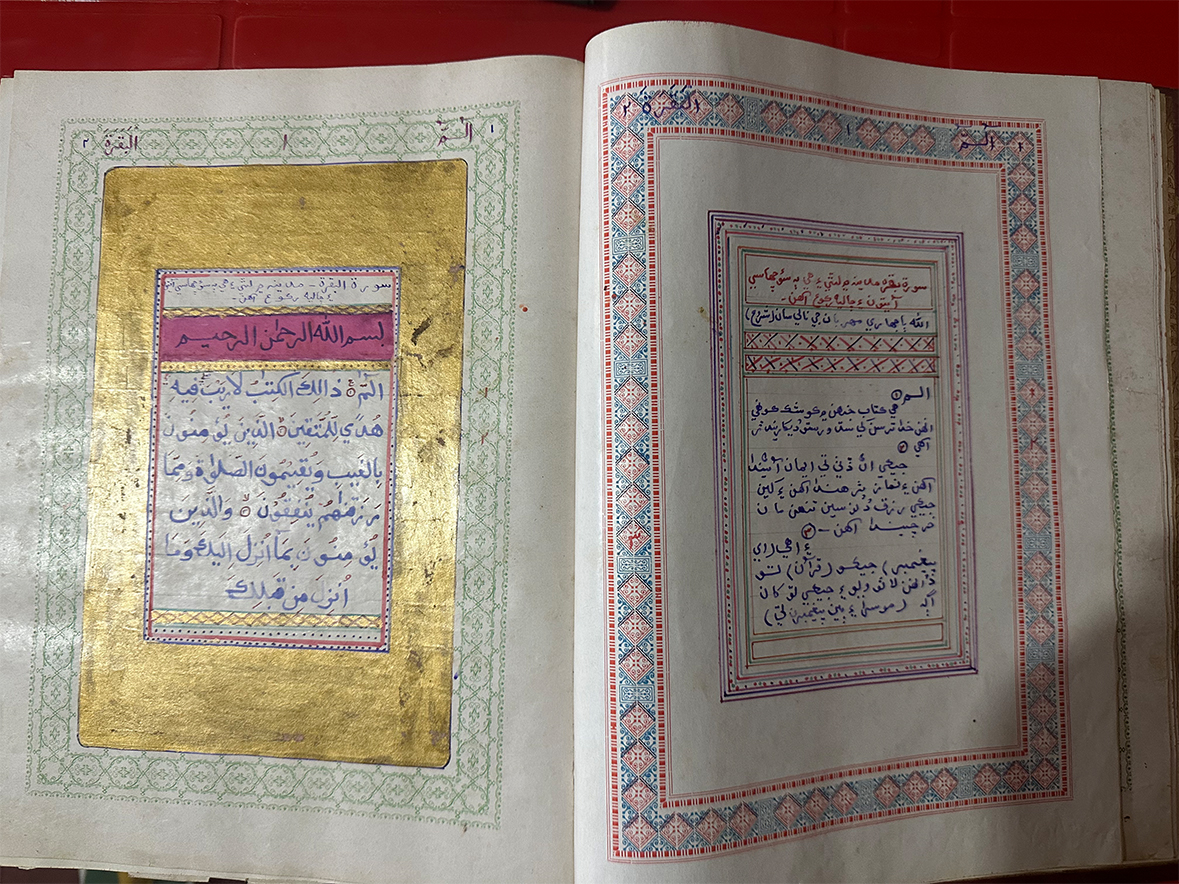


The picture taken on October 6, 2024, shows a hand-written copy of Holy Qur’an with Sindhi translation at Saghir Hussain Bhojani's, a 76-year-old retired statistician, house in Karachi, Pakistan. (AN photo)

“PRECIOUS INHERITANCE”

Born in 1886, Abdul Latif was the first Muslim mayor of Dadu district in Pakistan’s southern Sindh province and was elected chairman of the Kotri municipality several times. But being a close associate of Soreh Badshah, a champion of Hindu-Muslim unity and a freedom fighter executed by the British, cost him much of his property.

“We do not regret this loss because Allah has bestowed upon us a far more precious inheritance, the Holy Qur’an,” said Bhojani. “No matter how much we take pride in it, it is never enough.”


This photograph was taken during the return of Sayyid Sibghatullah Shah Al-Rashidi, popularly known as Soreh Badshah – a spiritual leader of the Hurs during the Indian independence movement, from Hajj in the early 1930s. Abdul Latif Sultan Dino Bhojani is seen fourth from the left in the front row. (Saghir Hussain Bhojani)

Abdul Latif spoke Marwari but chose to write in Sindhi for two reasons, according to his grandson: firstly, Marwari itself was not a formal language at the time, and secondly, he was far more proficient in Sindhi.

“He was the most prominent personality in Kotri,” Bhojani said, regretting that the Sindhi manuscript, a rarity at the time it was completed, was never printed.

“My parents were not very educated and didn’t have much understanding, which is why they couldn’t do it,” Bhojani, who retired as a Grade-18 chief statistician in Sindh, told Arab News. 


The picture taken on October 6, 2024, shows hand-written copies of Holy Qur’an with Sindhi translation at Saghir Hussain Bhojani's house in Karachi, Pakistan. (AN photo)

“It’s also my own incompetence that I didn’t pay attention to [printing] it later ... It should be preserved and read the way my grandfather worked hard to prepare it.”

Bhojani’s nephew, Mashhood, an 18-year-old computer science student, said he would strive to continue the family tradition of reading from and preserving the inherited book. 

“Our native language is Rajasthani and the [copy of] this Qur’an is in Sindhi,” he said as he took a brief pause from recitation.

“I still continue to read it with my uncle so that people like me remain in our family who can continue to read and understand it.”


IMF warns against policy slippage amid weak recovery as it clears $1.2 billion for Pakistan

Updated 11 December 2025
Follow

IMF warns against policy slippage amid weak recovery as it clears $1.2 billion for Pakistan

  • Pakistan rebuilt reserves, cut its deficit and slowed inflation sharply over the past one year
  • Fund says climate shocks, energy debt, stalled reforms threaten stability despite recent gains

ISLAMABAD: Pakistan’s economic recovery remains fragile despite a year of painful stabilization measures that helped pull the country back from the brink of default, the International Monetary Fund (IMF) warned on Thursday, after it approved a fresh $1.2 billion disbursement under its ongoing loan program.

The approval covers the second review of Pakistan’s Extended Fund Facility (EFF) and the first review of its climate-focused Resilience and Sustainability Facility (RSF), bringing total disbursements since last year to about $3.3 billion.

Pakistan entered the IMF program in September 2024 after years of weak revenues, soaring fiscal deficits, import controls, currency depletion and repeated climate shocks left the economy close to external default. A smaller stopgap arrangement earlier that year helped avert immediate default, but the current 37-month program was designed to restore macroeconomic stability through strict monetary tightening, currency adjustments, subsidy rationalization and aggressive revenue measures.

The IMF’s new review shows that Pakistan has delivered significant gains since then. Growth recovered to 3 percent last year after shrinking the year before. Inflation fell from over 23 percent to low single digits before rising again after this year’s floods. The current account posted its first surplus in 14 years, helped by stronger remittances and a sharp reduction in imports. And the government delivered a primary budget surplus of 1.3 percent of GDP, a key program requirement. Foreign exchange reserves, which had dropped dangerously low in 2023, rose from US$9.4 billion to US$14.5 billion by June.

“Pakistan’s reform implementation under the EFF arrangement has helped preserve macroeconomic stability in the face of several recent shocks,” IMF Deputy Managing Director Nigel Clarke said in a statement after the Board meeting.

But he warned that Islamabad must “maintain prudent policies” and accelerate reforms needed for private-sector-led and sustainable growth.

The Fund noted that the 2025 monsoon floods, affecting nearly seven million people, damaging housing, livestock and key crops, and displacing more than four million, have set back the recovery. The IMF now expects GDP growth in FY26 to be slightly lower and forecasts inflation to rise to 8–10 percent in the coming months as food prices adjust.

The review warns Pakistan against relaxing monetary or fiscal discipline prematurely. It urges the State Bank to keep policy “appropriately tight,” allow exchange-rate flexibility and improve communication. Islamabad must also continue raising revenues, broadening the tax base and protecting social spending, the Fund said.

Despite the progress, Pakistan’s structural weaknesses remain severe.

Power-sector circular debt stands at about $5.7 billion, and gas-sector arrears have climbed to $11.3 billion despite tariff adjustments. Reform of state-owned enterprises has slowed, including delays in privatizing loss-making electricity distributors and Pakistan International Airlines. Key governance and anti-corruption reforms have also been pushed back.

The IMF welcomed Pakistan’s expansion of its flagship Benazir Income Support Program, which raises cash transfers for low-income families and expands coverage, saying social protection is essential as climate shocks intensify. But it warned that high public debt, about 72 percent of GDP, thin external buffers and climate exposure leave the country vulnerable if reform momentum weakens.

The Fund said Pakistan’s challenge now is to convert short-term stabilization into sustained recovery after years of economic volatility, with its ability to maintain discipline, rather than the size of external financing alone, determining the durability of its gains.