
JERUSALEM/BEIRUT: Hezbollah fired rockets at Israel’s third-largest city, Haifa, and Israel looked poised to expand its offensive into Lebanon on Monday, one year after the devastating Hamas attack on Israel that sparked the Gaza war.
Israelis held ceremonies and protests to mark the first anniversary of the Oct. 7 attack as the Gaza conflict has spread across the Middle East and raised fears of an all-out regional war.
Iran-backed Hezbollah, an ally in Lebanon of the Palestinian militant group Hamas in Gaza, said it targeted a military base south of Haifa with “Fadi 1” missiles and launched another strike on Tiberias, 65 km (40 miles) away.
The armed group later said it also targeted areas north of Haifa with missiles. Israel’s military said around 190 projectiles had entered Israeli territory on Monday. There were at least 12 injuries.
Israel’s military said the air force was carrying out extensive bombings of Hezbollah targets in south Lebanon and two Israeli soldiers were killed, taking the Israeli military death toll inside Lebanon to 11.
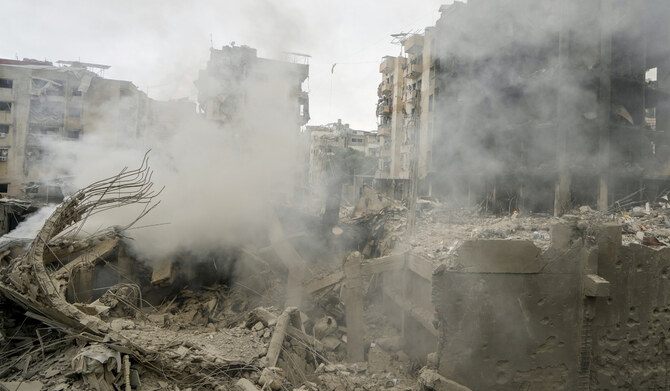
Smoke rises from destroyed buildings at the site of an Israeli airstrike hit in Choueifat, southeast of Beirut, Lebanon, on Oct. 7, 2024. (AP)
Lebanon’s health ministry reported dozens of deaths, including 10 firefighters killed in an airstrike on a municipal building in the border area. Around 2,000 Lebanese have been killed since Hezbollah began firing at Israel a year ago in solidarity with Hamas, most of them killed in the past few weeks.
The Israeli military has described its ground operation in Lebanon as “localized, limited and targeted,” but it has steadily increased in scale beginning last week.
Israel’s superpower ally, the United States, believes the Lebanon ground operation continues to be limited, State Department spokesperson Matthew Miller said on Monday.
On Monday, Democratic US President Joe Biden, Vice President Kamala Harris and Republican former President Donald Trump, who is running against Harris in the Nov. 5 presidential election, all held events to mark the anniversary of Hamas’ attack on Israel.
Israeli soldiers have been moving into southern Lebanon. The Israeli Defense Force (IDF) says their aim is to clear border areas where Hezbollah fighters have been embedded, with no plans to go deep into Lebanon.
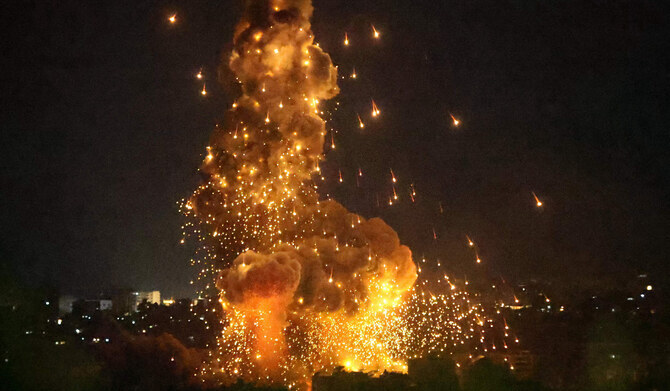
On Monday, Israel within the space of an hour carried out air strikes on 120 targets in southern Lebanon, including against Radwan special forces units, Hezbollah’s missile force and its intelligence directorate.
“This operation follows a series of strikes aimed at degrading Hezbollah’s command, control and firing capabilities, as well as assisting ground forces in achieving their operational goals,” the military said in a statement.
The spiraling conflict has raised concerns that the United States and Iran will be sucked into a wider war in the oil-producing region.
Iran launched a barrage of missiles at Israel on Oct. 1. Israel has said it will retaliate and is weighing its options. Iran’s oil facilities are a possible target.
ROCKETS HIT HAIFA
An Israeli military statement said five rockets were launched toward Haifa, a major Mediterranean port, from Lebanon and interceptors were fired at them.
The statement said 15 other rockets were fired at Tiberias in northern Israel, some of which were shot down. Israeli media said five more rockets hit the area later.
A surface-to-air missile fired at central Israel from Yemen was also intercepted, the military said. The Iran-backed Houthi movement, which controls northern Yemen, has attacked Israel during the past year in what it says is solidarity with Palestinians under attack in Gaza.
Hamas, which triggered the Gaza war with its surprise attack on Israel one year ago, said it targeted Israel’s commercial capital, Tel Aviv, with a missile salvo, setting off sirens.
Many Israelis have regained confidence in their long-vaunted military and intelligence after deadly blows in recent weeks to the command structure of Iran’s proxy force Hezbollah.
“We are changing the security reality in our region, for our children’s sake, for our future, to ensure that what happened on Oct. 7 does not happen again,” Israeli Prime Minister Benjamin Netanyahu said at a cabinet meeting in Jerusalem marking the Gaza war anniversary.
CONFLICT SPREADS
Israeli airstrikes have displaced 1.2 million people in Lebanon, and Israel’s intensified bombing campaign has left many Lebanese worried their country will experience the vast scale of destruction wrought on Gaza by Israel.
Israeli forces issued a warning in Arabic to beachgoers and boat users to avoid a stretch of the Lebanese coast, saying it would soon begin operations against Hezbollah from the sea.
The ceremonies in Israel on Monday included a memorial event for victims of the Nova Music Festival, where militants killed 364 people and kidnapped 44 partygoers and staff on Oct. 7 last year.
In a shock rampage through Israeli towns and kibbutz villages near the Gaza border a year ago, Hamas-led militants killed some 1,200 people and took about 250 hostages back to Gaza, according to Israeli figures.
The huge security lapse led to the single deadliest day for Jews since the Nazi Holocaust.
The Hamas assault unleashed an Israeli offensive on Gaza that has largely flattened the densely populated enclave and killed almost 42,000 people, Palestinian health authorities say.