Pakistan eyes up to $7 billion rice exports to support dwindling economy

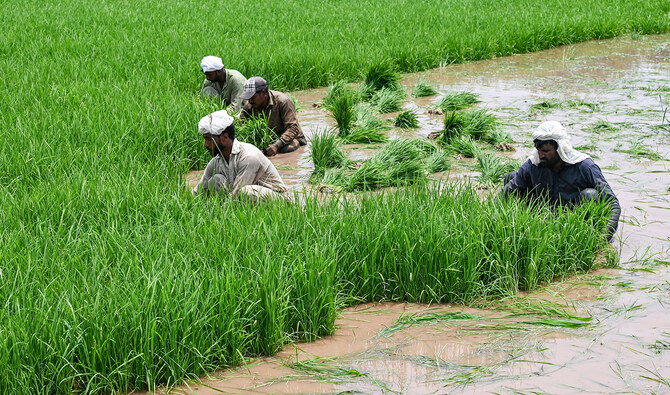
Farmers harvest rice seedlings at a paddy field on the outskirts of Lahore on June 25, 2024. (AFP/File)
Short Url
Updated 07 October 2024
Follow

Pakistan eyes up to $7 billion rice exports to support dwindling economy

  • While India has been the largest exporter of rice worldwide, Pakistan holds 25 percent of the European rice export market
  • Commerce Minister Jam Kamal stresses need for collaboration between government, exporters to maintain this edge

ISLAMABAD: Pakistan’s Commerce Minister Jam Kamal said on Monday the South Asian country aimed to boost its rice exports from the existing $4 billion to as much as $7 billion to support its dwindling economy, Pakistan state media reported.
Kamal said this during a meeting with the Rice Exporters Association of Pakistan (REAP) representatives. Rice exports play a vital role in Pakistan’s economy, ranking second in export value after cotton.
Pakistan is trying to navigate a prolonged economic crisis by actively pursuing foreign investments and enhanced trade opportunities, while it has also reached a staff-level agreement with the International Monetary Fund (IMF) for a $7 billion loan.
The South Asian holds 25 percent of the European rice export market, compared to India’s 16 percent, and there is a need for collaboration between the government and exporters to maintain this competitive edge, according to the commerce minister.
“Rice exports play a vital role in Pakistan’s economy, ranking second in export value after cotton,” Kamal was quoted as saying by the state-run APP news agency. “Rice exporters are a primary source of revenue and employment, with the government aiming to increase exports from $4 billion to $6-7 billion in the near future.”
Pakistan exported rice worth $3.9 billion this year as compared to $2.15 billion last year. It has also withdrawn the minimum export price for all rice varieties to compete with Indian exporters in the global market.
India has been the largest exporter of rice worldwide, followed by Pakistan, Thailand and Vietnam. The South Asian arch-rivals are also the only countries that produce basmati rice which is famous for its unique flavour and aroma around the globe.
“We are focusing on improving our standards to meet international food safety requirements, especially in Europe,” Kamal said.
Increasing rice exports to Malaysia were also part of the discussions held during a recent visit by Malaysian Prime Minister Anwar Ibrahim, who will host a business delegation led by Kamal in November to explore new opportunities.
REAP Chairman Malik Faisal Jahangir said Pakistan’s rice exports faced fewer regulatory challenges with only 74 rapid alerts for pesticides issued last year compared to 264 for India, according to the APP report.
He said Pakistan remained one of the “lowest-risk countries” concerning food safety standards.
Stressing the need to educate farmers to improve quality of rice production, Kamal called for a joint effort by all stakeholders to develop a five-year strategy to enhance the country’s rice export capacity and international standards compliance.
He urged REAP to give proposals on how to meet the government’s export targets within the next year, keeping in mind the “stringent” food safety standards in the European Union.


Pakistan launches privatization process for five power distributors under IMF reforms

Updated 10 sec ago
Follow

Pakistan launches privatization process for five power distributors under IMF reforms

  • Power-sector losses have pushed circular debt above $9 billion, official documents show
  • Move is tied to IMF and World Bank conditions aimed at cutting subsidies and fiscal risk

KARACHI: Pakistan has appointed financial advisers and launched sell-side due diligence for the privatization of five electricity distribution companies, marking a long-awaited step in power-sector reforms tied to International Monetary Fund (IMF) and World Bank programs, according to official documents shared with media on Monday.

The five companies, namely Islamabad Electric Supply Company (IESCO), Faisalabad Electric Supply Company (FESCO), Gujranwala Electric Power Company (GEPCO), Hyderabad Electric Supply Company (HESCO) and Sukkur Electric Power Company (SEPCO), supply electricity to tens of millions of customers and have long been a major source of financial losses for the state.

Pakistan’s power sector has accumulated more than Rs2.6 trillion (about $9.3 billion) in circular debt as of mid-2025, driven largely by distribution losses, electricity theft and weak bill recovery, according to official government data cited in the documents. The shortfall has repeatedly forced the government to provide subsidies, adding pressure to public finances in an economy under IMF supervision.

“The objective is to reduce losses, improve efficiency and limit the government’s fiscal exposure by transferring electricity distribution operations to the private sector,” the documents said, adding that sell-side due diligence for five distribution companies is under way as a prerequisite for investor engagement.

Two utilities, the Quetta Electric Supply Company and Tribal Areas Electric Supply Company, are excluded from the current privatization phase due to security and structural constraints, the documents said.

Power-sector reform is a central pillar of Pakistan’s IMF bailout program, under which Islamabad has committed to restructuring state-owned enterprises, improving governance and reducing budgetary support. The World Bank has also linked future energy-sector financing to progress on structural reforms.

Electricity distribution companies in Pakistan routinely report losses exceeding 20 percent of supplied power, far above international benchmarks, according to official figures. These inefficiencies have been a persistent obstacle to economic growth, investment and reliable power supply.

Previous attempts to privatize power distributors have stalled amid political resistance, labor union opposition and concerns over tariff increases. While officials have not announced a timeline for completing transactions, the launch of due diligence marks the most concrete step taken in years. International lenders and investors will now be closely watching whether Pakistan can translate this phase into completed sales, a key test of its ability to deliver on IMF-backed reforms.

In a related development in Pakistan’s privatization agenda, the government last month concluded the long-delayed sale of a 75 percent stake in national flag carrier Pakistan International Airlines (PIA) in a publicly televised auction. A consortium led by the Arif Habib Group emerged as the highest bidder with a Rs135 billion ($482 million) offer for the controlling stake, in a transaction officials have said will end decades of state-funded bailouts and inject fresh capital into the loss-making airline.