Maldives President Muizzu to meet India’s Modi to repair strained diplomatic ties

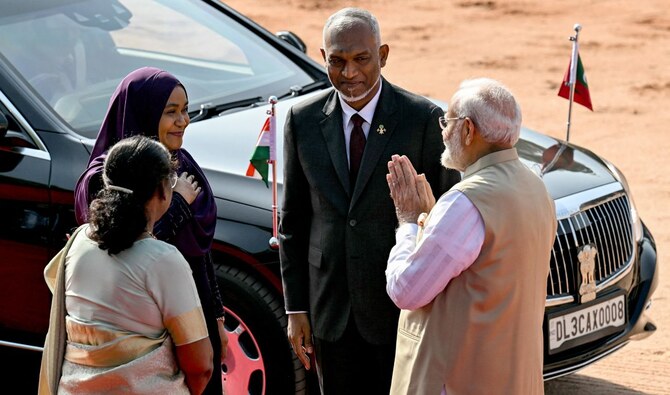
India's President Droupadi Murmu (L) with Prime Minister Narendra Modi (R) welcomes her Maldives counterpart Mohamed Muizzu (2R) and his wife Sajidha Mohamed during Muizzu's ceremonial reception at the presidential palace Rashtrapati Bhavan in New Delhi on October 7, 2024. (AFP)
Short Url
Updated 07 October 2024
Follow

Maldives President Muizzu to meet India’s Modi to repair strained diplomatic ties

  • Tensions between India and Maldives have grown since pro-China Muizzu came to power last year
  • Muizzu had promised to expel Indian soldiers deployed in Maldives to help in humanitarian assistance

NEW DELHI: Maldives President Mohamed Muizzu is expected to talk Monday with Indian Prime Minister Narendra Modi in New Delhi as he aims to repair ties between the countries that have been strained since he came to power last year.

Muizzu and Modi are expected to discuss “bilateral, regional, and international issues of mutual interest,” according to India’s foreign ministry. Muizzu will also hold meetings with senior Indian officials during his five-day India visit.

Tensions between India and Maldives have grown since pro-China Muizzu came to power last year after defeating India-friendly incumbent Ibrahim Mohamed Solih.

Leading up to the 2023 elections, Muizzu had promised to expel Indian soldiers deployed in Maldives to help in humanitarian assistance. In May, New Delhi replaced dozens of these soldiers with civilian experts.

Ties were also strained in January when some Maldivian leaders lashed out at Modi for promoting India’s Lakshadweep archipelago for Indian travelers. Lakshadweep is off the southwestern coast of the Indian mainland.

Maldivian leaders saw the move as a way to lure Indian tourists away from their country and encourage them to visit Lakshadweep instead. It sparked angry protests from Indian celebrities who called for a tourism boycott to Maldives. Tourism is the mainstay of the Maldives’ economy.

The dispute deepened when Muizzu visited China ahead of India in January, a move which was seen as a snub to New Delhi. On his return, Muizzu spelled out plans to rid his tiny nation of dependence on India for health facilities, medicines, and import of staples.

A thaw ensued after Muizzu attended Modi’s June swearing-in ceremony in New Delhi for a third five-year term. Since then, Muizzu has toned down his anti-Indian rhetoric, and official-level contacts have intensified with New Delhi.

India’s foreign minister, Subrahmanyam Jaishankar, on Sunday said he was confident Muizzu’s talks with Modi would give “a new impetus” to the “friendly ties” between the countries.

Regional powers India and China compete for influence in the archipelago nation, which is strategically located in the Indian Ocean.

For decades, India has been a critical provider of development assistance to the Maldives, including infrastructure projects, medical care, and health facilities. Meanwhile, Maldives is part of China’s “Belt and Road” initiative to build ports and highways and expand trade, as well as China’s influence across Asia, Africa, and Europe.

Muizzu’s visit to New Delhi is essential for Modi, who is facing a challenging time in neighborhood diplomacy with Marxist politician Anura Kumara Dissanayake taking over as Sri Lanka’s president and India-friendly Bangladesh Prime Minister Sheikh Hasina fleeing to India in August after being forced to resign by students-led protests. Nepal also now has pro-China K.P. Sharma Oli as its prime minister.

Experts say India needs to maintain close ties with Sri Lanka, Bangladesh, Bhutan, Nepal, and the Maldives, which are its traditional spheres of influence.

UK pays Guantanamo detainee ‘substantial’ compensation over US torture questions

Updated 5 sec ago
Follow

UK pays Guantanamo detainee ‘substantial’ compensation over US torture questions

  • Abu Zubaydah has been held at Guantanamo Bay without charge for 20 years
  • British security services knew he was subjected to ‘enhanced interrogation’ but failed to raise concerns for 4 years

LONDON: A Saudi-born Palestinian being held without trial by the US has received a “substantial” compensation payment from the UK government, the BBC reported.

Abu Zubaydah has been imprisoned at Guantanamo Bay in Cuba for almost 20 years following his capture in Pakistan in 2002, and was subjected to “enhanced interrogation” techniques by the CIA.

He was accused of being a senior member of Al-Qaeda in the aftermath of the Sept. 11 terror attacks on the US. The allegations were later dropped but he remains in detention.

The compensation follows revelations that UK security services submitted questions to the US to be put to Abu Zubaydah by their US counterparts despite knowledge of his mistreatment.

He alleged that MI5 and MI6 had been “complicit” in torture, leading to a legal case and the subsequent compensation.

Dominic Grieve, the UK’s former attorney general, chaired a panel reviewing Abu Zubaydah’s case.

He described the compensation as “very unusual” but said the treatment of Abu Zubaydah had been “plainly” wrong, the BBC reported.

Grieve added that the security services had evidence that the “Americans were behaving in a way that should have given us cause for real concern,” and that “we (UK authorities) should have raised it with the US and, if necessary, closed down co-operation, but we failed to do that for a considerable period of time.”

Abu Zubaydah’s international legal counsel, Prof. Helen Duffy, said: “The compensation is important, it’s significant, but it’s insufficient.”

She added that more needs to be done to secure his release, stating: “These violations of his rights are not historic, they are ongoing.”

Duffy said Abu Zubaydah would continue to fight for his freedom, adding: “I am hopeful that the payment of the substantial sums will enable him to do that and to support himself when he’s in the outside world.”

He is one of 15 people still being held at Guantanamo, many without charge. Following his initial detention, he arrived at the prison camp having been the first person to be taken to a so-called CIA “black site.”

He spent time at six such locations, including in Lithuania and Poland, outside of US legal jurisdiction. 

Internal MI6 messages revealed that the “enhanced interrogation” techniques he was subjected to would have “broken” the resolve of an estimated 98 percent of US special forces members had they been subjected to them.

CIA officers later decided he would be permanently cut off from the outside world, with then-President George W. Bush publicly saying Abu Zubaydah had been “plotting and planning murder.”

However, the US has since withdrawn the allegations and no longer says he was a member of Al-Qaeda.

A report by the US Senate Select Committee on Intelligence said Abu Zubaydah had been waterboarded at least 83 times, was locked in a coffin-like box for extended periods, and had been regularly assaulted. Much of his treatment would be considered torture under UK law.

Despite knowledge of his treatment, it was four years before British security services raised concerns with their American counterparts, and their submission of questions within that period had “created a market” for the torture of detainees, Duffy said.

A 2018 report by the UK Parliament’s Intelligence and Security Committee was deeply critical of the behavior of MI5 and MI6 in relation to Abu Zubaydah. 

It also criticized conduct relating to Guantanamo detainee Khalid Sheikh Mohammed, widely regarded as a key architect of the Sept. 11 attacks, warning that the precedent set by Abu Zubaydah’s legal action could be used by Mohammed to bring a separate case against the UK.

MI5 and MI6 failed to comment on Abu Zubaydah’s case. Neither the UK government nor Mohammed’s legal team would comment on a possible case over his treatment.