

Top official of ex-PM Khan party resurfaces in provincial assembly session after going ‘missing’ in Islamabad

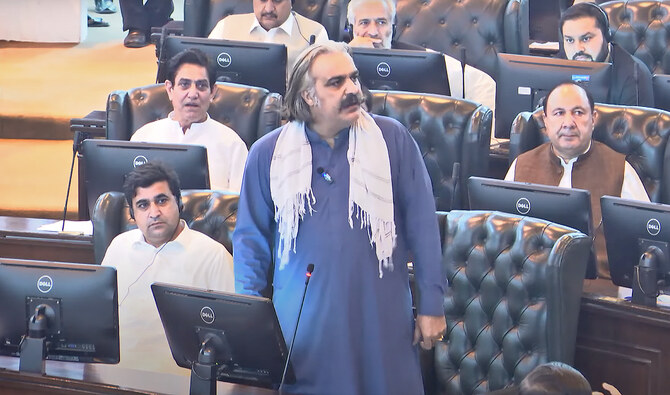
The screenshot taken from the KP Assembly Official live stream video on October 6, 2024, shows Ali Amin Gandapur, a key official of former prime minister Imran Khan’s Pakistan Tehreek-e-Insaf (PTI) opposition party, addressing Khyber Pakhtunkhwa (KP) provincial in Peshawar, Pakistan. ( KP Assembly Official/YouTube)
Short Url
Updated 07 October 2024
Follow

Top official of ex-PM Khan party resurfaces in provincial assembly session after going ‘missing’ in Islamabad

  • Ali Amin Gandapur, who heads the government of Khan's party in Khyber Pakhtunkhwa, went missing after leading thousands of Khan supporters to Islamabad
  • In a surprise turn of events, CM Gandapur resurfaced during a session of the KP assembly on Sunday evening amid cheers and applause from members of House

ISLAMABAD: Ali Amin Gandapur, a key official of former prime minister Imran Khan’s Pakistan Tehreek-e-Insaf (PTI) opposition party, resurfaced during a session of the Khyber Pakhtunkhwa (KP) provincial assembly on Sunday, after having gone missing during his party’s protest in Islamabad a day ago.

Gandapur, who heads the government of Khan’s party in KP, went missing after leading thousands of Khan supporters to the Pakistani capital to protest the government’s proposed constitutional amendments that the PTI claims are aimed at curtailing the independence of the judiciary, the government denies this. The PTI also aimed to mount pressure for the release of its leader who is in jail since August last year.

Mystery continued to surround the whereabouts of Gandapur on Sunday as the PTI protest entered its third day, with at least one policeman killed in clashes and almost 900 demonstrators arrested. The PTI alleged that CM Gandapur had been “kidnapped,” while Pakistan’s Interior Minister Mohsin Naqvi denied the PTI’s claims that the KP chief minister had been abducted by the Islamabad police or intelligence agencies.

In a surprise turn of events, Chief Minister Gandapur resurfaced during a session of the KP assembly on Sunday evening, amid cheers and applause from members of the House. Shortly afterward, he launched into a fiery speech in which he criticized the federal authorities for the road blockades and “torture” to prevent Khan supporters from entering Islamabad.

“We were protesting peacefully, they blocked the roads and tortured the workers,” he said. “Worst violence and shelling was done in Pathargarh, Burhan and other places. They used to say that we could not reach the D-Chowk [in Islamabad], but we reached there. Our protest was not a sit-in, we recorded the protest successfully.”

The KP chief minister accused the Islamabad Inspector-General Ali Nasir Rizvi of “attacking” the KP House, the provincial administration office in Islamabad where Gandapur had arrived on Saturday, with the help of police and paramilitary Rangers.

“When I reached KP House, IG Islamabad entered the KP House with police and Rangers. KP House is part of the KP province, the attack on it was an attack on the province,” he said. “IG Islamabad broke the windows of government vehicles and damaged property. He must be made accountable for damaging KP government property.”

Clashes erupted in Islamabad and nearby cities on Friday and Saturday as police tried to prevent Khan supporters protesters from entering the Pakistani capital, with federal officials accusing protesters accompanying Gandapur of firing tear gas at police. They said Gandapur was accompanied by serving police officers as well as heavy machinery to remove road blockades.

Earlier in the day, Interior Minister Naqvi said CM Gandapur was on the run and the Islamabad police would “deal with him as per law as they are definitely searching for him.”


Pakistan’s federal government has also constituted an inquiry committee to probe the use of resources of the Khyber Pakhtunkhwa (KP) provincial government for this week’s protest in Islamabad by Khan’s party, the Pakistani interior ministry said on Sunday.

Khan’s party says it is facing an over-year-long crackdown since protesters allegedly linked to the PTI attacked and damaged government and military installations on May 9, 2023, after the former premier’s brief arrest the same day in a land graft case.

Hundreds of PTI followers and leaders were arrested following the riots and many remain behind bars as they await trial. The military, which says Khan and his party were behind the attacks, has also initiated army court trials of at least 103 people accused of involvement in the violence.

Khan, who has been in jail since last August, was ousted from the PM’s office in 2022 in a parliamentary vote of no confidence after what is widely believed to be a falling out with Pakistan’s powerful military, which denies being involved in politics.


Pakistan, global crypto exchange discuss modernizing digital payments, creating job prospects 

Updated 05 December 2025
Follow

Pakistan, global crypto exchange discuss modernizing digital payments, creating job prospects 

  • Pakistani officials, Binance team discuss coordination between Islamabad, local banks and global exchanges
  • Pakistan has attempted to tap into growing crypto market to curb illicit transactions, improve oversight

ISLAMABAD: Pakistan’s finance officials and the team of a global cryptocurrency exchange on Friday held discussions aimed at modernizing the country’s digital payments system and building local talent pipelines to meet rising demand for blockchain and Web3 skills, the finance ministry said.

The development took place during a high-level meeting between Finance Minister Muhammad Aurangzeb, Pakistan Virtual Assets Regulatory Authority (PVARA) Chairman Bilal bin Saqib, domestic bank presidents and a Binance team led by Global CEO Richard Teng. The meeting was held to advance work on Pakistan’s National Digital Asset Framework, a regulatory setup to govern Pakistan’s digital assets.

Pakistan has been moving to regulate its fast-growing crypto and digital assets market by bringing virtual asset service providers (VASPs) under a formal licensing regime. Officials say the push is aimed at curbing illicit transactions, improving oversight, and encouraging innovation in blockchain-based financial services.

“Participants reviewed opportunities to modernize Pakistan’s digital payments landscape, noting that blockchain-based systems could significantly reduce costs from the country’s $38 billion annual remittance flows,” the finance ministry said in a statement. 

“Discussions also emphasized building local talent pipelines to meet rising global demand for blockchain and Web3 skills, creating high-value employment prospects for Pakistani youth.”

Blockchain is a type of digital database that is shared, transparent and tamper-resistant. Instead of being stored on one computer, the data is kept on a distributed network of computers, making it very hard to alter or hack.

Web3 refers to the next generation of the Internet built using blockchain, focusing on giving users more control over their data, identity and digital assets rather than big tech companies controlling it.

Participants of the meeting also discussed sovereign debt tokenization, which is the process of converting a country’s debt such as government bonds, into digital tokens on a blockchain, the ministry said. 

Aurangzeb called for close coordination between the government, domestic banks and global exchanges to modernize Pakistan’s payment landscape.

Participants of the meeting also discussed considering a “time-bound amnesty” to encourage users to move assets onto regulated platforms, stressing the need for stronger verifications and a risk-mitigation system.

Pakistan has attempted in recent months to tap into the country’s growing crypto market, crack down on money laundering and terror financing, and promote responsible innovation — a move analysts say could bring an estimated $25 billion in virtual assets into the tax net.

In September, Islamabad invited international crypto exchanges and other VASPs to apply for licenses to operate in the country, a step aimed at formalizing and regulating its fast-growing digital market.