

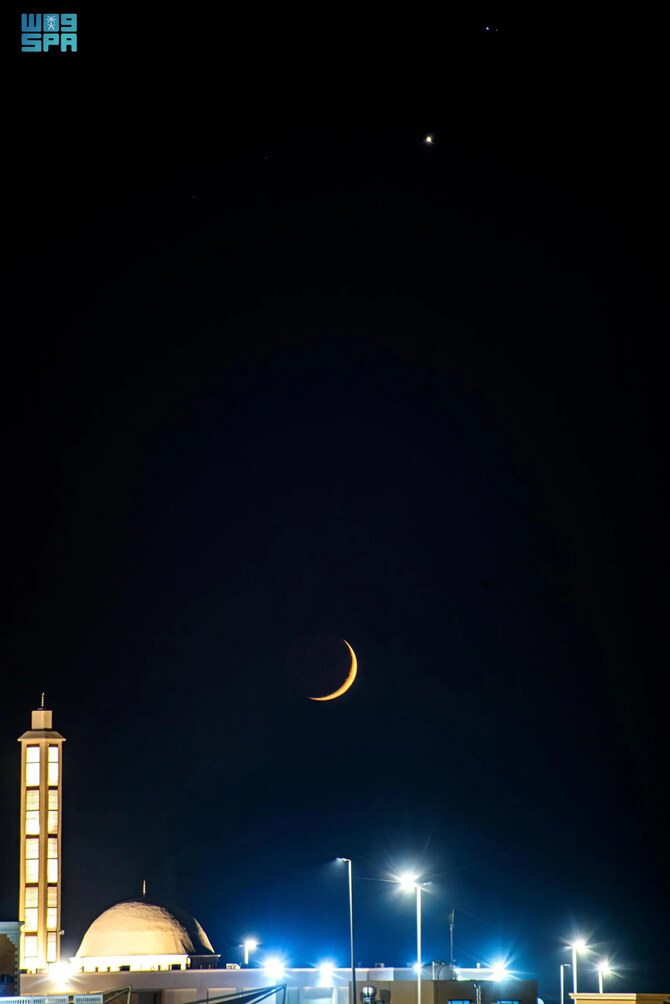
Moon-Venus conjunction visible in northern Saudi Arabia

The phenomenon occurred in the sky after sunset over the Northern Border region and was visible to the naked eye. (SPA)
Short Url
Updated 06 October 2024
Follow

Moon-Venus conjunction visible in northern Saudi Arabia

  • Celestial show after sunset over the Northern Border region was visible to the naked eye

RAFHA: A spectacular celestial event occurred over Saudi Arabia’s northern skies on Saturday night, with the moon and Venus in conjunction, the Saudi Press Agency reported on Sunday.

Known as a conjunction, the phenomenon in the sky after sunset in the Northern Border region was visible to the naked eye, with the moon and the planet separated by just three degrees.

A conjunction occurs when two celestial objects appear close to each other in the sky and share the same celestial longitude, according to astronomer Berjis Al-Fulaih.

Al-Fulaih, an official with the AFAQ Society for Astronomy in Taif, noted that Venus is often referred to as the “Evening Star” or the “Morning Star,” depending on its position in the west or east.

The alignment marks the beginning of the moon’s monthly journey past the bright planets.


The phenomenon occurred in the sky after sunset over the Northern Border region and was visible to the naked eye. (SPA)

In an interview with SPA before the celestial event, Jeddah Astronomy Society chief Majed Abu Zahra said the appearance of the crescent moon and Venus together shortly after sunset, before the sky darkened fully, created the spectacular view.

“As the second and third brightest objects in the night sky, after the sun, they will present a striking view,” he said.

A faint glow, caused by sunlight reflecting off Earth (known as Earthshine), will softly illuminate the unlit part of the moon’s disk, he explained.

Abu Zahra said there will be another astronomical event in mid-October: the arrival of Comet Tsuchinshan-ATLAS, which will appear 20 to 25 degrees northwest of Venus on Oct. 13 and 14. The comet may even be visible to the naked eye, although comets are notoriously unpredictable.

By Oct. 25, Venus will appear three degrees north of the star Antares. Toward the end of the month, Venus will draw closer to Earth, with its disk measuring 14 arcseconds and being 77 percent illuminated, Abu Zahra told SPA.


Saudi Arabia, Estonia strengthen cyber defense cooperation

Updated 09 February 2026
Follow

Saudi Arabia, Estonia strengthen cyber defense cooperation

  • Renowned for its leadership in digital governance, Estonia sees cybersecurity as central to its partnership potential with Saudi Arabia, building on years of regional engagement through its technology firms

RIYADH: Estonia aims to deepen defense, cybersecurity, and artificial intelligence cooperation with Saudi Arabia as both nations look to advance technology‑driven defense and cybersecurity capabilities.

Hanno Pevkur, Estonia’s minister of defense, told Arab News at the World Defense Show in Riyadh on Monday that Estonia’s defense industry is eager to contribute to the Kingdom’s fast‑growing defense ecosystem.

“In the modern world, cooperation built on trust and technology is the best defense,” he said. “It is important for us to be here because we clearly see there is a possibility to increase cooperation, not only bilaterally between Saudi Arabia and Estonia, but across the region.”

At Estonia’s pavilion, a cooperation agreement was signed between an Estonian company and a Saudi firm during the show, he noted.

Pevkur also said Estonia’s defense sector has expanded rapidly in recent years, driven by technological innovation and partnership.

“Our defense industry is growing very rapidly, and we continue to see strong momentum,” he said.

He said Estonia’s strengths lie in digital and smart‑system integration rather than large‑scale weapons production.

“We will not build airplanes or tanks, but what we can do is integrate robotics, automation and drones to make existing systems smarter,” he said.

The minister said effective defense collaboration must link businesses and governments to achieve meaningful results.

“When we want to have real cooperation, we need it on all levels,” he said. “The biggest client for any defense company is the government, so we must treat this as one ecosystem where the public and private sectors work hand in hand.”

Renowned for its leadership in digital governance, Estonia sees cybersecurity as central to its partnership potential with Saudi Arabia, building on years of regional engagement through its technology firms.

Pevkur said several Estonian companies, including Nortal, have already assisted Gulf governments in developing open IT and digital‑service systems.

“As the most digitalized nation in the world, almost every service in Estonia can be done online, except getting married,” he said. “But with such digitalization, we also need strong cyberdefense.”

He said data protection and digital resilience are treated as matters of national sovereignty in Tallinn, the capital of Estonia.

“Data is what we own. When someone steals that data, it becomes a serious threat,” he added. “That is why cyberdefense is not just about technology, it is about trust, sovereignty and protection.”

Pevkur said Saudi Arabia’s advances in AI offer promising opportunities for collaboration.

“I know that Saudi Arabia is doing great work when it comes to AI,” he said. “For us, as a small country with limited human resources, AI is essential not just for defense but for everyday life.”

Pevkur added that Estonia has launched a national AI strategy to promote responsible development and closer coordination between government and industry. One Estonian company, he said, has developed a system that allows a single operator to control hundreds of drones through AI.

“It is quite easy to put a weapon into the hands of a robot, but we also need to define who is accountable for its actions,” he said.

“The big question for the future is whether we can allow a war to be fought entirely by AI, or if humans must always make the final ethical decisions.”

He said in his conclusion that governments must reach a common understanding on how AI will be used and regulated on the battlefield.