Pakistan issues dengue prevention advisory as outbreak expected in 10 cities this month

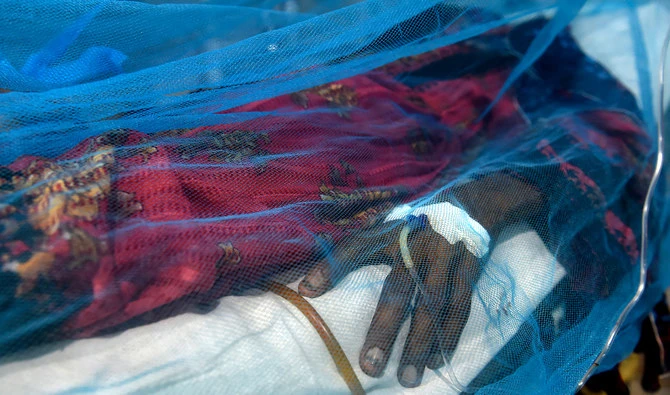
A patient suffering from dengue fever rests under a mosquito net at a hospital in Karachi on October 4, 2022. (AFP/File)
Short Url
Updated 04 October 2024
Follow

Pakistan issues dengue prevention advisory as outbreak expected in 10 cities this month

  • Karachi, Lahore, Peshawar, Rawalpindi, Islamabad, Hyderabad, Faisalabad, Sialkot, Larkana, Multan at risk
  • Dengue fever is endemic to Pakistan, which experiences year-round transmission with seasonal peaks

ISLAMABAD: Pakistan’s government-run National Institute of Health (NIH) on Friday issued a dengue prevention advisory after the Pakistan Meteorological Department (PMD) warned at least 10 Pakistani cities could face an outbreak in October. 

Over 21,000 dengue cases were reported in Pakistan last year while 8,909 cases have been reported so far this year, the NIH said. 

Dengue is an illness that spreads through vectors, carried by the bite of an infected mosquito. There is currently no cure or vaccine for dengue fever, which in its most severe form can lead to fatalities. People affected by dengue go through intense flu-like symptoms including high fever, intense headache, muscle and joint pain, and nausea and vomiting, typically persisting for approximately a week.

“It is imperative to work on prevention while staying vigilant for detection of cases and ensuring preparedness to launch response activities for curtailing the transmission of dengue fever,” the NIH said, urging the strengthening of disease surveillance and awareness campaigns by authorities and personal protection by members of the public. It also called on hospitals to improve preparedness. 

“Based on the analysis, the environment has become conducive from mid of September 2024 for dengue onset and it is predicted that it may outbreak in October 2024, particularly in ten major cities of Pakistan i.e., Karachi, Lahore, Peshawar, Rawalpindi, Islamabad, Hyderabad, Faisalabad, Sialkot, Larkana and Multan as well as in post monsoon rainfall affected areas of Pakistan,” the PMD said in an advisory last week. 

“It is advised to all stakeholders to take preemptive measures for the dengue outbreak in the districts. National Health agencies and Dengue control centers are advised to keep themselves updated on the PMD website.” 

The PMD said dengue outbreaks occurred in the post-monsoon season, which usually falls between Sept. 20 and Dec. 5 if conditions are favorable. It added that the active period for dengue attacks was two hours after sunrise and two hours before sunset, while breeding stopped once the temperature fell below 16°C. 

Dengue fever is endemic to Pakistan, which experiences year-round transmission with seasonal peaks. 

IMF board approves $1.3 billion disbursement for Pakistan after completing loan reviews

Updated 4 sec ago
Follow

IMF board approves $1.3 billion disbursement for Pakistan after completing loan reviews

  • The approval comes after an October staff-level deal that awaited the board’s formal endorsement
  • Economists say the money will boost Pakistan’s forex reserves, send positive signals to investors

KARACHI: The International Monetary Fund’s (IMF) executive board approved the release of $1.3 billion for Pakistan under two of its loan facilities, the Pakistani state media reported on Monday.

The board meeting was scheduled to take place during the day to decide on the Fund’s second review under the $7 billion Extended Fund Facility (EFF) and first review under the $1.4 billion Resilience and Sustainability Facility (RSF), a financing tool that provides long-term, low-cost loans to help countries address climate risks.

“The IMF executive board meeting has approved the third tranche of the loan program amounting to $1.3 billion,” the state-owned Pakistan Television reported.

It described the development as a major boost for Pakistan’s economy.

The IMF executive board’s meeting came nearly two months after a staff-level agreement (SLA) was signed between the two sides in October.

Procedurally, the SLAs are subject to approval by the executive board, though it is largely viewed as a formality.

A senior finance ministry official also confirmed to Arab News on condition of anonymity that the IMF had approved the tranche.

Economic experts said earlier in the day that the IMF disbursements would help Pakistan strengthen its balance of payments position.

Samiullah Tariq, group head of research at Pakistan Kuwait Investment Company Limited, said the IMF board’s approval would be an indication that Pakistan’s economy is on the right path.

“It obviously will help strengthen [the country’s] external sector, the balance of payments,” he told Arab News.

Until recently, Pakistan grappled with a macroeconomic crisis that drained its financial resources and triggered a balance of payments crisis.

However, the country witnessed financial gains in the last two years, recording current account surpluses and taming inflation that touched unprecedented levels in mid-2023.

Economists also viewed the IMF’s bailout packages as crucial for cash-strapped Pakistan, which has relied heavily on financing from bilateral partners such as Saudi Arabia, China and the United Arab Emirates, as well as multilateral lenders.

Saudi Arabia, through the Saudi Fund for Development, last week extended the term of its $3 billion deposit for another year to help Pakistan boost its foreign exchange reserves, which stood at $14.5 billion as of November 28, according to State Bank of Pakistan statements.

“In our view this [IMF tranche] will be approved,” said Shankar Talreja, head of research at Karachi-based brokerage Topline Securities Limited.

“This will help strengthen reserves and will eventually help a rating upgrade going forward,” he said.

The IMF board’s nod, Talreja said, would also send a signal to international and local investors regarding the continuation of the reform agenda by Pakistan’s government.