

Democratizing cybersecurity expertise crucial to counter AI-fueled digital crimes: Microsoft executive

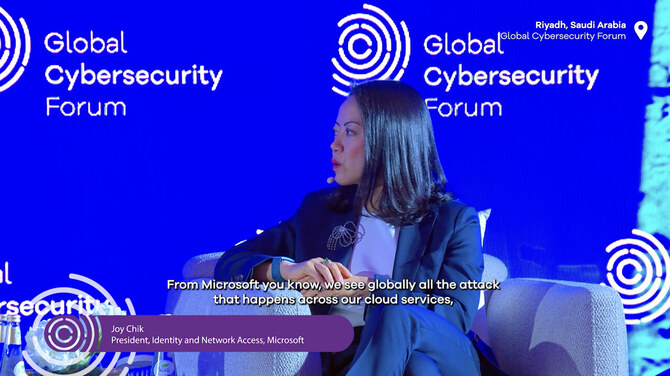
Joy Chik, president of Identity and Access Network at Microsoft.
Short Url
Updated 04 October 2024
Follow

Democratizing cybersecurity expertise crucial to counter AI-fueled digital crimes: Microsoft executive

RIYADH: Democratizing cybersecurity expertise is essential to combat the rising threat of digital crimes fueled by AI tools, according to Joy Chik, president of Identity and Access Network at Microsoft.

In an interview with Arab News during the Global Cybersecurity Forum in Riyadh, Chik emphasized how AI can help bridge the workforce gap in cybersecurity.

In the first quarter of 2023, Microsoft reported a staggering tenfold increase in password-based attacks on cloud identities, escalating from 3 billion to over 30 billion per month.

The company also detected approximately 6,000 attempted cyberattacks daily over the past year, which included phishing scams and sophisticated nation-state-backed attacks targeting critical infrastructure.

“So, I think to address that, one way is to democratize the expertise in security, and that’s when Gen AI, what Microsoft would produce — the kind of copilot for security. These are the tools so that you can have the skill set to democratize and have more people enabled to leverage these tools to combat cybercrime,” Chik said. 

She added that AI can help alleviate the shortage of skilled labor in the industry. “Earlier, I talked about whether we have a shortage of cybersecurity labor, skilled laborers, if you will, and expertise, and AI is a way to democratize that.”  

“I do think it is really important that we’re not just on the defense, but also move to the offense,” Chik said. “When I say offense, it’s about secure by design, secure by default, and how we can defend against supply chain attacks.”  

Chik explained that threats range from “probably the simplest, which is attacking your credentials, passwords, or identity, to phishing attacks, and to more sophisticated, nation-state-sponsored ones, like targeting critical infrastructure.” She emphasized Microsoft’s commitment to enhancing security measures based on insights gained from real-world incidents, noting that a key aspect of the company’s Secure Future initiative is not only addressing immediate needs but also promoting a security-first mindset and culture.

Chik also highlighted Microsoft’s efforts to move toward a password-free future, stating, “We all know passwords are not secure, and yet they’re the most common way for people to log into their online services. How can we provide a simple yet more secure method for identifying individuals without requiring them to remember passwords?”

One proposed solution is passkey technology, a multi-factor authentication method developed in collaboration with Microsoft, Google, Apple, and other industry leaders.

“That is a phishing-resistant multi-factor authentication that does not require a password at all. At the same time, it uses your mobile phone, for example, but saves your credentials in a safe manner so they cannot be easily phished,” she concluded. 


Saudi POS transactions see 20% surge to hit $4bn: SAMA

Updated 05 December 2025
Follow

Saudi POS transactions see 20% surge to hit $4bn: SAMA

RIYADH: Saudi Arabia’s total point-of-sale transactions surged by 20.4 percent in the week ending Nov. 29, to reach SR15.1 billion ($4 billion).

According to the latest data from the Saudi Central Bank, the number of POS transactions represented a 9.1 percent week-on-week increase to 240.25 million compared to 220.15 million the week before.

Most categories saw positive change across the period, with spending on laundry services registering the biggest uptick at 36 percent to SR65.1 million. Recreation followed, with a 35.3 percent increase to SR255.99 million. 

Expenditure on apparel and clothing saw an increase of 34.6 percent, followed by a 27.8 percent increase in spending on telecommunication. Jewelry outlays rose 5.6 percent to SR354.45 million.

Data revealed decreases across only three sectors, led by education, which saw the largest dip at 40.4 percent to reach SR62.26 million. 

Spending on airlines in Saudi Arabia fell by 25.2 percent, coinciding with major global flight disruptions. This followed an urgent Airbus recall of 6,000 A320-family aircraft after solar radiation was linked to potential flight-control data corruption. Saudi carriers moved swiftly to implement the mandatory fixes.

Flyadeal completed all updates and rebooked affected passengers, while flynas updated 20 aircraft with no schedule impact. Their rapid response contained the disruption, allowing operations to return to normal quickly.

Expenditure on food and beverages saw a 28.4 percent increase to SR2.31 billion, claiming the largest share of the POS. Spending on restaurants and cafes followed with an uptick of 22.3 percent to SR1.90 billion.

The Kingdom’s key urban centers mirrored the national decline. Riyadh, which accounted for the largest share of total POS spending, saw a 14.1 percent surge to SR5.08 billion, up from SR4.46 billion the previous week. The number of transactions in the capital reached 75.2 million, up 4.4 percent week-on-week.

In Jeddah, transaction values increased by 18.1 percent to SR2.03 billion, while Dammam reported a 14 percent surge to SR708.08 million.

POS data, tracked weekly by SAMA, provides an indicator of consumer spending trends and the ongoing growth of digital payments in Saudi Arabia. 

The data also highlights the expanding reach of POS infrastructure, extending beyond major retail hubs to smaller cities and service sectors, supporting broader digital inclusion initiatives. 

The growth of digital payment technologies aligns with the Kingdom’s Vision 2030 objectives, promoting electronic transactions and contributing to the nation’s broader digital economy.