

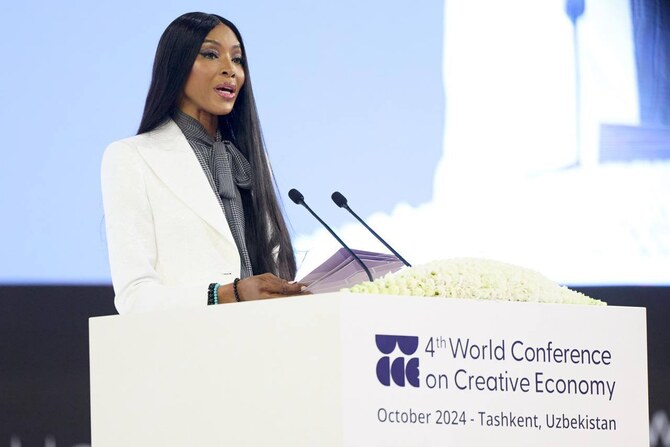
Naomi Campbell lauds ‘great impact’ of fashion creatives at 4th World Conference on Creative Economy

Keynote speaker and supermodel Naomi Campbell at the opening day of the fourth World Conference on Creative Economy. (Supplied)
Short Url
Updated 03 October 2024
Follow

Naomi Campbell lauds ‘great impact’ of fashion creatives at 4th World Conference on Creative Economy

TASHKENT: Creative leaders and policymakers from around the world gathered in Tashkent, Uzbekistan on Wednesday for the opening day of the fourth World Conference on Creative Economy.

Opening the event was keynote speaker and supermodel Naomi Campbell, who lauded the power of the fashion economy in an interview with Arab News.

The conference, organized by the Uzbekistan Art and Culture Development Foundation, is taking place until Oct. 4. In her opening remarks, Campbell said: “The theme of this year’s conference, ‘Inclusively Creative: A Shifted Reality,’ could not be more fitting. We are in a time of immense transformation, and this gathering is a testament to the power of creativity to not only adapt to but also lead these changes.”

The creative sectors are currently undergoing a transformation which can be a force for inclusive, sustainable economic growth. Cultural and creative industries are among the fastest-growing globally, generating annual revenues of nearly US$2.3 trillion, according to the UN Conference on Trade and Development.

In a panel discussion titled “Threads of Inclusion: The Impact of Fashion on the Creative Economy,” Campbell explored how supporting up-and-coming fashion designers within Africa and the diaspora, especially in emerging markets, can build economies and yield growth.

“There is a such a great impact,” she told Arab News afterwards. “I think governments of emerging markets didn’t realize before the impact what their talent in fashion could do and bring to their economy. They now do and understand what it can do. They’re now taking it more seriously and that’s what we want. We want them to invest in their own and then that is also how we can get investors from outside too. It is crucial to invest in your own talent.”

Campbell, who has been part of numerous events in Saudi Arabia — most notably on the red carpet at the Red Sea International Film Festival — said she had been impressed with the changes happening throughout the Gulf region.

“Women are getting opportunities that they never had before and that in itself is amazing,” she told Arab News, adding that many of these lay within creative fields.

“They are quickly embracing these roles and being included,” she said. “I just want to make people feel included because I know what it’s like to not be included. I don’t want people to ever feel that.”


Review: ‘Sorry, Baby’ by Eva Victor

Eva Victor appears in Sorry, Baby by Eva Victor, an official selection of the 2025 Sundance Film Festival. (Supplied)
Updated 27 December 2025
Follow

Review: ‘Sorry, Baby’ by Eva Victor

  • Victor makes a deliberate narrative choice; we never witness the violence of what happens to her character

There is a bravery in “Sorry, Baby” that comes not from what the film shows, but from what it withholds. 

Written, directed by, and starring Eva Victor, it is one of the most talked-about indie films of the year, winning the Waldo Salt Screenwriting Award at Sundance and gathering momentum with nominations, including nods at the Golden Globes and Gotham Awards. 

The film is both incisive and tender in its exploration of trauma, friendship, and the long, winding road toward healing. It follows Agnes, a young professor of literature trying to pick up the pieces after a disturbing incident in grad school. 

Victor makes a deliberate narrative choice; we never witness the violence of what happens to her character. The story centers on Agnes’ perspective in her own words, even as she struggles to name it at various points in the film. 

There is a generosity to Victor’s storytelling and a refusal to reduce the narrative to trauma alone. Instead we witness the breadth of human experience, from heartbreak and loneliness to joy and the sustaining power of friendship. These themes are supported by dialogue and camerawork that incorporates silences and stillness as much as the power of words and movement. 

The film captures the messy, beautiful ways people care for one another. Supporting performances — particularly by “Mickey 17” actor Naomi Ackie who plays the best friend Lydia — and encounters with strangers and a kitten, reinforce the story’s celebration of solidarity and community. 

“Sorry, Baby” reminds us that human resilience is rarely entirely solitary; it is nurtured through acts of care, intimacy and tenderness.

A pivotal scene between Agnes and her friend’s newborn inspires the film’s title. A single, reassuring line gently speaks a pure and simple truth: “I know you’re scared … but you’re OK.” 

It is a reminder that in the end, no matter how dark life gets, it goes on, and so does the human capacity to love.