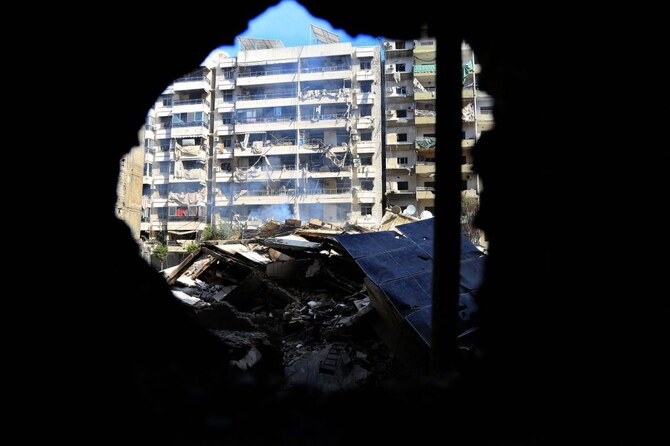
BEIRUT: Beirut’s southern suburbs, a stronghold of the Hezbollah militant group, are usually teeming with life but on Wednesday the rubble-strewn streets and burning buildings were almost empty after days of Israeli bombardment and evacuation orders.
AFP photographers saw thick smoke rising from buildings hit by overnight strikes while young men on mopeds sped along largely empty roads and residents grabbed what they could from their homes, some driving off with mattresses tied to car roofs.
Mohammed Sheaito, 31, one of the few not leaving, said that “during the night, the ground shook below us... and the sky lit up” from the force of the strikes.
“The area has become a ghost town,” said the taxi driver, who has sent his parents, his sister and her children — already displaced by Israeli bombing in south Lebanon — to safety elsewhere.
An area of tightly packed blocks of flats, shops and businesses, Beirut’s southern suburbs are also home to Hezbollah’s main institutions.
Israel says it is targeting sites belonging to the Iran-backed militant group, which was founded during the Lebanese civil war after Israel besieged the city in 1982.
A series of Israeli raids last week hit the southern suburbs — known as Dahiyeh — before a massive strike on Friday killed Hezbollah chief Hassan Nasrallah, with raids on the area increasing after that.
Thousands have fled the bombings or because of Israeli army evacuation orders on social media posted ahead of some strikes.
Some are staying with relatives, others in schools turned shelters in Beirut or in rented flats, while those with nowhere to go have been sleeping on the streets.
“The area was full of people. We used to sit at the cafe or along the street, older people would play backgammon,” Sheaito said.
Now, everything is “closed — corner stores, restaurants... even the pharmacy,” he said, adding: “I leave Dahiyeh to buy food supplies.”
Mohammed Afif, the head of Hezbollah’s information office, told journalists on a media tour that was broadcast that all the buildings hit in Dahiyeh were “civilian buildings and are not home to military activity.”
In one neighborhood, emergency workers combed the rubble of a flattened four-building residential complex in a grim search for survivors.
In another, a woman carried a cat as a building burned.
Rubble blocked some streets, with burnt-out cars scattered around various strike sites.
“I came quickly to get our identify papers and some other things,” said one resident who declined to be identified, expressing shock at finding an eight-building residential complex behind his home had been destroyed.
He said the neighborhood was uninhabitable, with no water, shops, petrol stations or even electricity because generators had shut down in a country where the state network struggles to supply a few hours of power a day.
“Our apartment is full of dust and there is a strange smell — I left quickly before I choked,” he said.
“I only saw one or two people on the street. There is no life here anymore.”

Israel strikes turn bustling south Beirut into ghost town
Short Url
https://arab.news/n7zvt
Israel strikes turn bustling south Beirut into ghost town
- Mohammed Sheaito, 31, one of the few not leaving, said that “during the night, the ground shook below us... and the sky lit up” from the force of the strikes
- An area of tightly packed blocks of flats, shops and businesses, Beirut’s southern suburbs are also home to Hezbollah’s main institutions
First Ramadan after truce brings flicker of joy in devastated Gaza
- Ramadan lanterns and string lights appear on streets lined with collapsed buildings and piles of rubble in Gaza City
- The first holy month since the October ceasefire brings mixed feelings for the many still living in tents
GAZA CITY: Little Ramadan lanterns and string lights appeared on streets lined with collapsed buildings and piles of rubble in Gaza City, bringing joy and respite as Islam’s holiest month began — the first since October’s ceasefire.
In the Omari mosque, dozens of worshippers performed the first Ramadan morning prayer, fajr, bare feet on the carpet but donning heavy jackets to stave off the winter cold.
“Despite the occupation, the destruction of mosques and schools, and the demolition of our homes... we came in spite of these harsh conditions,” Abu Adam, a resident of Gaza City who came to pray, told AFP.
“Even last night, when the area was targeted, we remained determined to head to the mosque to worship God,” he said.
A security source in Gaza told AFP Wednesday that artillery shelling targeted the eastern parts of Gaza City that morning.
The source added that artillery shelling also targeted a refugee camp in central Gaza.
Israel does not allow international journalists to enter the Gaza Strip, preventing AFP and other news organizations from independently verifying casualty figures.
‘Stifled joy’
In Gaza’s south, tens of thousands of people still live in tents and makeshift shelters as they wait for the territory’s reconstruction after a US-brokered ceasefire took hold in October.
Nivin Ahmed, who lives in a tent in the area known as Al-Mawasi, told AFP this first Ramadan without war brought “mixed and varied feelings.”
“The joy is stifled. We miss people who were martyred, are still missing, detained, or even traveled,” she said.
“The Ramadan table used to be full of the most delicious dishes and bring together all our loved ones,” the 50-year-old said.
“Today, I can barely prepare a main dish and a side dish. Everything is expensive. I can’t invite anyone for Iftar or suhoor,” she said, referring to the meals eaten before and after the daily fast of Ramadan.
Despite the ceasefire, shortages remain in Gaza, whose battered economy and material damage have rendered most residents at least partly dependent on humanitarian aid for their basic needs.
But with all entries into the tiny territory under Israeli control, not enough goods are able to enter to bring prices down, according to the United Nations and aid groups.
‘Still special’
Maha Fathi, 37, was displaced from Gaza City and lives in a tent west of the city.
“Despite all the destruction and suffering in Gaza, Ramadan is still special,” she told AFP.
“People have begun to empathize with each other’s suffering again after everyone was preoccupied with themselves during the war.”
She said that her family and neighbors were able to share moments of joy as they prepared food for suhoor and set up Ramadan decorations.
“Everyone longs for the atmosphere of Ramadan. Seeing the decorations and the activity in the markets fills us with hope for a return to stability,” she added.
On the beach at central Gaza’s Deir el-Balah, Palestinian artist Yazeed Abu Jarad contributed to the holiday spirit with his art.
In the sand near the Mediterranean Sea, he sculpted “Welcome Ramadan” in ornate Arabic calligraphy, under the curious eye of children from a nearby tent camp.
Nearly all of Gaza’s 2.2 million residents were displaced at least once during the more than two years of war between Israel and Hamas, sparked by the latter’s unprecedented October 7 attack on Israel.
Mohammed Al-Madhoun, 43, also lives in a tent west of Gaza City, and hoped for brighter days ahead.
“I hope this is the last Ramadan we spend in tents. I feel helpless in front of my children when they ask me to buy lanterns and dream of an Iftar table with all their favorite foods.”
“We try to find joy despite everything,” he said, describing his first Ramadan night out with the neighbors, eating the pre-fast meal and praying.
“The children were as if they were on a picnic,” he said.
In the Omari mosque, dozens of worshippers performed the first Ramadan morning prayer, fajr, bare feet on the carpet but donning heavy jackets to stave off the winter cold.
“Despite the occupation, the destruction of mosques and schools, and the demolition of our homes... we came in spite of these harsh conditions,” Abu Adam, a resident of Gaza City who came to pray, told AFP.
“Even last night, when the area was targeted, we remained determined to head to the mosque to worship God,” he said.
A security source in Gaza told AFP Wednesday that artillery shelling targeted the eastern parts of Gaza City that morning.
The source added that artillery shelling also targeted a refugee camp in central Gaza.
Israel does not allow international journalists to enter the Gaza Strip, preventing AFP and other news organizations from independently verifying casualty figures.
‘Stifled joy’
In Gaza’s south, tens of thousands of people still live in tents and makeshift shelters as they wait for the territory’s reconstruction after a US-brokered ceasefire took hold in October.
Nivin Ahmed, who lives in a tent in the area known as Al-Mawasi, told AFP this first Ramadan without war brought “mixed and varied feelings.”
“The joy is stifled. We miss people who were martyred, are still missing, detained, or even traveled,” she said.
“The Ramadan table used to be full of the most delicious dishes and bring together all our loved ones,” the 50-year-old said.
“Today, I can barely prepare a main dish and a side dish. Everything is expensive. I can’t invite anyone for Iftar or suhoor,” she said, referring to the meals eaten before and after the daily fast of Ramadan.
Despite the ceasefire, shortages remain in Gaza, whose battered economy and material damage have rendered most residents at least partly dependent on humanitarian aid for their basic needs.
But with all entries into the tiny territory under Israeli control, not enough goods are able to enter to bring prices down, according to the United Nations and aid groups.
‘Still special’
Maha Fathi, 37, was displaced from Gaza City and lives in a tent west of the city.
“Despite all the destruction and suffering in Gaza, Ramadan is still special,” she told AFP.
“People have begun to empathize with each other’s suffering again after everyone was preoccupied with themselves during the war.”
She said that her family and neighbors were able to share moments of joy as they prepared food for suhoor and set up Ramadan decorations.
“Everyone longs for the atmosphere of Ramadan. Seeing the decorations and the activity in the markets fills us with hope for a return to stability,” she added.
On the beach at central Gaza’s Deir el-Balah, Palestinian artist Yazeed Abu Jarad contributed to the holiday spirit with his art.
In the sand near the Mediterranean Sea, he sculpted “Welcome Ramadan” in ornate Arabic calligraphy, under the curious eye of children from a nearby tent camp.
Nearly all of Gaza’s 2.2 million residents were displaced at least once during the more than two years of war between Israel and Hamas, sparked by the latter’s unprecedented October 7 attack on Israel.
Mohammed Al-Madhoun, 43, also lives in a tent west of Gaza City, and hoped for brighter days ahead.
“I hope this is the last Ramadan we spend in tents. I feel helpless in front of my children when they ask me to buy lanterns and dream of an Iftar table with all their favorite foods.”
“We try to find joy despite everything,” he said, describing his first Ramadan night out with the neighbors, eating the pre-fast meal and praying.
“The children were as if they were on a picnic,” he said.
© 2026 SAUDI RESEARCH & PUBLISHING COMPANY, All Rights Reserved And subject to Terms of Use Agreement.


