

Pakistan rudderless after white-ball skipper Babar Azam resigns

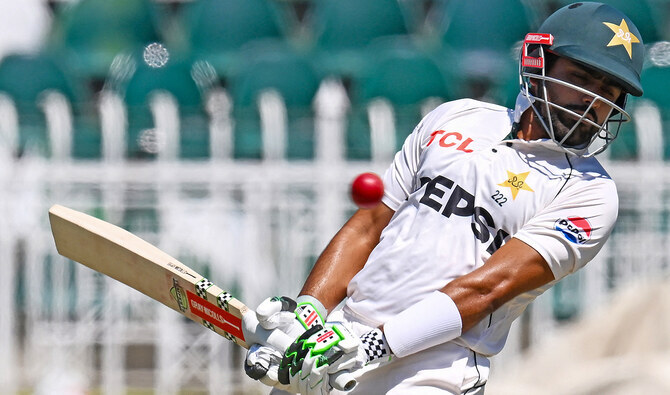
Pakistan’s Babar Azam avoids a ball during the second day of second and last cricket Test match between Pakistan and Bangladesh, at the Rawalpindi Cricket Stadium in Rawalpindi on August 31, 2024. (AFP/File)
Short Url
Updated 02 October 2024
Follow

Pakistan rudderless after white-ball skipper Babar Azam resigns

  • Pakistan’s cricket has suffered due to revolving door of bosses and allegations of nepotism 
  • Wicketkeeper-batsman Mohammad Rizwan is considered front-runner for white-ball captain

KARACHI: Pakistan’s limited-overs team was leaderless on Wednesday after captain Babar Azam resigned, compounding a management crisis experts say has badly affected the team’s international performance.

Pakistani cricket is flailing in all formats after a series of stinging losses, with a revolving door of bosses and allegations that nepotism has seeped into the sport.

Azam announced his resignation on his personal social media just before midnight on Tuesday, before an official Pakistan Cricket Board (PCB) statement more than 12 hours later.

Pakistan cricket has plowed through four coaches, three board heads and four captains in the past two years, at the same time sliding down international standings.

“It’s a leadership crisis,” former Pakistan captain Rashid Latif told AFP. “Pakistan cricket is in the ICU with no specialist for treatment.”

Azam’s resignation came hours before England touched down on Wednesday for a three-match Test series that follows Pakistan’s humiliating 2-0 home series defeat to lowly ranked Bangladesh last month.

It was 29-year-old Azam’s second turn as captain after a flip-flop saw him resign in all three formats following Pakistan’s early exit from the ODI World Cup in November.

He returned in March to captain white-ball competitions but lasted just six months, leaving Pakistan leaderless with four major series coming up and the Champions Trophy next year.

Azam was captain when Pakistan crashed out of the T20 World Cup after a bruising loss to newcomers the United States.

He said he stood down to focus on his playing role as a batsman.

“He should not have accepted captaincy again,” Latif said.

“Neither the team was performing nor was he scoring big,” he said. “This resignation has come very late and that has not only cost him badly, but also the team.”

The PCB said on Wednesday the national selection committee would begin the hunt for a successor.
“He believes that dedicating himself fully to his batting will enable him to play a more decisive role in the team’s success in the shorter formats,” a PCB statement said.

Wicketkeeper-batsman Mohammad Rizwan is considered the front-runner for the job.

Azam is slated to play in the England Test series starting in Multan on Monday, but red-ball skipper Shan Masood is also facing calls to step down over dire performances.

Pakistan has lost all five matches under his tenure, which began last year.


Islamabad dismisses claims about paying up to 8 percent interest on foreign loans as ‘misleading’

Updated 22 February 2026
Follow

Islamabad dismisses claims about paying up to 8 percent interest on foreign loans as ‘misleading’

  • Pakistan has long relied on external loans to help bridge persistent gaps in public finances and foreign exchange reserves
  • Pakistan’s total external debt, liabilities stand at $138 billion at an overall average cost of around 4 percent, ministry says

KARACHI: Pakistan’s finance ministry on Sunday dismissed as “misleading” claims that the country is paying up to 8 percent interest on external loans, saying the overall average cost of external public debt is approximately 4 percent.

Pakistan has long relied on external loans to help bridge persistent gaps in public finances and foreign exchange reserves, driven largely by a narrow tax base, chronic trade deficits, rising debt-servicing costs and repeated balance-of-payments pressures.

Over the decades, successive governments have turned to multilateral and bilateral lenders, including the International Monetary Fund, the World Bank and the Asian Development Bank, to support budgetary needs and shore up foreign exchange reserves.

The finance ministry on Sunday issued a clarification in response to a “recent press commentary” regarding the country’s external debt position and associated interest payments, and said the figures required contextual explanation to ensure accurate understanding of Pakistan’s external debt profile.

“Pakistan’s total external debt and liabilities currently stand at $138 billion. This figure, however, encompasses a broad range of obligations, including public and publicly guaranteed debt, debt of Public Sector Enterprises (both guaranteed and non-guaranteed), bank borrowings, private-sector external debt, and intercompany liabilities to direct investors. It is therefore important to distinguish this aggregate figure from External Public (Government) Debt, which amounts to approximately $92 billion,” it said.

“Of the total External Public Debt, nearly 75 percent comprises concessional and long-term financing obtained from multilateral institutions (excluding the IMF) and bilateral development partners. Only about 7 percent of this debt consists of commercial loans, while another 7 percent relates to long-term Eurobonds. In light of this composition, the claim that Pakistan is paying interest on external loans ‘up to 8 percent’ is misleading.

The overall average cost of External Public Debt is approximately 4 percent, reflecting the predominantly concessional nature of the borrowing portfolio.”

With respect to interest payments, public external debt interest outflows increased from $1.99 billion in Fiscal Year (FY) 2022 to $3.59 billion in FY2025, representing an increase of 80.4 percent, not 84 percent as reported. In absolute terms, interest payments rose by $1.60 billion over this period, not $1.67 billion, it said.

According to the State Bank of Pakistan’s records, Pakistan’s total debt servicing payments to specific creditors during the period under reference were as follows: the IMF received $1.50 billion, of which $580 million constituted interest; Naya Pakistan Certificates payments totaled $1.56 billion, including $94 million in interest; the Asian Development Bank received $1.54 billion, including $615 million in interest; the World Bank received $1.25 billion, including $419 million in interest; and external commercial loans amounted to nearly $3 billion, of which $327 million represented interest payments.

“While interest payments have increased in absolute terms, this rise cannot be attributed solely to an expansion in the debt stock,” the ministry said. “Although the overall debt stock has increased slightly since FY2022, the additional inflows have primarily originated from concessional multilateral sources and the IMF’s Extended Fund Facility (EFF) under the ongoing IMF-supported program.”

Pakistan secured a $7 billion IMF bailout in Sept. 2024 as part of Prime Minister Shehbaz Sharif’s efforts to stabilize the South Asian economy that narrowly averted a default in 2023. The government has since been making efforts to boost trade and bring in foreign investment to consolidate recovery.

“It is also important to note that the increase in interest payments reflects prevailing global interest rate dynamics. In response to the inflation surge of 2021–22, the US Federal Reserve raised the federal funds rate from 0.75-1.00 percent in May 2022 to 5.25–5.50 percent by July 2023. Although rates have since moderated to around 3.75 percent, they remain significantly higher than 2022 levels,” the finance ministry said.

“The government remains committed to prudent debt management, transparency, and the continued strengthening of Pakistan’s macroeconomic stability,” it added.