

Saudi Arabia, NASA explore collaborations in space technology

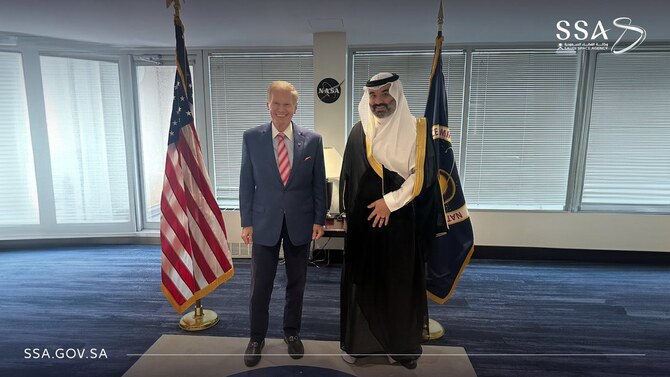
During his visit, Abdullah Al-Swaha, the Saudi minister of communications and information technology and chairman of the Saudi Space Commission, met with NASA Administrator Bill Nelson to discuss strategic collaborations in space-related industries. Photo/Supplied
Short Url
Updated 02 October 2024
Follow

Saudi Arabia, NASA explore collaborations in space technology

JEDDAH: Saudi Arabia is seeking to strengthen its ties with NASA following a recent high-level meeting in the US focused on exploring partnerships in advanced technologies and global scientific innovation.

During his visit, Abdullah Al-Swaha, the Saudi minister of communications and information technology and chairman of the Saudi Space Commission, met with NASA Administrator Bill Nelson to discuss strategic collaborations in space-related industries.

The discussions centered on joint efforts to promote space-based scientific innovation for the benefit of humanity.

Al-Swaha also met with Princess Reema bint Bandar, the Saudi ambassador to the US, and leaders from the American Chamber of Commerce to explore investment opportunities between the two nations.

Topics included potential investments in the digital economy, artificial intelligence, space, and innovation, as well as Saudi initiatives aimed at fostering science and entrepreneurship, according to the Saudi Press Agency.

While in Washington, Al-Swaha praised Saudi students at the Cultural Attaché office for their achievements, highlighting their contributions to the country’s competitiveness in science, engineering, technology, and space.

As part of Saudi Arabia’s delegation to the 79th session of the UN General Assembly, he also participated in the Summit of the Future held last month in New York.

During the summit, Al-Swaha noted that Crown Prince Mohammed bin Salman’s support for youth and women has led to significant progress in inclusion and empowerment, with a 35 percent participation rate of women in the tech sector in just six years—surpassing averages in the EU and G20 countries.

He highlighted initiatives like the Misk Foundation’s “Saudi Codes” program, which has trained one million women and youth in programming, and the historic journey of Rayyanah Barnawi, the first Muslim Arab female astronaut to the International Space Station.

He concluded by emphasizing that these efforts have improved Saudi Arabia’s standing in global indices, including the UN E-Government Development Index 2024, where the Kingdom ranked fourth worldwide and second among G20 nations in the digital services index.

Al-Swaha also discussed Saudi Arabia’s role as a model of international cooperation, collaborating with the UN’s International Telecommunication Union to address the digital divide affecting 2.6 billion people lacking access to digital solutions.

He showcased the Kingdom’s pioneering virtual hospital, which has successfully performed specialized surgeries, including open-heart operations for patients in various countries. Additionally, he reaffirmed Saudi Arabia’s commitment to advancing its digital economy through the proposed establishment of the Digital Cooperation Organization, aimed at serving over 800 million people by providing digital platforms and a unified digital market to stimulate innovation in healthcare, education, and business.

At the summit, Al-Swaha also discussed Saudi Arabia’s efforts to bridge social, economic, and AI gaps during a session titled “Toward a Common Digital Future.”

He revealed that the Kingdom presented seven recommendations to the UN, including the establishment of an independent international scientific committee on AI and the creation of a platform for sharing AI-related standards and best practices.


Beyond government: how digital defense is becoming a priority across Saudi Arabia

Updated 7 sec ago
Follow

Beyond government: how digital defense is becoming a priority across Saudi Arabia

RIYADH: Saudi Arabia’s cybersecurity market is entering a decisive growth phase, driven by rapid digital transformation, expanding cloud and artificial intelligence adoption, and increasingly robust regulatory frameworks.

Sustained public and private investment under Vision 2030 is expected to propel the sector into one of the fastest-growing and most structurally advanced cybersecurity markets in the region.

According to Dimension Market Research, the Kingdom’s cybersecurity market size is expected to reach $11.3 billion by the end of 2033 at a compound annual growth rate of 14.2 percent.

Projected size of the cybersecurity market in Saudi Arabia

In recent years Saudi Arabia has experienced consistent and strategic growth in cybersecurity investments, largely fueled by the rapid adoption of digital services across organizations.

Samer Omar, cybersecurity and digital trust leader at PwC Middle East, said there was around SR15.2 billion ($4.05 billion) of investment in the sector in Saudi Arabia in 2024, and if current trends continue, most market assessments suggest the industry could reach between $7 billion and $9 billion by 2030.

“What matters most is how organizations are maturing. As more services move to the cloud and AI becomes embedded in day-to-day operations, security is increasingly part of early decision-making rather than an afterthought,” Omar told Arab News.

Samer Omar, cybersecurity and digital trust leader at PwC Middle East. (Supplied)

He added: “I expect the market to continue growing as organizations strengthen governance, modernize legacy systems, and invest in more advanced monitoring and response capabilities.”

This market expansion is not just reactive or trend-driven — Saudi Arabia’s cybersecurity growth is structurally anchored in Vision 2030’s digital-first agenda, mandatory regulatory frameworks, and the sheer scale of state-led investments in digital and infrastructure projects.

According to Maximilian Chowanetz, partner at Kearney Middle East, and his colleague San Jain, principal in the firm’s digital and analytics practice in Dubai, the market is currently valued at approximately SR17 billion, is projected to more than double to around SR35 billion by 2030, reflecting annual growth of over 15 percent.

“Unlike many emerging markets where cybersecurity adoption remains uneven, Saudi Arabia combines giga-projects, nationally deployed digital platforms, and expanding cloud infrastructure with increasingly stringent compliance requirements across sectors. This creates sustained, non-discretionary demand for advanced cyber capabilities, particularly in critical infrastructure protection, cloud security, and operational technology/information technology convergence,” Chowanetz and Jain said in a joint statement.

They added: “As digital services become embedded across the economy, cybersecurity is evolving from a supporting IT function into a core enabler of national resilience and economic competitiveness. These fundamentals position Saudi Arabia as one of the fastest-growing and most structurally advanced cybersecurity markets in the region.”

Investment beyond finance, government

Cybersecurity is increasingly emerging as a key priority across various rapidly evolving sectors.

In Saudi Arabia, cybersecurity investment is growing not only in finance and government but also across sectors such as healthcare, energy, and the broader digital economy, where fast-paced digitization is surpassing conventional security frameworks. These industries lie at the crossroads of national priorities, operational risks, and major technology rollouts under Vision 2030.

From PwC’s lens, Omar shed light on how in the energy and industrial sectors the integration of connected technologies is on the rise, heightening the demand for robust protection of operational systems. Similarly, healthcare providers are broadening their digital health offerings, making security and privacy essential components of daily clinical practices.

“Telecoms, cloud providers, and data centers are also strengthening their capabilities as they support the Kingdom’s growing digital infrastructure. Retail, e-commerce, and education are evolving quickly as well, each with their own requirements as they introduce new digital platforms and services,” he said.

The official added: “What ties these sectors together is the recognition that secure digital services are essential to future growth. As the Kingdom continues progressing toward Vision 2030, cybersecurity is becoming a core enabler for sectors that are modernizing at pace.”

Maximilian Chowanetz, partner at Kearney Middle East. (Supplied)

From Kearney’s perspective, Chowanetz and Jain also highlighted how healthcare is digitizing at speed, with electronic health records, telemedicine platforms, and connected medical devices expanding the attack surface and making data protection and patient safety critical imperatives.

“In energy and critical infrastructure, the integration of smart grids, renewables, and industrial IoT is driving demand for advanced OT and industrial control systems security frameworks, an area where Saudi Arabia’s scale positions it as a global reference point. Alongside this, the rapid expansion of the digital economy, underpinned by cloud adoption and connected ecosystems, is elevating the need to secure data, networks, and edge devices,” they said.

The two spokespeople added: “Together, these sectors represent where cybersecurity is no longer discretionary, but foundational to service continuity, public trust, and economic resilience.”

Opportunities for local, global players

As with many other sectors in Saudi Arabia, cybersecurity presents a wealth of opportunities for both local and international players to tap into.

Omar from PwC highlighted that a major focus is growing cybersecurity talent, with rising demand pushing many organizations to rely on managed services and expert support.

He underlined that small and medium-sized businesses also present key opportunities, seeking affordable, user-friendly security solutions, ideally with Arabic-language support, to match their needs.

“As cloud adoption increases, there is rising demand for cloud security, identity management, and secure development practices. Industrial environments also need tailored support as they integrate older systems with modern technologies,” Omar said.

He added: “We’re also seeing interest in practical guidance related to the Personal Data Protection Law, along with locally relevant threat intelligence and training. These needs create space for both local and global providers to offer solutions that help organizations move forward with confidence as the digital economy continues to grow.”

From their side, Chowanetz and Jain shed light on how the Kingdom’s cybersecurity market holds major opportunities, with key gaps in capability, scale, and specialization — especially as demand expands beyond the public sector.

They went on to note that talent shortages are driving demand for managed services, automation, and upskilling to maintain resilience. Meanwhile, SMEs remain underserved, facing rising regulatory pressures but lacking affordable cybersecurity solutions — creating strong demand for scalable, compliance-ready offerings.

San Jain, principal at Kearney Middle East’s digital and analytics practice in Dubai. (Supplied)

“Sector-specific solutions remain underdeveloped, particularly in areas such as health care device security, OT and ICS protection, cloud sovereignty, and IoT segmentation. Addressing these gaps will be critical not only to strengthening national cyber resilience but also to attracting investment, accelerating localization, and supporting sustainable growth across Saudi Arabia’s digital economy,” Chowanetz and Jain said.

Awareness increasing for individuals, SMEs

As digital services expand under Vision 2030, cybersecurity in Saudi Arabia is becoming a personal priority, with risks now extending to homes, devices, and daily transactions. At the same time, people are becoming more aware of protecting their personal data and managing their digital lives more securely.

From PwC’s side, Omar indicated that clearer data protection laws and educational initiatives have improved public awareness of cybersecurity, especially among younger audiences.

“Over time, this gradual change plays an important role in building long-term digital confidence and supporting the Kingdom’s wider digital ambitions,” he said.

On Kearney’s behalf, Chowanetz and Jain clarified that with national platforms like Absher and Tawakkalna and the rise of fintech and smart cities, cybersecurity in Saudi Arabia now directly affects individuals, expanding risks beyond organizations to personal data and daily life.

“As consumer awareness rises, driven by both local experience and global breaches, trust is becoming the critical currency of Saudi Arabia’s digital ecosystem. This shift is accelerating demand for user-centric security solutions, stronger data protection frameworks, and shared accountability between institutions and citizens to ensure confidence, resilience, and long-term digital adoption,” they said.