

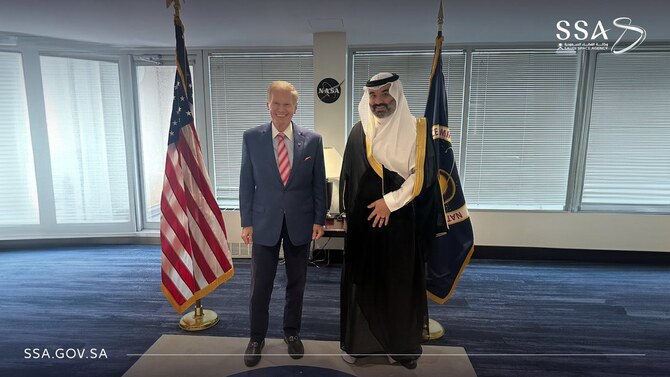

JEDDAH: Saudi Arabia is seeking to strengthen its ties with NASA following a recent high-level meeting in the US focused on exploring partnerships in advanced technologies and global scientific innovation.
During his visit, Abdullah Al-Swaha, the Saudi minister of communications and information technology and chairman of the Saudi Space Commission, met with NASA Administrator Bill Nelson to discuss strategic collaborations in space-related industries.
The discussions centered on joint efforts to promote space-based scientific innovation for the benefit of humanity.
Al-Swaha also met with Princess Reema bint Bandar, the Saudi ambassador to the US, and leaders from the American Chamber of Commerce to explore investment opportunities between the two nations.
Topics included potential investments in the digital economy, artificial intelligence, space, and innovation, as well as Saudi initiatives aimed at fostering science and entrepreneurship, according to the Saudi Press Agency.
While in Washington, Al-Swaha praised Saudi students at the Cultural Attaché office for their achievements, highlighting their contributions to the country’s competitiveness in science, engineering, technology, and space.
As part of Saudi Arabia’s delegation to the 79th session of the UN General Assembly, he also participated in the Summit of the Future held last month in New York.
During the summit, Al-Swaha noted that Crown Prince Mohammed bin Salman’s support for youth and women has led to significant progress in inclusion and empowerment, with a 35 percent participation rate of women in the tech sector in just six years—surpassing averages in the EU and G20 countries.
He highlighted initiatives like the Misk Foundation’s “Saudi Codes” program, which has trained one million women and youth in programming, and the historic journey of Rayyanah Barnawi, the first Muslim Arab female astronaut to the International Space Station.
He concluded by emphasizing that these efforts have improved Saudi Arabia’s standing in global indices, including the UN E-Government Development Index 2024, where the Kingdom ranked fourth worldwide and second among G20 nations in the digital services index.
Al-Swaha also discussed Saudi Arabia’s role as a model of international cooperation, collaborating with the UN’s International Telecommunication Union to address the digital divide affecting 2.6 billion people lacking access to digital solutions.
He showcased the Kingdom’s pioneering virtual hospital, which has successfully performed specialized surgeries, including open-heart operations for patients in various countries. Additionally, he reaffirmed Saudi Arabia’s commitment to advancing its digital economy through the proposed establishment of the Digital Cooperation Organization, aimed at serving over 800 million people by providing digital platforms and a unified digital market to stimulate innovation in healthcare, education, and business.
At the summit, Al-Swaha also discussed Saudi Arabia’s efforts to bridge social, economic, and AI gaps during a session titled “Toward a Common Digital Future.”
He revealed that the Kingdom presented seven recommendations to the UN, including the establishment of an independent international scientific committee on AI and the creation of a platform for sharing AI-related standards and best practices.


